Want to be in the loop?
subscribe to
our notification
Business News
USAID SUPPORTS EFFORTS TO REDUCE CONGESTION AT CÁT LÁI PORT
The United States Agency for International Development (USAID) and the General Department of Vietnam Customs (GDVC) released on Thursday an action plan for reducing congestion at Cát Lái Terminal in HCM City, Việt Nam’s busiest container port.
The action plan, unveiled at a workshop co-organised by USAID and GDVC, contains 21 recommendations to help position the port to meet increasing demand. Before COVID-19, the port was operating at full capacity, with demand as measured by container volume expected to double by 2030.
The workshop brought together more than 70 representatives from Vietnam Customs, ministries, and the business community to discuss the action plan — the result of a Pre-Feasibility Study on Anti-Congestion and Facilitating Trade Logistics at Cát Lái Port conducted by the USAID Trade Facilitation Programme between May 2020 and March 2021.
The study takes a comprehensive look at the 160-hectare port’s operations, to assess performance, bottlenecks, and constraints to increasing port handling capacity, and offers 21 recommendations in the form of an action plan for government and local stakeholders to consider.
These recommendations range from leveraging IT solutions to enhance information flows and cargo clearance, to new or expanded port facilities and improved operational performance.
In addition, through USAID’s INVEST project, USAID is working with the Ministry of Transport’s Vietnam Maritime Authority to examine likely areas for public-private partnership, which is an effective way to mobilise investment for large-scale infrastructure projects.
“As international trade recovers from the impacts of COVID-19, addressing congestion at Cát Lái Port has become a priority. When implemented, the anti-congestion measures identified at today’s workshop will facilitate international trade, contributing to Việt Nam’s competitiveness both in the region and in the world,” said Mai Xuân Thành, GDVC Deputy Director General.
“Easing congestion at Việt Nam’s ports will become increasingly important as trade rebounds in the post-COVID-19 environment. The Cát Lái Port Pre-Feasibility Study conducted by USAID recommends an action plan for Việt Nam's busiest container port to help position it to handle a projected surge in container volume. This effort reaffirms our ongoing commitment to support the Government of Việt Nam in its efforts to facilitate trade and investment and increase its competitiveness,” said Ann Marie Yatishock, USAID/Vietnam Mission Director.
Approximately 4.9 million 20-foot containers (TEUs) are handled in HCM City each year, which equates to about three million trucks, or more than 8,000 trucks per day transiting in and around the city to discharge or load containers from the port area. Cát Lái Port handles over 92 per cent of this volume and roughly 50 per cent of the country’s total container volume.
The five-year, $21.7 million USAID Trade Facilitation Programme (2018-2023) is supporting the Government of Việt Nam to adopt a risk-management approach to customs and specialised inspection, strengthening the implementation of the World Trade Organisation’s Trade Facilitation Agreement.
The programme works with the Ministry of Finance’s GDVC to standardise customs procedures, strengthen national and provincial coordination, and build the capacity of customs officials. The aim of the programme is to support Việt Nam in developing a more attractive trade and investment climate for enterprises, traders and investors.
Source: VNS
Related News
MEMBER CORNER / PROMOTIONS
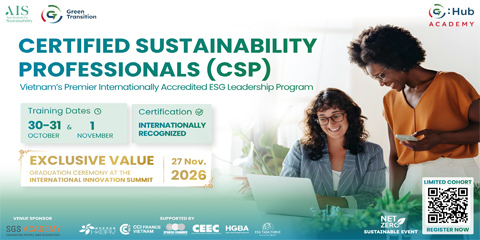
HCMC | CERTIFIED SUSTAINABILITY PROFESSIONAL (CSP) TRAINING | REGISTRATION OPEN
As sustainability becomes deeply embedded in corporate strategy and supply-chain operations across Vietnam, Hong Kong Business Association Vietnam is pleased to endorse the upcoming Certified Sustainability Professional (CSP) training program by the Asia Institute for Sustainability (AIS) - a premier internationally recognized ESG credential in Vietnam.
VIETNAM ECONOMY INVESTMENT
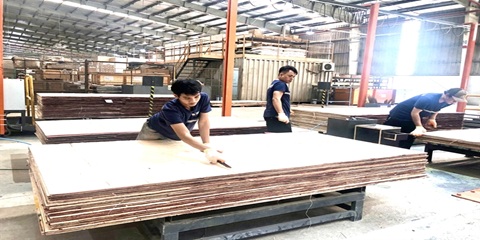
HCM CITY SAYS HOW IT PLANS TO ACHIEVE 10-11% ANNUAL EXPORT GROWTH FOR REST OF DECADE
The southern economic hub aims to strengthen its role as the country’s largest import-export centre while developing into a regional transhipment centre in Southeast Asia, supported by green and digital transformation and a circular economy. HCM City has outlined measures to expand production capacity, cut logistics costs, diversify export markets, and help businesses meet increasingly stringent international standards as it targets average annual export growth of 10-11 per cent through 2030.
VIETNAM ECONOMY INVESTMENT
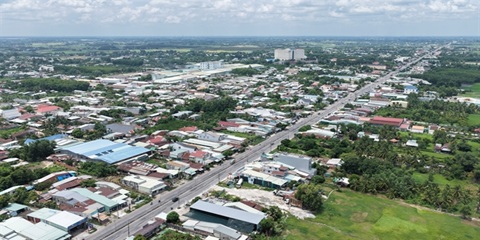
HCM CITY LEADS ECONOMIC RESTRUCTURING IN SOUTHEAST REGION
According to Associate Professor, Dr Vũ Tuấn Hưng, director of the Institute of Social Sciences of the Southern Region, the Southeast is a strategically important socio-economic space in Việt Nam’s development given its advantages in location, industry, trade, services, logistics, science and technology, urbanisation and human resources.
TECHNOLOGY
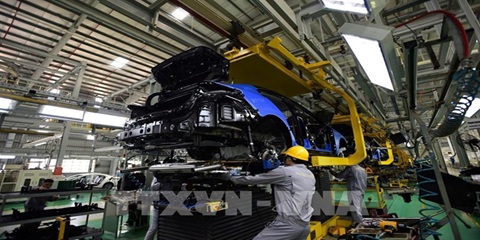
DIGITAL TRANSFORMATION TURNED INTO PRACTICAL TOOLS FOR PEOPLE, BUSINESSES
Việt Nam is moving its digital transformation agenda beyond policy frameworks and individual technology platforms towards practical applications that address everyday needs, as authorities seek measurable outcomes from science, technology and innovation. Under Politburo Resolution No. 57-NQ/TW issued on December 22, 2024, the implementation is increasingly shifting from simply completing assigned tasks towards developing concrete products and services for citizens and businesses.
TECHNOLOGY
APPLYING TECHNOLOGY FOR ECONOMIC TRANSFORMATION
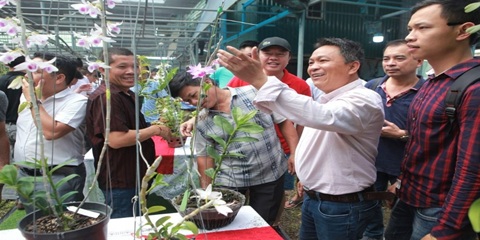
Having completed its new rural development program, Hanoi is shifting its focus toward improving development quality and building smart, sustainable rural areas. The transformation of Dong La orchid-growing village in An Khanh, a western commune of Hanoi, shows how digital technology is becoming a driver of production, market expansion, and higher incomes for local residents.
MEMBER CORNER / PROMOTIONS
VIGLACERA HONORED AS THE "LEADING GREEN INDUSTRIAL REAL ESTATE DEVELOPER 2026"
Organized by the Vietnam Investment Review, this prestigious awards program recognizes industry pioneers advancing eco-industrial parks, clean energy transition, and rigorous ESG standards. Outperforming competitors through a rigorous evaluation, Viglacera Corporation – JSC proudly ranked among the Top 5 highest-positioned enterprises in the Leading Green Industrial Real Estate Developers 2026 category, reinforcing its premier position in Vietnam’s industrial real estate sector.
Events Sponsors






















