Want to be in the loop?
subscribe to
our notification
Business News
VIỆT NAM BREAKS INTO GLOBAL TOP 10 FOR REAL ESTATE TRANSPARENCY IMPROVEMENTS
Overall, Việt Nam ranked 50th among 88 countries and territories surveyed with a transparency score of 3.15, remaining in the 'Semi-Transparent' category.

Việt Nam was among the 10 most improved in real estate market transparency, alongside Poland, Thailand, Australia, Qatar, the Republic of Korea, India, Saudi Arabia, Dubai and Abu Dhabi. — VNA/VNS Photo
HÀ NỘI — Việt Nam has emerged among the world’s 10 most improved real estate markets in terms of transparency dủing the 2024-26 period, according to the 2026 Global Real Estate Transparency Index released by global real estate services firm JLL.
Overall, Việt Nam ranked 50th among 88 countries and territories surveyed, with a transparency score of 3.15, remaining in the 'Semi-Transparent' category.
However, the country was among the 10 most improved markets globally, alongside Poland, Thailand, Australia, Qatar, the Republic of Korea, India, Saudi Arabia, Dubai and Abu Dhabi.
JLL’s index assesses real estate transparency across six areas: market performance measurement, governance and regulation, market fundamentals, transaction processes, governance of listed companies and sustainability.
The Asia-Pacific region recorded the strongest gains in transparency, accounting for five of the 10 most improved markets: India, Việt Nam, the Republic of Korea, Australia and Thailand.
JLL said the improvements had helped drive a recovery in cross-border investment in the region over the past 12 months, with direct investment transaction volumes in some markets, including Việt Nam, reaching record levels.
Before 2020, Việt Nam was classified as a 'Low Transparency' market, with limited market data and complex legal frameworks that created challenges for foreign property investors, according to JLL’s data.
A turning point came in 2016 when Việt Nam joined the Trans-Pacific Partnership and proposed developing a national real estate database, signalling efforts to align the market with international standards.
The country moved into the 'Semi-Transparent' category in 2020.
In 2024, Việt Nam took a major step in strengthening its legal framework, as the revised laws on land, housing and real estate business came into effect. The revised Law on Price also introduced requirements for certified valuation professionals and verifiable audit trails for valuations, while regulations required real estate transactions to be conducted through the banking system.
This year, Decree 357 on the construction, management and operation of housing and real estate market information systems took effect, with the goal of completing the national land database by the end of 2026.
The country has also seen greater adoption of sustainable development practices in the real estate sector.
“The fact that Việt Nam is ranked among the global top 10 markets with the strongest improvements in transparency is the result of a long and sustained process,” said General Director of JLL Vietnam Lê Thị Huyền Trang.
Trang said reforms to the legal framework, administrative procedures and economic policy, have begun to produce positive results, reflected in rising registered foreign investment.
She noted that Việt Nam recorded US$38.1 billion in registered foreign investment in the first seven months of 2026, nearly matching the total registered FDI in the previous year and marking the highest level in a decade.
JLL’s report also highlighted a relationship between market transparency and the accuracy and efficiency of property valuations.
In semi-transparent markets such as Việt Nam, fragmented and limited data mean valuation accuracy is estimated at around 70 per cent, while the process can take up to 20 days.
Meanwhile, in 'Highly Transparent' markets, where transaction data is publicly available and comprehensive, valuation accuracy is around 90 per cent, with valuations typically taking five to 10 days.
Võ Văn Hữu Phước, senior director of valuation advisory and risk management at JLL Vietnam, said that the digitisation of land records, development of a unified nationwide property registration system and adoption of international valuation standards would be key to narrowing the gap.
According to JLL, further progress towards greater transparency in Việt Nam will depend on completing the digitisation of land records, establishing a unified nationwide property registration system, applying international valuation standards and publishing data on commercial real estate credit markets.
It also requires expanding green building certification, more comprehensive planning and reliable databases and stronger disclosure requirements for listed companies.
JLL said greater transparency would become increasingly important for investors as economic and geopolitical uncertainty, artificial intelligence, shifting capital flows, energy security and changes in real estate credit markets reshape investment decision-making worldwide. — VNS
Source: VNS
Related News

VIETNAM ECONOMY INVESTMENT
MOBILE PHONE EXPORTS RISE 20% TO $51.8 BILLION IN FIRST NINE MONTHS
Exports of mobile phones and components rose 20 per cent year-on-year to nearly US$51.8 billion in the first nine months of 2026, with China, the US and Republic of Korea accounting for more than half of the total. Shipments to the three markets reached a combined $26.18 billion, or 50.6 per cent of total exports of the product group during the period, according to data from the Vietnam Department of Customs under the Ministry of Finance.

INFRASTRUCTURE / CONSTRUCTION / LOGISTIC / PORT
ĐÀ NẴNG GREEN-LIGHTS US$105 MILLION THAI DEVELOPMENT DEAL
The central city has approved an investment proposal by Thailand’s WHA Group to develop infrastructure for the 400ha WHA Đà Nẵng Industrial Park project on two communes of Thăng Bình and Đồng Dương, with an investment of more than VNĐ2.7 trillion (US$105 million). The city said it approved WHA Industrial Development International's status as an investor in the project, which is expected to take place between 2027 and 2034.

INFRASTRUCTURE / CONSTRUCTION / LOGISTIC / PORT
VIỆT NAM-CAMBODIA TRADE GATHERS PACE TOWARDS $20 BILLION TARGET
Trade between Việt Nam and Cambodia continues to grow, remaining a bright spot and a key pillar of bilateral cooperation as the two countries aim to raise two-way trade to US$20 billion in the coming years. After setting a record of more than $11.3 billion last year, bilateral trade reached about $8.7 billion in the first eight months of this year, up 8.3 per cent year on year.

VIETNAM ECONOMY INVESTMENT
FRUIT AND VEGETABLE EXPORTS POISED TO HIT $10 BILLION IN 2026
Fruit and vegetable exports are on track to reach nearly US$10 billion in 2026, after rising 19.9 per cent year on year to nearly US$7.4 billion in the first nine months, driven by strong seasonal demand and abundant tropical fruit supplies. The Ministry of Agriculture and Environment said the growth reflected stronger international demand for fresh produce and processed agricultural products.

GARMENT / TEXTILE
TEXTILE EXPORTS FACE DUAL CHALLENGES OF SUSTAINING ORDERS AND BOOSTING EFFICIENCY AMID GROWING COMPETITION
Data shows that the textile and garment sector maintained its growth momentum in the first nine months of this year. The industry's total export turnover reached an estimated US$35.721 billion in the first nine months of this year, up 3.3 per cent year-on-year. Despite posting encouraging export figures, Vietnamese textile and garment enterprises continue to navigate unpredictable market variables.
VIETNAM ECONOMY INVESTMENT
HUNG YEN’S REGIONAL GDP BEATS EXPECTATIONS
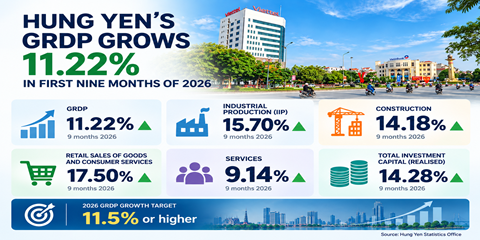
Hung Yen’s regional GDP grew 11.2 per cent in the first nine months of 2026, exceeding the 11.1 per cent growth scenario, with industry remaining the key growth driver, supported by construction and investment. Growth continued to accelerate on a quarterly basis. Along with this, the province’s regional GDP increased around 10.6 per cent in Q1, 11 per cent in Q2, and 10.8 per cent in the first six months, before reaching an estimated 12.01 per cent in the third quarter (Q3).
Events Sponsors






















