Want to be in the loop?
subscribe to
our notification
Business News
VIỆT NAM REMAINS ATTRACTIVE TO FOREIGN INVESTORS DESPITE TARIFF HEADWINDS
As long as the tariffs imposed by the US are no more than 10 per cent higher than those applied to regional competitors, Việt Nam’s pre-existing advantages, including workforce quality, competitive costs, favourable demographics, and strategic location, will continue to drive investor interest, VinaCapital said.
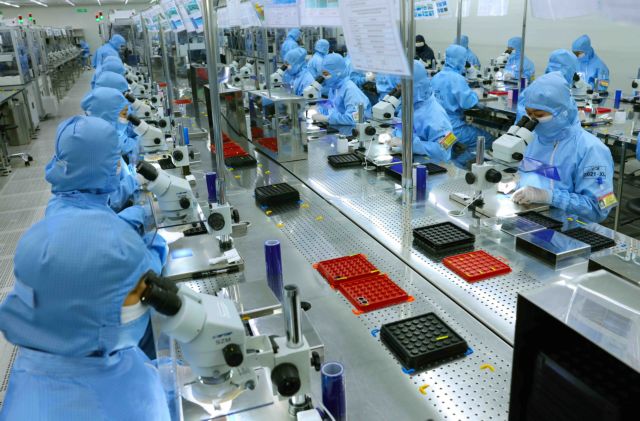
A production line of camera modules and electronic components for export at MCNEX VINA Co., Ltd, a South Korean-invested company in Ninh Bình Province. — VNA/VNS Photo Vũ Sinh
HCM CITY — Việt Nam is expected to remain an attractive destination for global manufacturers and foreign direct investment (FDI), even as the US moves forward with new tariffs on Vietnamese imports.
As long as the tariffs imposed by the US are no more than 10 per cent higher than those applied to regional competitors, Việt Nam’s pre-existing advantages, including workforce quality, competitive costs, favourable demographics, and strategic location, will continue to drive investor interest, according to investment management firm VinaCapital.
Following a call with General Secretary Tô Lâm on the evening of Wednesday, July 2, President Donald Trump announced that the US had reached a tariff agreement with Việt Nam – the first of its kind with an ASEAN country. While many details are still pending, the Vietnamese Government stated the agreement creates “a framework for a fair and balanced reciprocal trade agreement.”
The announced 20 per cent average tariff on imports from Việt Nam is around the consensus expectation and marks a significant improvement over the 46 per cent “reciprocal tariff” initially proposed by Trump on April 2.
The Vietnamese stock market reacted mildly positively to the news as of mid-day July 3, though shares of industrial park developers and exporters saw declines. In contrast, shares of US-listed companies with significant sourcing from Việt Nam such as Nike and Under Armour rose on Wednesday.
Looking ahead, the final agreement is expected to include a tiered tariff schedule, with significantly lower rates for products that are fully manufactured in Việt Nam.
“Once the final agreement is announced, we will take a closer look at the potential impact those rates may have. In the meantime, we believe the 10 per cent tariffs on Việt Nam's exports to the US (plus exemptions on most electronics products) currently in place will likely remain in effect until a final agreement is signed,” VinaCapital said.
Another key element in Trump’s announcement is a proposed 40 per cent tariff on transshipments. A recent Harvard study estimates that transshipments may account for 2 to 17 per cent of Việt Nam’s exports, while earlier reports cited a figure of approximately 14 per cent.
VinaCapital noted that the Vietnamese Government had been actively cracking down on transhipment practices since the first Trump administration and was likely to intensify these efforts. However, the firm stressed that the lack of a clear definition of “transshipments” would mean the actual impact would depend heavily on how the term is defined in the final agreement.
Despite the positive signals, VinaCapital does not expect the announcement to significantly impact the economy in the short term for several reasons.
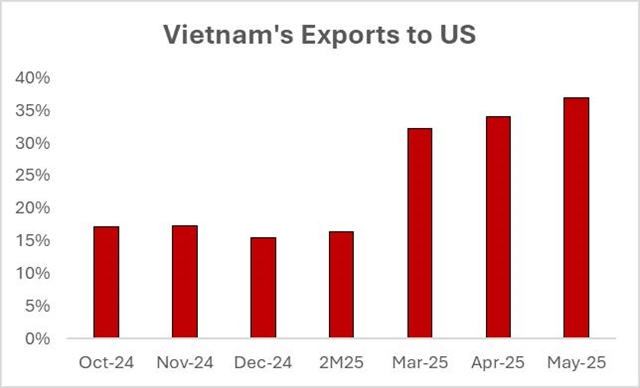
A chart shows an increase in Việt Nam’s export to the US this year. — Source: Customs, VinaCapital
First, exports to the US are expected to slow in the second half of 2025 after surging nearly 30 per cent earlier in the year. The surge was driven by US retailers rushing to secure goods during the 90-day temporary pause on reciprocal tariffs.
Meanwhile, FDI into Việt Nam remains strong. In the first five months of 2025, registered FDI rose nearly 50 per cent year-on-year to over US$15 billion or more than 7 per cent of GDP.
“Pending a final agreement, as long as Việt Nam’s tariffs are less than 10 per cent higher than regional competitors, all of the advantages it had pre-tariffs in terms of workforce quality, costs, demographics, and location continue to apply. Việt Nam should continue to be an attractive destination for global manufacturers and FDI for years to come,” the company said.
VinaCapital also reiterated that Việt Nam’s growth in 2025 would be driven primarily by internal factors, including increased public infrastructure investment, a revival of the real estate market, and significant government administrative reforms and initiatives, which some have called “Đổi Mới 2.0.”
In general, the company said “This initial announcement marks a constructive step forward for both countries. The 20 per cent tariff is far lower than the 46 per cent announced on April 2 and it removes some of the uncertainty that has loomed since then.
“In the meantime, the actions the Vietnamese Government has been taking and plans to take for the remainder of this year and beyond will be more important catalysts than exports for creating the growth required to meet its targets.” — VNS
Source: VNS
Related News

CHARITY / EXHIBITION / OTHER EVENTS
INVESTMENT OPPORTUNITIES IN CA MAU PROVINCE: 96 PROJECTS AND 20 STRATEGIC PROJECTS
We are pleased to share with you information on investment projects currently seeking investors in Ca Mau Province. Should your esteemed company or association be interested, we kindly invite you to review the project information and complete the registration form via the links provided. The Ho Chi Minh City Investment and Trade Promotion Centre (ITPC) will consolidate the expressions of interest and facilitate connections with the leadership of Ca Mau Province at a meeting tentatively scheduled for 13 November 2026 in Ho Chi Minh City.
MEMBER CORNER / PROMOTIONS
BẰNG KIỀU LIVESHOW - A SYMPHONY OF LOVE UNDER THE GOLDEN GLOW
A masterclass in live music that takes the audience on a soulful journey through immortal love songs, guided by the peerless artistry and emotive storytelling of renowned singer Bằng Kiều. The highlight of the night is his seamless musical chemistry with special guest Triệu Hồng Ngọc, promising passionate and deeply resonant duets inside the magnificent Grand Ballroom.

INFRASTRUCTURE / CONSTRUCTION / LOGISTIC / PORT
ĐÀ NẴNG GREEN-LIGHTS US$105 MILLION THAI DEVELOPMENT DEAL
The central city has approved an investment proposal by Thailand’s WHA Group to develop infrastructure for the 400ha WHA Đà Nẵng Industrial Park project on two communes of Thăng Bình and Đồng Dương, with an investment of more than VNĐ2.7 trillion (US$105 million). The city said it approved WHA Industrial Development International's status as an investor in the project, which is expected to take place between 2027 and 2034.

VIETNAM ECONOMY INVESTMENT
MOBILE PHONE EXPORTS RISE 20% TO $51.8 BILLION IN FIRST NINE MONTHS
Exports of mobile phones and components rose 20 per cent year-on-year to nearly US$51.8 billion in the first nine months of 2026, with China, the US and Republic of Korea accounting for more than half of the total. Shipments to the three markets reached a combined $26.18 billion, or 50.6 per cent of total exports of the product group during the period, according to data from the Vietnam Department of Customs under the Ministry of Finance.

INFRASTRUCTURE / CONSTRUCTION / LOGISTIC / PORT
VIỆT NAM-CAMBODIA TRADE GATHERS PACE TOWARDS $20 BILLION TARGET
Trade between Việt Nam and Cambodia continues to grow, remaining a bright spot and a key pillar of bilateral cooperation as the two countries aim to raise two-way trade to US$20 billion in the coming years. After setting a record of more than $11.3 billion last year, bilateral trade reached about $8.7 billion in the first eight months of this year, up 8.3 per cent year on year.

VIETNAM ECONOMY INVESTMENT
FRUIT AND VEGETABLE EXPORTS POISED TO HIT $10 BILLION IN 2026
Fruit and vegetable exports are on track to reach nearly US$10 billion in 2026, after rising 19.9 per cent year on year to nearly US$7.4 billion in the first nine months, driven by strong seasonal demand and abundant tropical fruit supplies. The Ministry of Agriculture and Environment said the growth reflected stronger international demand for fresh produce and processed agricultural products.
Events Sponsors






















