Want to be in the loop?
subscribe to
our notification
Business News
VIỆT NAM’S COFFEE INDUSTRY SPOTS OPPORTUNITY AMID RISING GLOBAL PRICES
The country's coffee export turnover reached more than US$560 million last month.
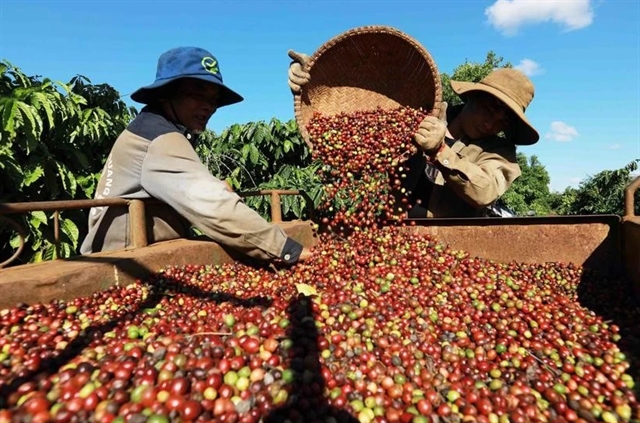
Farmers harvesting coffee. — VNA/VNS Photo
HÀ NỘI — As global coffee prices surge, Việt Nam's coffee industry is presented with a significant opportunity to expand its export market share, industry insiders say.
A recent study by the Food and Agriculture Organization noted that coffee prices rose globally by around 40 per cent in 2024, largely due to unfavourable weather conditions caused by climate change.
This has reduced production in Brazil, Colombia and Indonesia, while demand in Europe, the US and Asia has soared.
Last month, Việt Nam's coffee export turnover reached more than US$560 million, bringing the total export value for the first seven months of the year to $3.6 billion and marking an impressive year-on-year growth of 20 per cent, according to data from the Ministry of Agriculture and Environment.
The industry's growth is mostly attributed to the jump in global coffee prices.
Việt Nam is the largest exporter of Robusta coffee in the world, accounting for about 40 per cent of global market share. The country is now looking to seize the opportunity to expand its market share.
Nguyễn Nam Hải, president of the Vietnam Coffee Cocoa Association (Vicofa), said that the international coffee market has never been as favourable as it is now.
With high prices and growing demand, coupled with Việt Nam’s stable supply, the country is in an advantageous position, he said.
However, to fully capitalise on this opportunity, Việt Nam needs to delve deeper into processing, rather than relying on raw bean exports, he added.
Although exports have increased in value, the product structure of Việt Nam’s coffee exports still reveals significant limitations.
The share of deep-processed coffee, including roasted, instant and specialty coffee, currently accounts for only 12-15 per cent of total exports, according to Vicofa.
This figure is modest compared to the products' potential. In Brazil and Colombia, the ratio ranges from 30-40 per cent.
Thời báo Ngân hàng (The Banking Times) quoted founder and CEO of TNI King Coffee Lê Hoàng Diệp Thảo as saying that investing in deep processing helps companies multiply the value of their products significantly.
But initial investments can be substantial, especially for instant coffee technology, which she said requires hundreds of billions of Vietnamese đồng in capital. Not all businesses are financially capable of such investments.
Other reasons Việt Nam’s coffee sector has been slow to transition to deep processing are technological challenges and branding issues, she added.
Technology and branding challenges
The technology for processing instant coffee and specialty coffee in Việt Nam is still not uniformly developed.
Large enterprises like Vinacafé, Trung Nguyên and Nestlé have made significant investments, but the number of small and medium-sized enterprises with sufficient capabilities is limited.
Vietnamese coffee brands have not yet been firmly established on the international market. While Việt Nam is well known for its production volume, when it comes to global brands, consumers often think of Starbucks (USA), Lavazza (Italy) or Nestlé (Switzerland). This makes it difficult for processed coffee products from Việt Nam to compete in the premium segment.
Đinh Văn Thành, an agricultural economics expert, said that if Việt Nam continued to depend on raw coffee exports, it would remain only an "ingredient factory" for large corporations.
A long-term strategy for investment in deep processing is needed, along with efforts to elevate the national coffee brand on the global stage, he added.
Despite these challenges, positive signals are emerging from businesses. Trung Nguyên Legend, for example, is expanding its instant coffee exports to the Middle East and Eastern Europe.
Vinacafé is focusing on developing the ASEAN market, while several start-ups in Lâm Đồng and Gia Lai are boldly building specialty coffee brands for markets like Japan and South Korea.
Instead of selling raw beans, they are partnering with companies to process roasted coffee and sell it directly to the South Korean market, said Thảo. The selling price is double that of raw beans, while farmers also earn better profits.
To capitalise on high coffee prices and expand export potential, experts recommended three key strategies for Việt Nam’s coffee industry.
Việt Nam should first invest in deep processing technology. The Government should offer preferential credit policies to businesses that invest in production lines for instant and specialty coffee, rather than leaving them to manage on their own.
Experts also suggest that the country focus on building a national coffee brand, similar to Thailand's Jasmine rice or Colombia’s Arabica coffee. A strong, internationally recognised coffee brand is essential for Việt Nam.
Finally, Việt Nam should prioritise emerging markets like the Middle East, South Asia and Eastern Europe, where coffee demand is growing rapidly. This presents an opportunity for processed Vietnamese coffee to expand its distribution channels. — VNS
Source: VNS
Related News

MEMBER CORNER / PROMOTIONS
BẰNG KIỀU LIVESHOW - A SYMPHONY OF LOVE UNDER THE GOLDEN GLOW
A masterclass in live music that takes the audience on a soulful journey through immortal love songs, guided by the peerless artistry and emotive storytelling of renowned singer Bằng Kiều. The highlight of the night is his seamless musical chemistry with special guest Triệu Hồng Ngọc, promising passionate and deeply resonant duets inside the magnificent Grand Ballroom.

INFRASTRUCTURE / CONSTRUCTION / LOGISTIC / PORT
ĐÀ NẴNG GREEN-LIGHTS US$105 MILLION THAI DEVELOPMENT DEAL
The central city has approved an investment proposal by Thailand’s WHA Group to develop infrastructure for the 400ha WHA Đà Nẵng Industrial Park project on two communes of Thăng Bình and Đồng Dương, with an investment of more than VNĐ2.7 trillion (US$105 million). The city said it approved WHA Industrial Development International's status as an investor in the project, which is expected to take place between 2027 and 2034.

VIETNAM ECONOMY INVESTMENT
MOBILE PHONE EXPORTS RISE 20% TO $51.8 BILLION IN FIRST NINE MONTHS
Exports of mobile phones and components rose 20 per cent year-on-year to nearly US$51.8 billion in the first nine months of 2026, with China, the US and Republic of Korea accounting for more than half of the total. Shipments to the three markets reached a combined $26.18 billion, or 50.6 per cent of total exports of the product group during the period, according to data from the Vietnam Department of Customs under the Ministry of Finance.

INFRASTRUCTURE / CONSTRUCTION / LOGISTIC / PORT
VIỆT NAM-CAMBODIA TRADE GATHERS PACE TOWARDS $20 BILLION TARGET
Trade between Việt Nam and Cambodia continues to grow, remaining a bright spot and a key pillar of bilateral cooperation as the two countries aim to raise two-way trade to US$20 billion in the coming years. After setting a record of more than $11.3 billion last year, bilateral trade reached about $8.7 billion in the first eight months of this year, up 8.3 per cent year on year.

VIETNAM ECONOMY INVESTMENT
FRUIT AND VEGETABLE EXPORTS POISED TO HIT $10 BILLION IN 2026
Fruit and vegetable exports are on track to reach nearly US$10 billion in 2026, after rising 19.9 per cent year on year to nearly US$7.4 billion in the first nine months, driven by strong seasonal demand and abundant tropical fruit supplies. The Ministry of Agriculture and Environment said the growth reflected stronger international demand for fresh produce and processed agricultural products.
GARMENT / TEXTILE
TEXTILE EXPORTS FACE DUAL CHALLENGES OF SUSTAINING ORDERS AND BOOSTING EFFICIENCY AMID GROWING COMPETITION
Data shows that the textile and garment sector maintained its growth momentum in the first nine months of this year. The industry's total export turnover reached an estimated US$35.721 billion in the first nine months of this year, up 3.3 per cent year-on-year. Despite posting encouraging export figures, Vietnamese textile and garment enterprises continue to navigate unpredictable market variables.
Events Sponsors






















