Want to be in the loop?
subscribe to
our notification
Business News
AI BECOMES LOGISTICS GAME-CHANGER
Vietnam’s logistics sector must contend with the application of AI and other critical factors shaping the industry’s future.
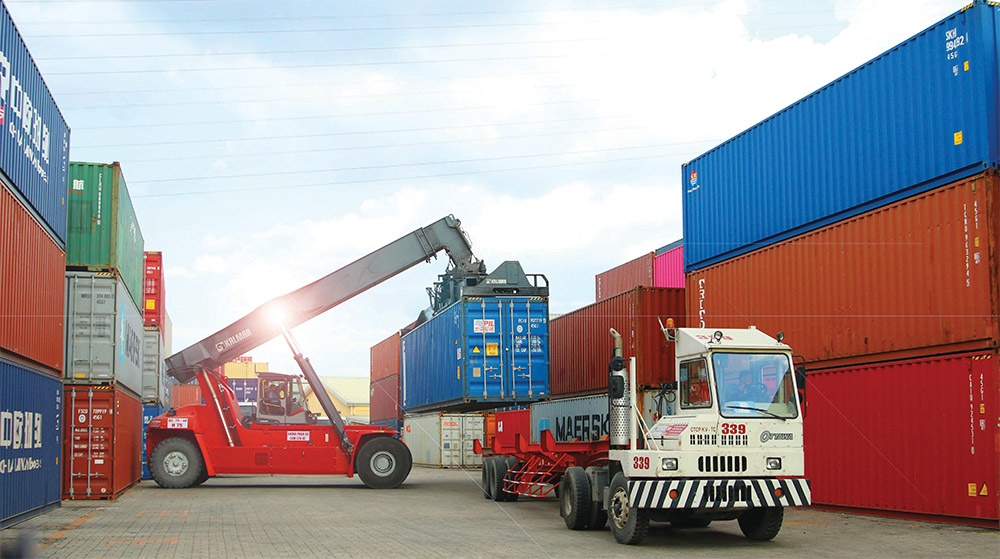
Various operational aspects are being transformed with tech upgrades such as AI, photo Le Toan
At a seminar on sustainable development of logistics in the 4.0 era in Hanoi at the end of April, organised by the Ministry of Industry and Trade (MoIT), Vu Khac Anh, director of cross-border e-commerce company Pervasel, said that his business currently processes around one million orders in the US market.
“With a global operational scale, technology is indispensable in all aspects of management. From human resource management, advertising, logistics, to customer service, everything must be digitised,” explained Anh.
Currently, Pervasel uses AI to operate 24/7 automated response systems in multiple countries, significantly reducing labour costs. At the same time, it is training AI to forecast fashion trends in different countries, allowing the company to develop products tailored to each market, Anh added.
“The utilisation of big data and AI not only shortens product development time for Pervasel, but also significantly enhances operational efficiency and responsiveness to market fluctuations,” Anh said.
Dr. Nguyen Tien Minh, an expert in logistics, told VIR that using AI is a necessity for the logistics industry. It enables businesses to forecast demand, optimise warehouse operations, and coordinate transportation more efficiently, he said.
“However, implementing it requires substantial investment and a digitally skilled workforce, something many small and medium-sized enterprises still lack,” Minh explained. “The second half of the year is a pivotal time for Vietnam’s logistics sector to transform. Businesses must act quickly, invest in technology and people, and form strategic partnerships to overcome challenges and seize growth opportunities.”
Dr. Nguyen Thi Xuan Hoa, deputy head of Research at the Vietnam Association for Logistics Manpower Development, believes that AI is an effective tool when used properly.
“In our research, we use AI tools like Google Notebook to process and analyse big data. When used correctly, AI can significantly boost productivity and accuracy,” Hoa noted. “However, as powerful as it is, it still requires human oversight, leadership, and validation.”
Meanwhile Tran Thanh Hai, who is deputy director of the Foreign Trade Agency under the MoIT, said that the logistics industry must transform and capitalise on economic recovery and tech advancement.
“However, for sustainable development, businesses need to proactively adapt, invest in technology and human resources, and collaborate closely with partners to overcome challenges and capture opportunities,” Hai said.
To encourage the application of AI in the logistics industry, Hai emphasised that logistics enterprises need to develop a digital transformation strategy, clearly define digital transformation goals, and establish a roadmap tailored to their own operations.
“Within this strategy, businesses must identify specific technological applications, including AI, across various aspects of their operations,” he added.
In addition, the choice of a technology application model within the enterprise should be carefully researched. “Enterprises should foster strong internal connections within the logistics sector and seek advice from digital transformation service providers to help determine the most suitable approach,” Hai said.
Finally, businesses must ensure that the transition to technology-based operations is carried out steadily, following a roadmap that aligns with each company’s actual capabilities.
“Companies should also clearly define the objectives of software applications, with a primary focus on enhancing customer experience, ensuring accurate, real-time information retrieval, and supporting internal management operations,” he added.
Vietnam’s logistics market in the second half of 2025 is expected to continue its strong growth. According to the MoIT, the country currently has over 40,000 enterprises operating in the logistics sector, with an average annual growth rate of 12–14 per cent. The market size has surpassed $60 billion, making logistics a key pillar in Vietnam’s integration and economic development strategy.
Source: VIR
Related News
MEMBER CORNER / PROMOTIONS
HCMC | CERTIFIED SUSTAINABILITY PROFESSIONAL (CSP) TRAINING | REGISTRATION OPEN
As sustainability becomes deeply embedded in corporate strategy and supply-chain operations across Vietnam, Hong Kong Business Association Vietnam is pleased to endorse the upcoming Certified Sustainability Professional (CSP) training program by the Asia Institute for Sustainability (AIS) - a premier internationally recognized ESG credential in Vietnam.
VIETNAM ECONOMY INVESTMENT
HCM CITY SAYS HOW IT PLANS TO ACHIEVE 10-11% ANNUAL EXPORT GROWTH FOR REST OF DECADE
The southern economic hub aims to strengthen its role as the country’s largest import-export centre while developing into a regional transhipment centre in Southeast Asia, supported by green and digital transformation and a circular economy. HCM City has outlined measures to expand production capacity, cut logistics costs, diversify export markets, and help businesses meet increasingly stringent international standards as it targets average annual export growth of 10-11 per cent through 2030.
VIETNAM ECONOMY INVESTMENT
HCM CITY LEADS ECONOMIC RESTRUCTURING IN SOUTHEAST REGION
According to Associate Professor, Dr Vũ Tuấn Hưng, director of the Institute of Social Sciences of the Southern Region, the Southeast is a strategically important socio-economic space in Việt Nam’s development given its advantages in location, industry, trade, services, logistics, science and technology, urbanisation and human resources.
TECHNOLOGY
DIGITAL TRANSFORMATION TURNED INTO PRACTICAL TOOLS FOR PEOPLE, BUSINESSES
Việt Nam is moving its digital transformation agenda beyond policy frameworks and individual technology platforms towards practical applications that address everyday needs, as authorities seek measurable outcomes from science, technology and innovation. Under Politburo Resolution No. 57-NQ/TW issued on December 22, 2024, the implementation is increasingly shifting from simply completing assigned tasks towards developing concrete products and services for citizens and businesses.
TECHNOLOGY
APPLYING TECHNOLOGY FOR ECONOMIC TRANSFORMATION
Having completed its new rural development program, Hanoi is shifting its focus toward improving development quality and building smart, sustainable rural areas. The transformation of Dong La orchid-growing village in An Khanh, a western commune of Hanoi, shows how digital technology is becoming a driver of production, market expansion, and higher incomes for local residents.

MEMBER CORNER / PROMOTIONS
VIGLACERA HONORED AS THE "LEADING GREEN INDUSTRIAL REAL ESTATE DEVELOPER 2026"
Organized by the Vietnam Investment Review, this prestigious awards program recognizes industry pioneers advancing eco-industrial parks, clean energy transition, and rigorous ESG standards. Outperforming competitors through a rigorous evaluation, Viglacera Corporation – JSC proudly ranked among the Top 5 highest-positioned enterprises in the Leading Green Industrial Real Estate Developers 2026 category, reinforcing its premier position in Vietnam’s industrial real estate sector.
Events Sponsors






















