Want to be in the loop?
subscribe to
our notification
Business News
AMENDED CIRCULAR 36: POTENTIAL IMPACTS ON PROPERTY MARKET
According to the draft, the maximum ratio of short-term funds used for medium and long-term loans will be reduced from 60 per cent to 40 per cent and the risk index of receivable lending for real estate will be raised from 150 per cent to 250 per cent.
Necessary step?
The SBV said the move is aimed to ensure the safety of the banking system and financial market stability for the sake of macroeconomic stability. The central lender is responsible for making warnings whenever it sees signs of risk to bring the market to the trajectory of long-term and stable growth.
According to data from the SBV, by the end of 2015, State-owned commercial banks, which provide more than half of credits for the economy, has the capital adequacy ratio (CAR) was just slightly higher than the regulatory rate, reaching 9.42 per cent while the rate of joint stock commercial banks was as high as 12.74 per cent. Therefore, to keep this rate at 9 per cent, banks must maintain a tier 1 capital and tier 2 capital in the numerator of the CAR calculating formula at a high level or restrict loans for risky sectors. Hence, the hike in banks’ capital is not always done immediately. With this message of the SBV, banks necessarily strengthen risk control in lending for real estate sector and keep CAR as stipulated by the SBV.
Mr Nguyen Tri Hieu, an expert in banking sector, said that all credit in t commercial banking system is short-term. But if this fund is used for medium and long-term property loans, the market liquidity will be greatly affected. Thus, commercial banks administered the SBV must be closely controlled since the capital inflow for real estate is potentially risky.
According to the macroeconomic report of the fourth quarter 2015 released by the Vietnam Institute for Economy and Policy Research (VEPR), as of November 30, 2015, property credit increased by nearly 20 per cent from the start of 2015 to over VND374,800 billion. This showed potential risk of the formation of property bubble in the future. The sustainability of the property market may be affected if monetary and credit policy is governed inappropriately.
Therefore, according to an SBV official, the draft amendments and supplements to some articles of Circular 36/2014/TT-NHNN are aimed to reduce the maximum ratio of short-term funds used for medium and long-term loans from 60 per cent to 40 per cent and raising the risk index of receivable lending for real estate from 150 per cent to 250 per cent. This measure will strengthen loan risk control. This does not mean loosening or tightening credit in this field.
Dr Le Ba Chi Nhan, an economist, said that up to 70 per cent of investment capital of property companies presently comes from banks and the remaining 30 per cent comes from various sources. If companies are in trouble and banks lack good assessment and continue to provide loans, the market will further recess. Hence, according to Dr Nhan, tightening credit for the real estate market is now necessary. The move of the SBV is aimed to lead the real estate market to the right track to avoid the reformation of property bubble.
Real estate inventory is still very large. Banks need much capital to handle this source of commodity. The SBV’s hike in risk ratio is intended to ensure good market liquidity and reduce bad debts for the market.
Market liquidity will be affected
According to economic experts, the SBV draft on the credit squeeze on real estate is likely to realise what is about to happen because commercial banks now do not have much capital for strong lending in 2015. This will cause certain difficulties for businesses and the real estate market will probably cool down in 2016.
Mr Su Ngoc Khuong, Director of Savills Vietnam Company, said that the housing demand remains high but the market liquidity has not improved much since banks have tightened property credit valve. Consequently, lending rates are likely to rise and lending terms for homebuyers will be also shortened.
Dr Nhan predicted, “If the SBV increases the risk factor from 150 per cent to 250 per cent, counterpart funds will also increase as a result. If credit flow into the real estate is limited, the supply source will be halted.”
Mr Tran Khanh Quang, CEO of Viet An Hoa Real Estate Investment Joint Stock Company, analysed that the room for property loans will be reduced when the risk coefficient is raised from 150 per cent to 250 per cent. Then, property companies will find it harder to borrow money for their projects. Furthermore, high-class property segments will face more obstacles to loans.
“Credit crunch will not only downsize property supply but also raise interest rates, resulting in weaker demands. Then, the market liquidity will go down and corporate profits will be affected,” he added.
Source: VCCI
Related News

INFRASTRUCTURE / CONSTRUCTION / LOGISTIC / PORT
VIỆT NAM-CAMBODIA TRADE GATHERS PACE TOWARDS $20 BILLION TARGET
Trade between Việt Nam and Cambodia continues to grow, remaining a bright spot and a key pillar of bilateral cooperation as the two countries aim to raise two-way trade to US$20 billion in the coming years. After setting a record of more than $11.3 billion last year, bilateral trade reached about $8.7 billion in the first eight months of this year, up 8.3 per cent year on year.
TECHNOLOGY
AI BEGINNING TO RESHAPE RECRUITMENT CRITERIA
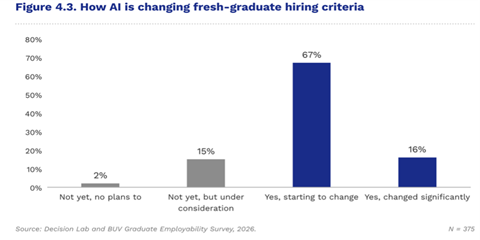
Digital literacy is the only capability area in which fresh graduates meet employers’ expectations, according to a new report. Yet, it is also the standard rising fastest, as businesses increasingly expect new hires to use AI effectively in the workplace. Some 83 per cent of employers say AI has changed, or is beginning to change, their hiring criteria, while 94 per cent report higher expectations for digital and AI capabilities than they had two to three years ago.

INFRASTRUCTURE / CONSTRUCTION / LOGISTIC / PORT
ĐÀ NẴNG GREEN-LIGHTS US$105 MILLION THAI DEVELOPMENT DEAL
The central city has approved an investment proposal by Thailand’s WHA Group to develop infrastructure for the 400ha WHA Đà Nẵng Industrial Park project on two communes of Thăng Bình and Đồng Dương, with an investment of more than VNĐ2.7 trillion (US$105 million). The city said it approved WHA Industrial Development International's status as an investor in the project, which is expected to take place between 2027 and 2034.

VIETNAM ECONOMY INVESTMENT
MOBILE PHONE EXPORTS RISE 20% TO $51.8 BILLION IN FIRST NINE MONTHS
Exports of mobile phones and components rose 20 per cent year-on-year to nearly US$51.8 billion in the first nine months of 2026, with China, the US and Republic of Korea accounting for more than half of the total. Shipments to the three markets reached a combined $26.18 billion, or 50.6 per cent of total exports of the product group during the period, according to data from the Vietnam Department of Customs under the Ministry of Finance.

VIETNAM ECONOMY INVESTMENT
FRUIT AND VEGETABLE EXPORTS POISED TO HIT $10 BILLION IN 2026
Fruit and vegetable exports are on track to reach nearly US$10 billion in 2026, after rising 19.9 per cent year on year to nearly US$7.4 billion in the first nine months, driven by strong seasonal demand and abundant tropical fruit supplies. The Ministry of Agriculture and Environment said the growth reflected stronger international demand for fresh produce and processed agricultural products.

GARMENT / TEXTILE
TEXTILE EXPORTS FACE DUAL CHALLENGES OF SUSTAINING ORDERS AND BOOSTING EFFICIENCY AMID GROWING COMPETITION
Data shows that the textile and garment sector maintained its growth momentum in the first nine months of this year. The industry's total export turnover reached an estimated US$35.721 billion in the first nine months of this year, up 3.3 per cent year-on-year. Despite posting encouraging export figures, Vietnamese textile and garment enterprises continue to navigate unpredictable market variables.
Events Sponsors






















