Want to be in the loop?
subscribe to
our notification
Business News
BLUE CHIPS LIFT VN-INDEX PAST 1,345 POINTS
From the opening bell, there was robust upward momentum driven by large-cap stocks, with gains sustained throughout the trading session.
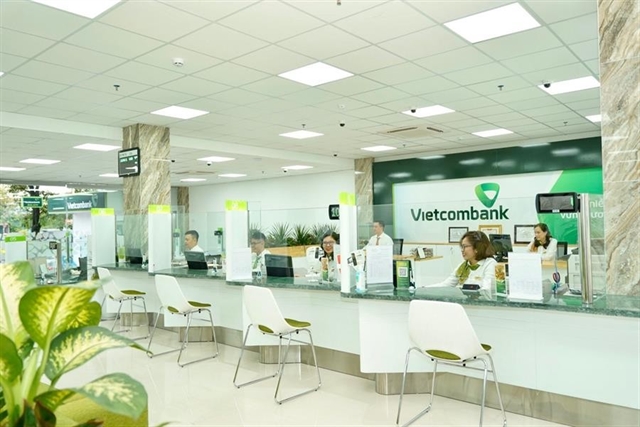
A Vietcombank transaction office in Hà Nội. The bank's VCB shares led the market as the VN-Index approached the 1,350-point mark. — Photo vietcombank.com.vn
HÀ NỘI — Vietnamese stocks extended gains on Tuesday, powered largely by blue-chip shares, sending the VN-Index closer to the 1,350-point threshold. Liquidity rose significantly, while foreign investors returned as net buyers after seven consecutive sessions of net selling.
From the opening bell, the market saw robust upward momentum driven by large-cap stocks, with gains sustained throughout the trading session. At the close, the VN-Index climbed 10.95 points, or 0.82 per cent, to 1,347.25.
Market breadth was positive, with 195 gainers against 119 decliners. Liquidity on the Hồ Chí Minh Stock Exchange (HoSE) increased by 23.5 per cent compared to the previous session, reaching VNĐ25.7 trillion (approximately US$984 million).
The VN30-Index, which tracks the top 30 listed companies by market capitalisation, also rose sharply by 14.83 points, or 1.04 per cent, to 1,437.87. Within this basket, 26 stocks advanced, three declined and one remained unchanged.
Leading the rally were banking stocks, especially Techcombank (TCB) and Vietcombank (VCB), which gained 2.43 and 1.07 per cent respectively, contributing nearly 2.5 points to the VN-Index.
Other notable gainers included Hoà Phát Group (HPG), which added 1.76 per cent, Vingroup (VIC), which rose marginally by 0.1 per cent, and Vietnam Airlines (HVN), which advanced 2.77 per cent.
Analysts from Saigon – Hanoi Securities (SHS) commented: “The short-term trend of the VN-Index remains positive, with support at around 1,320 points and stronger backing near 1,300 points – the highest price zone in 2024. However, the resistance zone around 1,343 points, which marked the March 2025 peak, remains a significant hurdle. This is not considered an attractive level for further buying.”
They explained: “As the market enters June, the main driver of VN-Index performance in May came from VN30 stocks. From the end of 2024 to the end of May 2025, the VN-Index increased by 5.20 per cent, largely thanks to a 5.87 per cent rise in VN30. In contrast, the VNMID index rose slightly by 0.68 per cent, while the VNSML fell 0.70 per cent. This trend suggests that mid and small-cap stocks (VNMID and VNSML) may show stronger price movements in June.
“In May, liquidity in the VN30 group declined by 21 per cent month-on-month, mostly due to a sharp drop in trading volume of VIC, VHM and VRE after a period of strong price growth. Meanwhile, liquidity improved notably in mid and small-cap stocks, indicating a healthy rotation of cash flows into these segments. Short-term opportunities will likely come from rotational recoveries toward pre-correction levels. Therefore, stock selection must be cautious and based on each company's growth prospects,” they added.
On the Hà Nội Stock Exchange, the HNX-Index also advanced 2.77 points, or 1.22 per cent, to 228.94. Total trading value on the northern bourse reached VNĐ2.6 trillion, with nearly 145 million shares exchanged. — VNS
Source: VNS
Related News

CHARITY / EXHIBITION / OTHER EVENTS
INVESTMENT OPPORTUNITIES IN CA MAU PROVINCE: 96 PROJECTS AND 20 STRATEGIC PROJECTS
We are pleased to share with you information on investment projects currently seeking investors in Ca Mau Province. Should your esteemed company or association be interested, we kindly invite you to review the project information and complete the registration form via the links provided. The Ho Chi Minh City Investment and Trade Promotion Centre (ITPC) will consolidate the expressions of interest and facilitate connections with the leadership of Ca Mau Province at a meeting tentatively scheduled for 13 November 2026 in Ho Chi Minh City.

MEMBER CORNER / PROMOTIONS
BẰNG KIỀU LIVESHOW - A SYMPHONY OF LOVE UNDER THE GOLDEN GLOW
A masterclass in live music that takes the audience on a soulful journey through immortal love songs, guided by the peerless artistry and emotive storytelling of renowned singer Bằng Kiều. The highlight of the night is his seamless musical chemistry with special guest Triệu Hồng Ngọc, promising passionate and deeply resonant duets inside the magnificent Grand Ballroom.

INFRASTRUCTURE / CONSTRUCTION / LOGISTIC / PORT
ĐÀ NẴNG GREEN-LIGHTS US$105 MILLION THAI DEVELOPMENT DEAL
The central city has approved an investment proposal by Thailand’s WHA Group to develop infrastructure for the 400ha WHA Đà Nẵng Industrial Park project on two communes of Thăng Bình and Đồng Dương, with an investment of more than VNĐ2.7 trillion (US$105 million). The city said it approved WHA Industrial Development International's status as an investor in the project, which is expected to take place between 2027 and 2034.

VIETNAM ECONOMY INVESTMENT
MOBILE PHONE EXPORTS RISE 20% TO $51.8 BILLION IN FIRST NINE MONTHS
Exports of mobile phones and components rose 20 per cent year-on-year to nearly US$51.8 billion in the first nine months of 2026, with China, the US and Republic of Korea accounting for more than half of the total. Shipments to the three markets reached a combined $26.18 billion, or 50.6 per cent of total exports of the product group during the period, according to data from the Vietnam Department of Customs under the Ministry of Finance.

INFRASTRUCTURE / CONSTRUCTION / LOGISTIC / PORT
VIỆT NAM-CAMBODIA TRADE GATHERS PACE TOWARDS $20 BILLION TARGET
Trade between Việt Nam and Cambodia continues to grow, remaining a bright spot and a key pillar of bilateral cooperation as the two countries aim to raise two-way trade to US$20 billion in the coming years. After setting a record of more than $11.3 billion last year, bilateral trade reached about $8.7 billion in the first eight months of this year, up 8.3 per cent year on year.

VIETNAM ECONOMY INVESTMENT
FRUIT AND VEGETABLE EXPORTS POISED TO HIT $10 BILLION IN 2026
Fruit and vegetable exports are on track to reach nearly US$10 billion in 2026, after rising 19.9 per cent year on year to nearly US$7.4 billion in the first nine months, driven by strong seasonal demand and abundant tropical fruit supplies. The Ministry of Agriculture and Environment said the growth reflected stronger international demand for fresh produce and processed agricultural products.
Events Sponsors






















