Want to be in the loop?
subscribe to
our notification
Business News
BUSINESSES ADOPTS ESG AS PART OF LONG-TERM STRATEGY
As global markets demand greater sustainability, companies are facing pressure and opportunity to integrate environmental, social and governance (ESG) standards into long-term strategies, with stronger regulatory backing and sector-wide support.
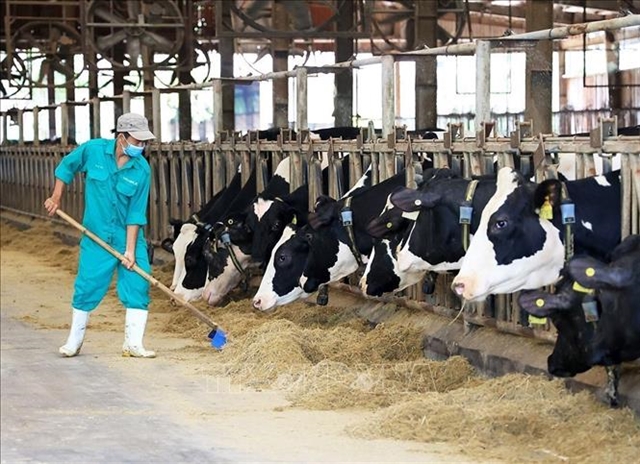
A worker cares for livestock at a farm operated by Vinamilk in Bình Dương Province. — VNA/VNS Photo
HÀ NỘI — Climate change poses challenges and opportunities for Vietnamese businesses as global markets increasingly prioritise sustainable products and services, said economists and industry experts.
The Director of Sustainability & Climate Change Advisory Services at Deloitte Việt Nam, Phạm Minh Hương, noted that enterprises can tap into new potential by developing environmentally-friendly products and improving energy efficiency.
According to the Ministry of Industry and Trade, if Việt Nam raises its energy efficiency rate from the current 1.8 per cent to 2 per cent, it would have an impact equivalent to halving the electricity output from coal, currently the country’s largest source of carbon emissions.
Companies like Hòa Phát have already begun investing in green steel technologies, adopting renewable energy to reduce emissions. These efforts meet regulatory requirements and help expand market share in developed economies.
Despite promising examples, ESG adoption in Việt Nam remains limited.
Lê Hoàng Hải, Deputy Head of the Public Company Supervision Department at the State Securities Commission of Việt Nam (SSC), revealed that only 14 per cent of more than 700 companies listed on the Hochiminh Stock Exchange (HOSE) publish standalone sustainability reports. This figure drops below five per cent when limited to those who are audited.
The primary barrier is the lack of a comprehensive legal framework and specific guidance for ESG standards. To address this, the SSC is collaborating with the International Finance Corporation (IFC) to develop a national set of ESG standards, expected by 2026. The aim is to assist small and medium-sized enterprises (SMEs), which make up 97 per cent of Việt Nam’s total businesses, in aligning with international regulations.
The Vice Chairman and Secretary-General of the Vietnam Association of Certified Public Accountants (VACPA), Trần Khánh Lâm, views ESG assurance as a business opportunity for auditors and a driver for improved corporate governance.
In 2023, over 500 auditors participated in IFRS S1 and S2 training programmes co-organised by VACPA and the Association of Chartered Certified Accountants (ACCA). However, Lâm acknowledged that a shortage of experts in environmental and technological fields poses a challenge to high-quality ESG auditing.
A recent report by PwC Vietnam found that only 20 per cent of auditors currently possess basic ESG knowledge, underlining the need for long-term workforce training and resource development.
International governance expert Simon C.Y. Wong warned that climate-related economic losses could reach US$38 trillion globally by 2049 without urgent action. This highlights the need for decisive corporate governance that integrates environmental and social risks.
Leading Vietnamese corporations such as Vinamilk and PAN Group offer successful examples. Vinamilk has developed Global GAP-certified dairy farms and integrated ESG practices across its supply chain to reduce emissions. Meanwhile, PAN Group has applied international governance standards to improve sustainable operations.
Phạm Minh Hương stressed that governance is not just about compliance, but a foundation for achieving environmental and social goals. Implementing international standards like IFRS S1 and S2 enables transparency and boosts credibility in global markets.
For instance, Vietnamese seafood exporters have used these frameworks to meet rigorous ESG requirements in the EU and US markets, where sustainability has become a crucial evaluation criterion.
Lê Hoàng Hải reaffirmed that Việt Nam’s regulatory framework is evolving. Corporate governance obligations are already set out in the 2019 Securities Law and Decree No 155/2020/NĐ-CP. The SSC has intensified its monitoring of ESG disclosures and imposed strict penalties on non-compliant firms.
In 2023, 15 listed companies were fined for delayed or opaque sustainability reporting – a sign of growing enforcement. These regulatory efforts help enterprises adapt to climate risks and prepare them to capture opportunities in a greener global economy. — VNS
Source: VNS
Related News

CHARITY / EXHIBITION / OTHER EVENTS
INVESTMENT OPPORTUNITIES IN CA MAU PROVINCE: 96 PROJECTS AND 20 STRATEGIC PROJECTS
We are pleased to share with you information on investment projects currently seeking investors in Ca Mau Province. Should your esteemed company or association be interested, we kindly invite you to review the project information and complete the registration form via the links provided. The Ho Chi Minh City Investment and Trade Promotion Centre (ITPC) will consolidate the expressions of interest and facilitate connections with the leadership of Ca Mau Province at a meeting tentatively scheduled for 13 November 2026 in Ho Chi Minh City.

MEMBER CORNER / PROMOTIONS
BẰNG KIỀU LIVESHOW - A SYMPHONY OF LOVE UNDER THE GOLDEN GLOW
A masterclass in live music that takes the audience on a soulful journey through immortal love songs, guided by the peerless artistry and emotive storytelling of renowned singer Bằng Kiều. The highlight of the night is his seamless musical chemistry with special guest Triệu Hồng Ngọc, promising passionate and deeply resonant duets inside the magnificent Grand Ballroom.
INFRASTRUCTURE / CONSTRUCTION / LOGISTIC / PORT
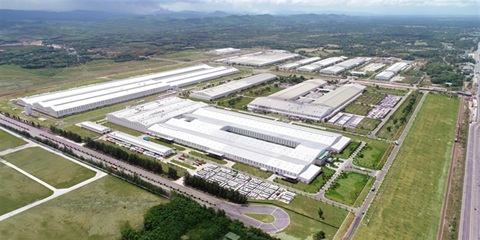
ĐÀ NẴNG GREEN-LIGHTS US$105 MILLION THAI DEVELOPMENT DEAL
The central city has approved an investment proposal by Thailand’s WHA Group to develop infrastructure for the 400ha WHA Đà Nẵng Industrial Park project on two communes of Thăng Bình and Đồng Dương, with an investment of more than VNĐ2.7 trillion (US$105 million). The city said it approved WHA Industrial Development International's status as an investor in the project, which is expected to take place between 2027 and 2034.
VIETNAM ECONOMY INVESTMENT
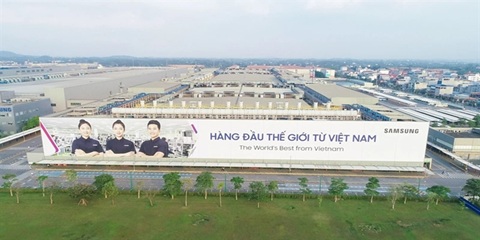
MOBILE PHONE EXPORTS RISE 20% TO $51.8 BILLION IN FIRST NINE MONTHS
Exports of mobile phones and components rose 20 per cent year-on-year to nearly US$51.8 billion in the first nine months of 2026, with China, the US and Republic of Korea accounting for more than half of the total. Shipments to the three markets reached a combined $26.18 billion, or 50.6 per cent of total exports of the product group during the period, according to data from the Vietnam Department of Customs under the Ministry of Finance.

INFRASTRUCTURE / CONSTRUCTION / LOGISTIC / PORT
VIỆT NAM-CAMBODIA TRADE GATHERS PACE TOWARDS $20 BILLION TARGET
Trade between Việt Nam and Cambodia continues to grow, remaining a bright spot and a key pillar of bilateral cooperation as the two countries aim to raise two-way trade to US$20 billion in the coming years. After setting a record of more than $11.3 billion last year, bilateral trade reached about $8.7 billion in the first eight months of this year, up 8.3 per cent year on year.
VIETNAM ECONOMY INVESTMENT
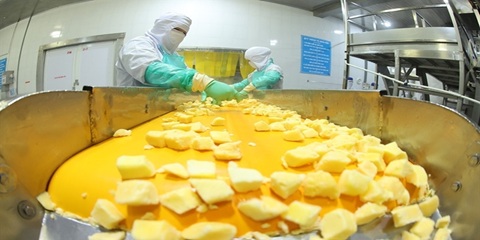
FRUIT AND VEGETABLE EXPORTS POISED TO HIT $10 BILLION IN 2026
Fruit and vegetable exports are on track to reach nearly US$10 billion in 2026, after rising 19.9 per cent year on year to nearly US$7.4 billion in the first nine months, driven by strong seasonal demand and abundant tropical fruit supplies. The Ministry of Agriculture and Environment said the growth reflected stronger international demand for fresh produce and processed agricultural products.
Events Sponsors






















