Want to be in the loop?
subscribe to
our notification
Business News
DEPUTY PM EXPLORES ECONOMIC DEVELOPMENT EXPERIENCE IN CHINA
At working sessions with specialised agencies in Shenzhen, China, Deputy PM Nguyễn Chí Dũng shared Việt Nam's development priorities in the new era, underscoring the Vietnamese Party and Government's interest in enhancing the private sector's role, improving the business climate, attracting high-quality human resources, and developing free trade zones.
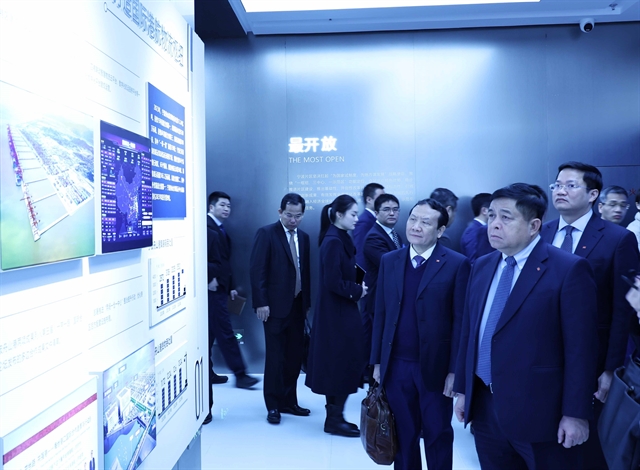
Deputy Prime Minister Nguyễn Chí Dũng visited the free trade zone Ningbo in Shenzhen, China. — VNA/VNS Photo
BEIJING — Vietnamese Deputy Prime Minister Nguyễn Chí Dũng paid a working trip to Guangdong Province’s Shenzhen City on March 18 and 19 as part of his visit to China.
Meeting with Executive Vice Mayor of Shenzhen Tao Yongxin, Dũng expressed his admiration for the city's transformation into a modern and prosperous metropolis, praising its remarkable economic and social achievements under the leadership of the Communist Party of China, headed by Party General Secretary and President Xi Jinping.
Dũng underscored Việt Nam's significant economic and social development achievements during nearly 40 years of Đổi mới (renewal), which have enhanced the country's capabilities and international standing.
He highlighted Việt Nam's ambitious goals to become an upper-middle income country by 2030 and a high-income developed nation by 2045, requiring the country to overcome challenges, particularly achieving double-digit growth rates through digital transformation, scientific-technological advancement, and developing the private economic sector as the most important driver for the country's growth.
Deputy PM Dũng expressed his appreciation for the positive and extensive development of the Việt Nam – China comprehensive strategic cooperative partnership and the community with a shared future that carries strategic significance.
He emphasised that the Vietnamese Party, Government, and people view strengthening and developing friendly relations with China as a consistent policy, an objective requirement, a strategic choice, and a top priority in its foreign policy of independence, self-reliance, multilateralisation and diversification of external relations.
For his part, Tao expressed his gratitude for the support from the Vietnamese Government, ministries, sectors and localities for Shenzhen city.
He highlighted Shenzhen's evolution from a new city established after China's reform and opening-up period to the country's largest industrial and commercial centre, and a symbol of socialism with Chinese characteristics.
The official noted that Việt Nam is the city's largest trading partner in ASEAN and expressed his desire to strengthen practical cooperation between local administrations, businesses, and organisations from both countries, highlighting its focus on four key areas of high-quality development, industry, trade-investment, and tourism.
Dũng agreed with Tao’s proposals while requesting Shenzhen to continue bolstering cooperation and exchanging experiences regarding the private sector's development, ways to strengthen linkages between economic sectors, the role of the State and the market, and special policies for free trade zones and special economic zones.
At working sessions with specialised agencies in Shenzhen, Dũng shared Việt Nam's development priorities in the new era, underscoring the Vietnamese Party and Government's interest in enhancing the private sector's role, improving the business climate, attracting high-quality human resources, and developing free trade zones.
Professor Tao Yitao, Director of the China Special Economic Zone Research Centre of the Shenzhen University, shared Shenzhen's successful development experiences, focusing on international integration, persistence in economic reforms, improvement in the business environment, and development of science-technology and innovation.
Established in 1980 as China's first special economic zone, Shenzhen has grown into a powerhouse with a GDP of US$500 billion in 2024, investing 6.46 per cent of its GDP in research and development.
Billed as "China's silicon valley," it hosts technology giants like Huawei, Tencent, and BYD.
Regarding experiences in developing the private economic sector, leaders from the Shenzhen Bay Science and Technology Ecological Park, and Development and Reform Commission of Shenzhen Municipality stressed that it is necessary to build mechanisms to encourage enterprises to enhance investment in R&D activities, and accelerate the market orientation, the legal framework, and international integration of the business environment.
A representative from the Shenzhen Innovation and Investment Group affirmed the role of the State in identifying the potential of and arrange resources for small firms to operate in strategic areas like science-technology, innovation, smart production, new energy and healthcare.
The Chinese partners pledged to continue sharing experiences, supporting Việt Nam's innovation ecosystem development, expanding investment, and implementing new cooperation models with Vietnamese partners in the spirit of being "both comrades and brothers”. — VNA/VNS
Source: VNS
Related News
CHARITY / EXHIBITION / OTHER EVENTS
INVESTMENT OPPORTUNITIES IN CA MAU PROVINCE: 96 PROJECTS AND 20 STRATEGIC PROJECTS
We are pleased to share with you information on investment projects currently seeking investors in Ca Mau Province. Should your esteemed company or association be interested, we kindly invite you to review the project information and complete the registration form via the links provided. The Ho Chi Minh City Investment and Trade Promotion Centre (ITPC) will consolidate the expressions of interest and facilitate connections with the leadership of Ca Mau Province at a meeting tentatively scheduled for 13 November 2026 in Ho Chi Minh City.
MEMBER CORNER / PROMOTIONS
BẰNG KIỀU LIVESHOW - A SYMPHONY OF LOVE UNDER THE GOLDEN GLOW
A masterclass in live music that takes the audience on a soulful journey through immortal love songs, guided by the peerless artistry and emotive storytelling of renowned singer Bằng Kiều. The highlight of the night is his seamless musical chemistry with special guest Triệu Hồng Ngọc, promising passionate and deeply resonant duets inside the magnificent Grand Ballroom.

INFRASTRUCTURE / CONSTRUCTION / LOGISTIC / PORT
ĐÀ NẴNG GREEN-LIGHTS US$105 MILLION THAI DEVELOPMENT DEAL
The central city has approved an investment proposal by Thailand’s WHA Group to develop infrastructure for the 400ha WHA Đà Nẵng Industrial Park project on two communes of Thăng Bình and Đồng Dương, with an investment of more than VNĐ2.7 trillion (US$105 million). The city said it approved WHA Industrial Development International's status as an investor in the project, which is expected to take place between 2027 and 2034.

VIETNAM ECONOMY INVESTMENT
MOBILE PHONE EXPORTS RISE 20% TO $51.8 BILLION IN FIRST NINE MONTHS
Exports of mobile phones and components rose 20 per cent year-on-year to nearly US$51.8 billion in the first nine months of 2026, with China, the US and Republic of Korea accounting for more than half of the total. Shipments to the three markets reached a combined $26.18 billion, or 50.6 per cent of total exports of the product group during the period, according to data from the Vietnam Department of Customs under the Ministry of Finance.

INFRASTRUCTURE / CONSTRUCTION / LOGISTIC / PORT
VIỆT NAM-CAMBODIA TRADE GATHERS PACE TOWARDS $20 BILLION TARGET
Trade between Việt Nam and Cambodia continues to grow, remaining a bright spot and a key pillar of bilateral cooperation as the two countries aim to raise two-way trade to US$20 billion in the coming years. After setting a record of more than $11.3 billion last year, bilateral trade reached about $8.7 billion in the first eight months of this year, up 8.3 per cent year on year.

VIETNAM ECONOMY INVESTMENT
FRUIT AND VEGETABLE EXPORTS POISED TO HIT $10 BILLION IN 2026
Fruit and vegetable exports are on track to reach nearly US$10 billion in 2026, after rising 19.9 per cent year on year to nearly US$7.4 billion in the first nine months, driven by strong seasonal demand and abundant tropical fruit supplies. The Ministry of Agriculture and Environment said the growth reflected stronger international demand for fresh produce and processed agricultural products.
Events Sponsors






















