Want to be in the loop?
subscribe to
our notification
Business News
DRAFT AMENDED LAND LAW AIMS TO PROTECT AND INCREASE LAND RESERVES FOR ETHNIC MINORITIES
Deputy head of the Land Department under the Ministry of Natural Resources and Environment Lê Văn Bình says the Land Law when adopted will ensure that ethnic minority groups living in remote and mountainous regions can lead stable lives and have the necessary conditions for socio-economic development.
Deputy head of the Land Department under the Ministry of Natural Resources and Environment Lê Văn Bình spoke about the Draft Land Law (amended), in which the priority solution is to reclaim land funds from organisations that use them ineffectively to return to local authorities for more efficient management and distribution among local residents.
Could you clarify what specific provisions in the draft amended land law were discussed in the 6th session of the 15th National Assembly regarding land policies for ethnic minority communities?
In the proposed amendments to the Land Law, there are clear provisions regarding land policies for ethnic minority communities. However, some of these provisions still lack the specific details needed to effectively implement these policies. To address this, the Ministry of Natural Resources and Environment has been working in collaboration with the Economic Committee and the Council of Ethnic Minorities of the National Assembly to enhance and refine the regulations related to land allocation for ethnic minorities.
Within these proposed amendments, there are significant changes to state policies regarding land for ethnic minority communities. These changes include the initial allocation of land and support for ethnic minorities who are landless or have insufficient land.
The draft law outlines the responsibilities of various authorities at the commune, provincial, and central levels while also clearly defining the necessary resources for the successful implementation of these policies. Notably, the draft law introduces additional provisions to deter violations of land policies concerning ethnic minorities. These provisions aim to prevent actions like the unauthorised transfer of land use rights, especially in cases where ethnic minorities receive land support but are not permitted to transfer those rights.
The overarching goal of these provisions is to protect and preserve land resources for ethnic minorities.
Furthermore, the draft law introduces regulations empowering the state to reclaim land for the purpose of establishing land funds for ethnic groups.
The law provides detailed guidance on land use planning, emphasising the importance of district-level land use plans in identifying land reserves for the implementation of land policies benefiting ethnic minority. These provisions are required to be integrated into annual land use plans.
Who are the specific targets outlined in the draft law for land reclamation and allocation, with the aim of supporting the development and production of ethnic minority communities, to ensure the effective implementation of these policies?
Currently, almost all our land has owners. If we want to create a land fund to allocate to ethnic minority, it is necessary to reclaim land from organisations and businesses currently using it.
In the coming time, the legal framework concerning land will primarily target organisations using land inefficiently or wastefully, including state-owned public entities. Especially for land funds used inefficiently by agricultural and forestry companies, the government will review, allocate, reorganise, and plan to allocate it to ethnic minority groups.
Any areas that companies or businesses are encroaching on, renting, or lending in violation of legal regulations must also be identified and returned.
Following these guidelines, the provincial People's Committees will evaluate and endorse the plan. Based on the land returned to the locality, the district People's Committees will manage the allocation for ethnic minority communities, addressing both residential and agricultural land needs.
In addition to the provisions safeguarding the land reserve, Resolution 18-NQ/TW on land policies has also emphasised the need for preferential policies for ethnic minorities. So, how has the current draft amended land law specified these requirements?
At present, the law provides clear provisions that involve ethnic minority communities being granted land for residential purposes, primarily within specified limits, with associated reductions in land use fees. In cases where ethnic minority individuals lose their residential land or encounter land scarcity, they are afforded the option to switch land from agricultural or other categories to residential use, provided it aligns with land use planning.
This conversion of land to residential use in line with the land use plan also entitles ethnic minority individuals to reduced land use fees.
Furthermore, if ethnic minority communities require non-agricultural land, the government will allocate land for their use, granting them land use fee reductions.
Following the approval of the draft land law (amended) by the National Assembly, what actions must the Government and relevant ministries, departments, and local authorities take to swiftly put the regulations regarding land policies for ethnic minority groups into practical effect?
To begin, the government must create detailed regulations to provide guidance for the implementation of the law. These regulations should contain specific provisions related to the allocation of residential and agricultural land for ethnic minorities, considering local conditions to ensure alignment with the effective Land Law.
In order to ensure that all levels, sectors, localities, and citizens are well-informed about the legal provisions, both central and local authorities need to intensify their efforts in disseminating and educating people about the law. This should target both administrative agencies and the general public.
Effective monitoring during the law's enforcement is crucial. The National Assembly, People's Councils at all levels, the Việt Nam Fatherland Front, and the public have the right to oversee the allocation of residential and agricultural land for ethnic minority communities, aiming for the most effective implementation.
Lastly, central and local authorities should allocate resources to sustainably review and allocate land reserves to support ethnic minority communities.
Successfully completing these tasks will help ensure that ethnic minority groups living in remote and mountainous regions can lead stable lives and have the necessary conditions for socio-economic development, ultimately contributing to sustainable poverty reduction.
Source: VNS
Related News

MEMBER CORNER / PROMOTIONS
KNIC ENGAGES WITH GOVERNMENT AND HIGH-TECH BUSINESS COMMUNITIES IN CHINA
From Beijing to Shandong, KN Holdings and KN Industrial City are continuing to expand their engagement with government authorities, trade promotion organizations, and high-tech business communities in China. In Beijing, the delegation met with the Center for International Economic and Technological Cooperation under the Ministry of Industry and Information Technology (MIIT), exchanging perspectives on industrial and technology cooperation between the two markets.

VIETNAM ECONOMY INVESTMENT
VIETNAM’S TRADE TOPS $825 BILLION BY MID-SEPTEMBER
Figures released on September 21 showed goods trade reached nearly $55 billion in the first 15 days of September alone, bringing cumulative turnover since the beginning of the year to more than $825 billion. The strong growth reflects robust trade flows, with demand for consumer goods and production inputs remaining high.

TECHNOLOGY
VIỆT NAM'S BUSINESSES MOVE TOWARDS AI AGENTS
Việt Nam’s AI landscape is entering a new phase as businesses move beyond generative AI (GenAI) tools designed to assist human users towards autonomous AI, agentic AI and AI agents that can take action with limited supervision, experts have said. The shift comes as Việt Nam seeks to accelerate science and technology, innovation and digital transformation under Politburo Resolution 57-NQ/TW, issued on December 22, 2024.
GARMENT / TEXTILE
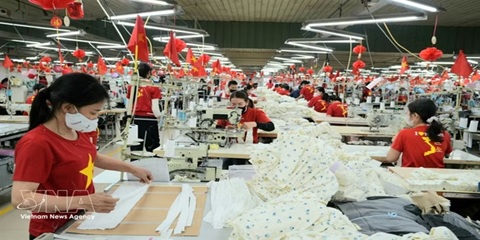
VIỆT NAM TARGETS $48 BILLION IN TEXTILE-GARMENT EXPORTS
Việt Nam’s textile and garment industry is facing both opportunities and challenges amid complex and unpredictable developments in the global market, prompting businesses to improve growth quality, optimise production costs and enhance adaptability in pursuit of an export turnover of about $48 billion this year. The target is considered an important milestone that requires concerted efforts from management agencies and the business community.

INFRASTRUCTURE / CONSTRUCTION / LOGISTIC / PORT
CUTTING LOGISTICS COSTS KEY TO BOOSTING EXPORTS
Reducing costs has become an increasingly urgent priority for import-export activities, particularly logistics costs, a conference in Hà Nội was told on Tuesday. According to Deputy General Director of the Ministry of Industry and Trade's Agency for Foreign Trade, Trần Thanh Hải, import-export activities has remained a bright spot for the economy in recent years, playing an important role and helping drive macroeconomic growth.

LEGAL UPDATE / POLICY
FLEXIBLE FISCAL POLICY HELPS DRIVE ECONOMIC GROWTH
Việt Nam’s fiscal policy has been implemented in a targeted expansionary manner since early 2026, helping maintain macroeconomic stability and supporting the country’s goal of achieving double-digit economic growth. According to the Ministry of Finance, State budget revenue in the first eight months of 2026 was estimated at VNĐ2.02 quadrillion (US$77.7 billion), equivalent to 80 per cent of the annual estimate and up 16 per cent year-on-year.
Events Sponsors






















