Want to be in the loop?
subscribe to
our notification
Business News
GOVERNMENT SETS MULTIPLE TARGETS IN LATEST FINANCIAL STRATEGY
Việt Nam will work to place its investment environment among the top three countries in ASEAN and among the top 30 economies worldwide by 2028.
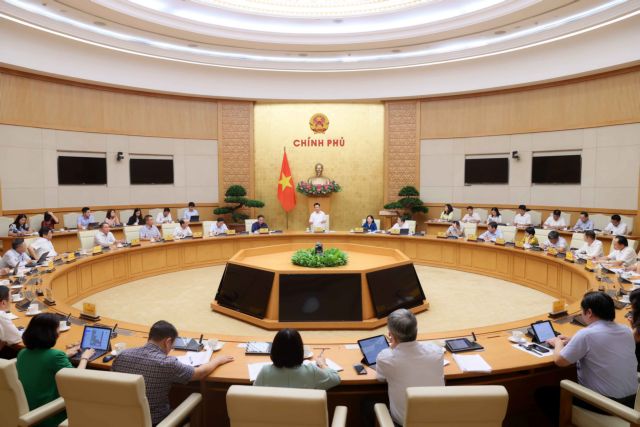
A Government meeting on restructuring capital for State-owned enterprises held on October 14, 2025. — VNA/VNS Photo An Đăng
HÀ NỘI — Việt Nam's Government aims to see 50 State-owned enterprises included among the 500 largest companies in Southeast Asia, and at least one listed among the 500 largest firms in the world by 2030.
These targets were set in Decision 1119/QĐ-TTg, which was recently signed by Deputy Prime Minister Nguyễn Văn Thắng.
The decision on the country's financial strategy through 2030 has also set objectives on promoting the socialisation of public services, streamlining organisational structures and retaining only units performing core political tasks and essential public services.
In addition, it outlines nearly two dozen steps to help achieve an average annual GDP growth rate of 10 per cent or higher for the 2026–2030 period.
The steps are as follows:
Develop and complete institutions and legislation suitable for establishing a new growth model, restructuring the economy and accelerating industrialisation and modernisation, with science, technology, innovation and digital transformation as the principal drivers.
Intensify administrative procedure reform, standardise and digitise all procedure-handling processes in a digital environment, ensure interoperability and data sharing among agencies and minimise the time and compliance costs for citizens and enterprises.
Work to place Việt Nam’s investment environment among the top three countries in ASEAN and among the top 30 economies worldwide by 2028.
Develop an effective State economy that plays a leading role in guiding development and ensuring macroeconomic stability, major balances and strategic orientation.
Reform the State economy with a focus on corporate governance of State-owned enterprises according to international standards, strengthening their efficiency and leading role in key sectors.
Vigorously implement an action programme for private sector development and support for small and medium-sized enterprises, while focusing on measures to improve private sector access to financial and credit resources.
Actively support and create a favourable environment for cooperative and collective economies, foreign-invested enterprises and other economic forms.
Complete mechanisms and policies to attract resources and the application of science and technology; develop the circular economy, green economy, organic agriculture, climate change adaptation and digital transformation; and expand markets for collective economy entities and cooperatives.
Renew policies to attract foreign direct investment by shifting from tax-based incentives towards other forms of preferential policies, applying post-approval and results-based incentives.
Enhance new economic models and push up dynamic regions, growth poles, economic corridors, economic and technology zones, free trade zones, international financial centres and national data centres.
Invest in high-speed rail and urban rail in Hà Nội and HCM City, as well as nuclear, solar and offshore wind power.
Pursue double-digit growth targets while controlling inflation and maintaining macroeconomic stability.
Build a modern, transparent tax system that both promotes growth and secures revenue for the State budget. Manage and use post-tax profits of State-owned enterprises effectively, to fulfil the objectives of developing the State economy without significantly affecting State budget revenues.
Manage and administer the State budget effectively and efficiently, ensuring the central budget’s leading role, improving revenue quality, broadening the tax base and enhancing the sustainability of national public finances.
Allocate State budget expenditure to implement national target programmes in an effective and feasible manner, avoiding duplication among them and with other initiatives, consistent with implementation schedules, disbursement capacity and a balanced State budget.
Promptly adopt measures to manage and regulate production and stabilise supply and demand; closely monitor and control prices of goods, especially essential goods; and manage the prices of goods under State management according to appropriate roadmaps to limit rising inflation expectations.
Strengthen statistical capacity and standardise statistical indicators and data, while enhancing the efficacy of domestic and international analysis and forecasting.
Improve the effectiveness of trade agreements and free trade agreements, commitments and cooperation agreements with international financial organisations and the financial regulatory authorities of partner countries.
Finally, use international preferential resources to support the green transition and greenhouse gas emissions reduction efforts, aiming for net zero emissions by 2050.
The decision takes effect from June 23 this year. — VNS
Source: VNS
Related News

INFRASTRUCTURE / CONSTRUCTION / LOGISTIC / PORT
VIỆT NAM-CAMBODIA TRADE GATHERS PACE TOWARDS $20 BILLION TARGET
Trade between Việt Nam and Cambodia continues to grow, remaining a bright spot and a key pillar of bilateral cooperation as the two countries aim to raise two-way trade to US$20 billion in the coming years. After setting a record of more than $11.3 billion last year, bilateral trade reached about $8.7 billion in the first eight months of this year, up 8.3 per cent year on year.
TECHNOLOGY
AI BEGINNING TO RESHAPE RECRUITMENT CRITERIA
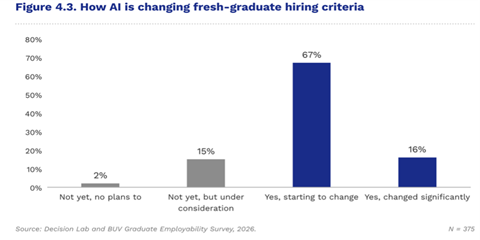
Digital literacy is the only capability area in which fresh graduates meet employers’ expectations, according to a new report. Yet, it is also the standard rising fastest, as businesses increasingly expect new hires to use AI effectively in the workplace. Some 83 per cent of employers say AI has changed, or is beginning to change, their hiring criteria, while 94 per cent report higher expectations for digital and AI capabilities than they had two to three years ago.

INFRASTRUCTURE / CONSTRUCTION / LOGISTIC / PORT
ĐÀ NẴNG GREEN-LIGHTS US$105 MILLION THAI DEVELOPMENT DEAL
The central city has approved an investment proposal by Thailand’s WHA Group to develop infrastructure for the 400ha WHA Đà Nẵng Industrial Park project on two communes of Thăng Bình and Đồng Dương, with an investment of more than VNĐ2.7 trillion (US$105 million). The city said it approved WHA Industrial Development International's status as an investor in the project, which is expected to take place between 2027 and 2034.

VIETNAM ECONOMY INVESTMENT
MOBILE PHONE EXPORTS RISE 20% TO $51.8 BILLION IN FIRST NINE MONTHS
Exports of mobile phones and components rose 20 per cent year-on-year to nearly US$51.8 billion in the first nine months of 2026, with China, the US and Republic of Korea accounting for more than half of the total. Shipments to the three markets reached a combined $26.18 billion, or 50.6 per cent of total exports of the product group during the period, according to data from the Vietnam Department of Customs under the Ministry of Finance.

VIETNAM ECONOMY INVESTMENT
FRUIT AND VEGETABLE EXPORTS POISED TO HIT $10 BILLION IN 2026
Fruit and vegetable exports are on track to reach nearly US$10 billion in 2026, after rising 19.9 per cent year on year to nearly US$7.4 billion in the first nine months, driven by strong seasonal demand and abundant tropical fruit supplies. The Ministry of Agriculture and Environment said the growth reflected stronger international demand for fresh produce and processed agricultural products.
GARMENT / TEXTILE
TEXTILE EXPORTS FACE DUAL CHALLENGES OF SUSTAINING ORDERS AND BOOSTING EFFICIENCY AMID GROWING COMPETITION
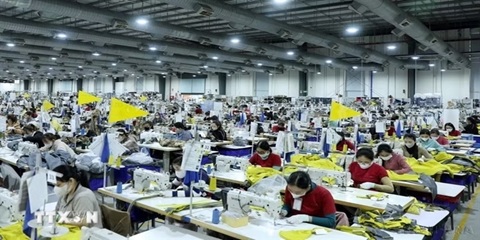
Data shows that the textile and garment sector maintained its growth momentum in the first nine months of this year. The industry's total export turnover reached an estimated US$35.721 billion in the first nine months of this year, up 3.3 per cent year-on-year. Despite posting encouraging export figures, Vietnamese textile and garment enterprises continue to navigate unpredictable market variables.
Events Sponsors






















