Want to be in the loop?
subscribe to
our notification
Business News
HÀ NỘI SEEKS NEW GENERATION OF FDI TO POWER TECH, INNOVATION-LED GROWTH
For decades, foreign direct investment has helped fuel Hà Nội's economic growth. Now the capital is raising its ambitions, shifting its focus towards technology-intensive, innovation-driven investment that can reshape its economy for the decades ahead.
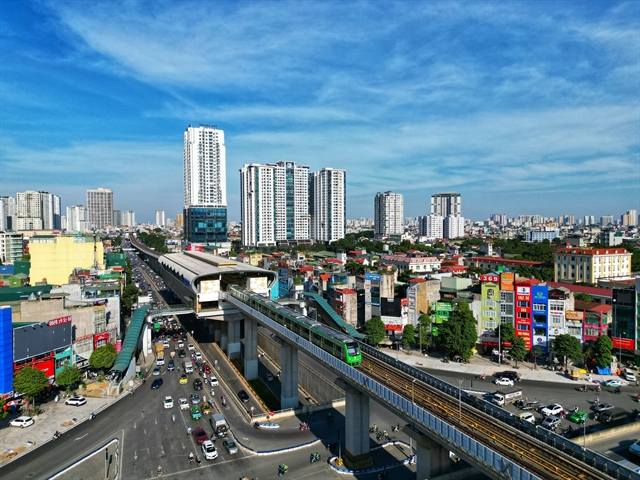
A view of Hà Nội. The capital is seeking to attract high-quality, technology-intensive foreign direct investment to drive growth. — VNA/VNS Photo Tuấn Anh
HÀ NỘI — After more than three decades as one of Việt Nam's leading destinations for foreign investment, Hà Nội is entering a new phase, shifting its focus from attracting capital in volume to drawing technology-intensive investment that can help transform the capital into a regional hub for research, innovation and high-tech industries.
Since opening to foreign investment in 1989, the city has attracted US$74.6 billion in foreign direct investment (FDI) across more than 9,200 projects, according to the Hà Nội Department of Finance.
But much of that capital has flowed into real estate, trade and services, and labour-intensive industries while investment in high-technology manufacturing, research and development (R&D) and technology transfer has remained relatively modest, according to Nguyễn Xuân Lưu, vice chairman of the municipal People’s Committee.
Links between foreign-invested companies and domestic businesses have remained weak with limited technology transfer, local procurement and value creation.
The city now wants to change that equation as it seeks to overhaul its growth model and meet its new development goals for 2030 and 2045.
Under a draft action plan to implement Resolution 10, issued by the Communist Party of Việt Nam on using FDI for economic development, Hà Nội aims for half of newly attracted FDI by 2030 to go into high technology, innovation, R&D and green industries while around 80 per cent of new FDI would come from developed economies.
The city also plans to raise localisation rates in key industries to at least 45 per cent, bring about 350 domestic companies into the value chains of foreign-invested enterprises and attract 10 multinational corporations to establish headquarters, regional operating centres or R&D facilities in the capital.
By 2045, Hà Nội wants its foreign-invested sector to be more deeply integrated with the state-owned and private domestic sectors and to contribute around 15 per cent of GRDP as it aims to position itself as an Asia-Pacific innovation hub.
Priorities will be given to strategic technologies including semiconductors, chip design, artificial intelligence (AI), big data, cloud computing, data centres, biotechnology, green technology, advanced materials and quantum technology, alongside international finance, smart logistics and R&D.
The goal is not simply to bring in more money but to use foreign capital as a lever to build domestic technological capabilities.
"Hà Nội is no longer pursuing FDI by quantity at all costs," Lê Trung Hiếu, deputy director of the Hà Nội Department of Finance, said.
“The goal is a new generation of FDI – cleaner, more technology-intensive and based on knowledge and innovation."
The shift comes as Hà Nội is seeking to sustain rapid economic growth with a target of average annual GRDP growth of more than 11 per cent during 2026-35 and an economy reaching around $200 billion by 2035 and $640 billion by 2045.
Changing focus
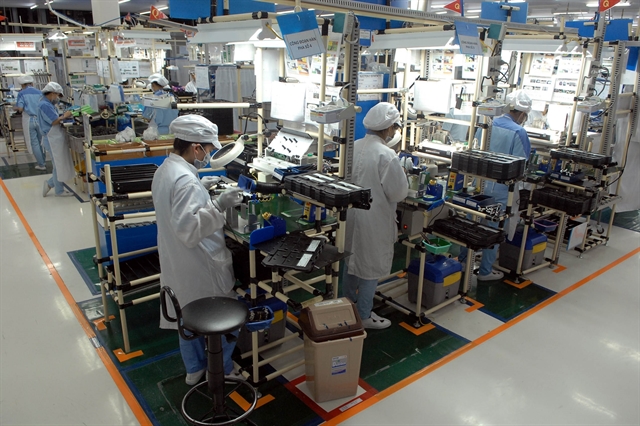
Production at Japan-invested Vietnam Stanley Electric Co Ltd in Hà Nội. A new generation of FDI is expected to help turn the digital economy, AI and semiconductors into new engines of growth. — VNA/VNS Photo Danh Lâm
There are already signs of a shift in the city's FDI structure.
Hiếu cited statistics showing that Hà Nội attracted about $3.16 billion in FDI in the first six months of 2026 with investment in professional services and science and technology accounting for about 72 per cent, suggesting that the city's capital flows are beginning to align more closely with its new priorities.
The city has set a target of attracting $25 billion in FDI during 2026-30, more than double the amount recorded in the previous five-year period.
The target is challenging because the capital needs to increase its share of the country's total FDI from the current 6.2 per cent to about 10 per cent while competing with neighbouring industrial hubs such as Hải Phòng, Bắc Ninh and Quảng Ninh, according to Hiếu.
However, the target is critical to achieving the city's goal of sustaining annual GRDP growth of more than 11 per cent. A new generation of FDI is needed to turn the digital economy, AI and semiconductors into new engines of growth.
"We are shifting firmly towards quality, with technological sophistication and the ability to forge links with domestic businesses becoming key criteria in selecting investors," he said.
Hiếu added that he expected Hà Nội's FDI landscape to undergo a fundamental transformation by 2030, moving away from a model centred on real estate and assembly towards one driven by knowledge and innovation.
The capital city is also changing the way it measures the success of FDI.
It plans to develop a Hanoi FDI Quality Index and a Hanoi FDI Dashboard to monitor foreign-invested projects against criteria including technology quality, innovation, technology transfer, workforce development, green transition and corporate social responsibility.
It also plans to establish a strategic FDI project list, create an investment map, develop criteria for new-generation industrial parks and strengthen its evaluation of the effectiveness of foreign investment.
"Success will not be measured by the size of registered investment capital," the city's vice chairman Lưu said.
"It will be measured by real changes in the quality of growth, innovation capacity, the emergence of new industries and technology, finance and R&D centres, the strengthening of Vietnamese businesses in global value chains and the quality of life of the capital's people."
Talent challenge
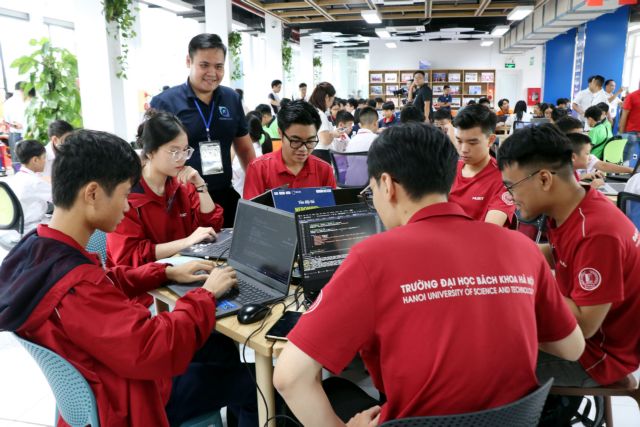
Students at Hanoi University of Science and Technology. Hà Nội is working to develop a high-quality workforce for emerging industries. — VNA/VNS Photo Nguyễn Lành
The city's ambitions, however, face a number of bottlenecks.
According to Hiếu, Hà Nội still faces problems in attracting high-quality FDI, particularly a shortage of technical infrastructure, including the availability of reliable, high-capacity electricity and digital infrastructure needed to support data centres.
Complicated land and construction procedures, high land costs and weak links between FDI companies and domestic businesses are also obstacles.
The problem, however, is not necessarily a lack of industrial land. Hà Nội has more than 7,600ha of industrial land, while the Hòa Lạc Hi-Tech Park alone has more than 700ha of cleared land available for investment.
The bigger challenge might be human capital, Hiếu said.
As Hà Nội moves towards high-tech FDI in semiconductors, AI and advanced technology, the city is facing a shortage of highly skilled workers who can immediately meet the standards of international technology companies.
“There is a shortage of high-quality human resources who can enter the workforce immediately," Hiếu said.
"The gap between domestic theoretical training and the demanding international standards of major corporations remains a major challenge that the city must bridge."
The Chairman of the municipal People’s Committee, Vũ Đại Thắng, said that the city had identified high-quality human resources as the foundation for attracting high-tech FDI and promoting innovation.
“International corporations are no longer looking only at market size, labour costs or investment incentives when choosing an investment destination. Increasingly, they are assessing the availability of skilled workers, research capacity and the strength of the local technology ecosystem,” he said.
As the country's political and administrative centre and home to a large concentration of universities, research institutes and science and technology organisations, Hà Nội has significant advantages in developing talent for emerging industries, especially with a budget of around VNĐ9 trillion ($343 million) a year allocated to science and technology,
The city plans to shift from training based primarily on the capacity of educational institutions towards training aligned with the needs of the future economy.
The city will promote cooperation among the government, universities, research institutes and businesses, creating closer links between training, research and practical applications.
FDI companies, technology businesses and major corporations will be encouraged to participate in designing training programmes, commissioning talent, providing internships and retraining workers.
Hà Nội will also focus on developing scientists, experts and strong research teams while creating a more favourable environment for attracting talent in Việt Nam and from abroad.
Special mechanisms provided under the 2026 Capital Law, which took effect on July 1, also offer stronger incentives to attract international experts, senior engineers and overseas Vietnamese professionals to lead core technology projects.
Beyond talent, Hà Nội is also strengthening administrative reforms, streamlining investment procedures and improving infrastructure to create a more predictable and competitive business environment for attracting new-generation FDI. — VNS
Source: VNS
Related News
MEMBER CORNER / PROMOTIONS
A CULINARY MASTERPIECE
Don't need a special occasion to treat yourself to a perfect Chinese dining experience. This October, Ngan Dinh Restaurant introduces an exquisite three-dish menu, promising to satisfy diners who appreciate culinary innovation and refined flavors. Enjoy 20% OFF a glass of house red/white wine, or Imported German Veltins Draught Beer/Maisel's Weisse Dunkel when ordering any of the above dishes!

MEMBER CORNER / PROMOTIONS
ONE YEAR OF PRIME MOMENTS — LET’S CELEBRATE!
Olivia’s Prime Saigon is turning one, and we’d love to celebrate this special milestone with you! Order any featured steak size and enjoy all its designated complimentary pasta, side dishes and sauces — with a combined value of up to 80% of your steak price! Thank you for being part of our journey. Here’s to great steaks, wonderful company, and many more prime moments together!
MEMBER CORNER / PROMOTIONS
SENTRYSAFE - PROTECT WHAT MATTERS MOST
From cash, important documents and records to valuable belongings, a quality safe gives you greater peace of mind against unexpected risks. SentrySafe - a trusted safe brand from the USA, suitable for homes, offices and various storage needs. Contact Sen Wai Vietnam for expert advice and to find the right safe for your needs.

MEMBER CORNER / PROMOTIONS
50% DISCOUNT FOR HKBAV MEMBER: EUGENE ONEGIN - EIFMAN BALLET OF ST. PETERSBURG WORLD TOUR 2026
Adapted from the classic novel in verse by acclaimed Russian poet Alexander Pushkin, Eugene Onegin explores timeless themes of love, pride, choices, and irreversible regret. Eifman's distinctive language of psychological ballet is brought to life through Tchaikovsky's music alongside contemporary rock by Alexander Sitkovetsky, creating an extraordinary artistic experience.

MEMBER CORNER / PROMOTIONS
COSMOPARK – ENERGY ADVANTAGES FOR POWER-INTENSIVE INDUSTRIES
As global corporations place increasing emphasis on energy security, renewable energy adoption, and carbon emissions reduction, electricity is no longer viewed merely as a component of technical infrastructure. For high-tech projects, data centers, and large-scale manufacturing facilities, reliable energy infrastructure has become a critical factor in investment location decisions.

VIETNAM ECONOMY INVESTMENT
FOREIGN INVESTORS TO BE WIDENED FOR MARKET ACCESS
Vietnam is moving to widen market access, improve investment incentives, and streamline procedures, with greater support tied to investors’ actual commitments and results, as part of the law on amending and supplementing a number of articles of the Law on Investment. The proposal was mentioned at the sixth session of the National Assembly Standing Committee in Hanoi on September 30, on amending the Law on Investment.
Events Sponsors






















