Want to be in the loop?
subscribe to
our notification
Business News
HALF LOCALITIES WILL CONVERT EXISTING INDUSTRIAL PARKS INTO ECOLOGICAL MODELS
Experts said that the eco-industrial park model is becoming an important trend in the overall industrial and economic development in Việt Nam.
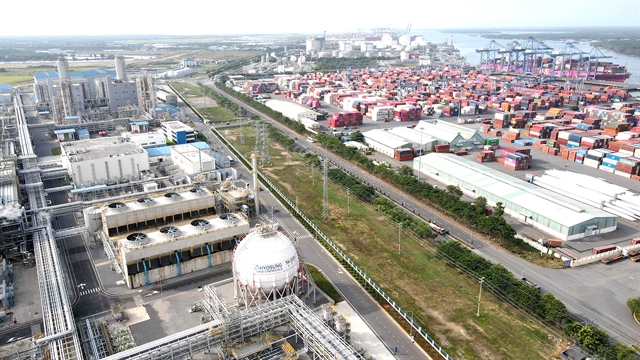
A view of Phú Mỹ 2 Industrial Park in Bà Rịa-Vũng Tàu Province. This industrial park has been converted to become the first eco-industrial park model in the province. VNA/VNS Photo
HÀ NỘI — About 40-50 per cent of localities in Việt Nam have plans to turn existing industrial parks into eco-industrial parks by 2030, and between 8 to 10 per cent of them will build new ecological parks.
The shift is coming, experts say, as part of an important trend in industrial and economic development in Việt Nam. The model not only brings financial benefits to businesses and the community, but also positively contributes to environmental protection and improves workers' quality of life.
The eco-industrial park is a special model in which businesses participate in production activities to create green products and optimise resource use. This industrial park model focuses on the connection and cooperation between businesses in the same industrial park to promote symbiotic production activities, ensuring sustainability and contributing to the sustainable development of the industrial sector as a whole.
In recent years, FDI capital in industrial parks and economic zones has accounted for about 35 – 40 per cent of the total additional registered FDI capital of the country.
A survey by Savills Vietnam shows that, although the number of eco-industrial parks currently is still limited, the demand for this type of real estate is set to grow substantially.
Senior Manager of the Industrial Real Estate Department of Savills Hanoi, Thomas Rooney said that most existing industrial park projects were developed according to traditional models and had not applied sustainable design solutions.
“The development of green industrial parks is currently in the early stages and will be a long-term story,” said Rooney.
According to experts, eco-industrial parks are also a tool to achieve sustainable development goals following three pillars - the economy, society and the environment. Sustainable development is increasingly becoming an overarching trend and green economic development and creating a circular economy are currently the development model chosen by many countries.
According to the Deputy Director of the Department of Economic Zones Management, Ministry of Planning and Investment, Vương Thị Minh Hiếu, said that the eco-industrial park model towards sustainable development has been implemented since the 1990s and achieved many positive results in countries such as Denmark, Korea, Japan and China.
In Việt Nam, green economic development and circular economy have received special attention from the Party and State, included in major and important policies. With the efforts and determination of the Government and the support of international organisations and experts, Việt Nam recently has piloted the conversion of many industrial parks from traditional models into eco-industrial parks by promoting cleaner production and linking cooperation in production to more effectively use resources.
Since 2014, the Ministry of Planning and Investment has coordinated with international organisations and cooperation from foreign partners to form and develop a sustainable eco-industrial park model on the three pillars. The ministry has coordinated with the United Nations Industrial Development Organization (UNIDO) to carry out the pilot implementation in three local areas, including Ninh Bình, Đà Nẵng and Cần Thơ.
From 2020 to 2024, with financial support from the Swiss Government, the Ministry of Planning and Investment continued to coordinate with UNIDO to expand eco-industrial park model and achieved encouraging results in three localities of Hải Phòng, Đồng Nai and HCM City.
Industrial park infrastructure investors also proposed many new eco-industrial park infrastructure investment projects from the beginning with stronger commitments to sustainable development strategies right from the planning stage, preparing documents to approach investment policies as well as orientation to attract secondary investors.
With 25 years of experience, IDICO is a pioneer in the journey of developing industrial park real estate in Việt Nam. To date, IDICO has invested in and operated a system of 12 industrial parks across the country with a total area of nearly 4,000 hectares, attracting more than 400 businesses, including major investors such as Suntory Pepsico, Fujiya, Hyosung and Messer.
Deputy General Director of IDICO Corporation Phan Văn Chính said that the company had proactively launched the journey to realise the goal of developing sustainable, modern and environmentally friendly industrial parks.
“IDICO has pioneered the transformation of the development model of industrial parks towards green and sustainable orientation, to become a typical model of ecologically oriented smart industrial parks in Việt Nam to meet the diverse and increasingly demanding needs of domestic and international businesses,” said Chính.
IDICO initially is converting from traditional industrial parks to green industrial parks in Phú Mỹ II Industrial Park and the expanded Phú Mỹ II, becoming the first eco-industrial park model in the area, according to Chính.
IDICO currently has been implementing many practical solutions, such as applying advanced technology to minimise the amount of waste and emissions into the environment and using a smart industrial park monitoring platform that allows for effective management and monitoring of energy use.
Kingspan, an investor from Ireland and also a strategic partner of IDICO in the expanded Phú Mỹ II Industrial Park, said that Kingspan Phú Mỹ recently completed the installation of a solar power system on the entire roof of the factory. The system is expected to help reduce more than 1,000 tonnes of CO2 per year, significantly contributing to the company’s on-site energy production target of 20 per cent.
The project is not only a Kingspan’s commitment to the environment but also demonstrates its sustainable companionship of businesses operating in IDICO's industrial park system.
Developing industrial parks following ecological models will not only help businesses here meet strict export standards but also create a sustainable production ecosystem, contributing to the goal of reducing emissions and moving towards net zero. — VNS
Source: VNS
Related News

INFRASTRUCTURE / CONSTRUCTION / LOGISTIC / PORT
VIỆT NAM-CAMBODIA TRADE GATHERS PACE TOWARDS $20 BILLION TARGET
Trade between Việt Nam and Cambodia continues to grow, remaining a bright spot and a key pillar of bilateral cooperation as the two countries aim to raise two-way trade to US$20 billion in the coming years. After setting a record of more than $11.3 billion last year, bilateral trade reached about $8.7 billion in the first eight months of this year, up 8.3 per cent year on year.

TECHNOLOGY
AI BEGINNING TO RESHAPE RECRUITMENT CRITERIA
Digital literacy is the only capability area in which fresh graduates meet employers’ expectations, according to a new report. Yet, it is also the standard rising fastest, as businesses increasingly expect new hires to use AI effectively in the workplace. Some 83 per cent of employers say AI has changed, or is beginning to change, their hiring criteria, while 94 per cent report higher expectations for digital and AI capabilities than they had two to three years ago.

INFRASTRUCTURE / CONSTRUCTION / LOGISTIC / PORT
ĐÀ NẴNG GREEN-LIGHTS US$105 MILLION THAI DEVELOPMENT DEAL
The central city has approved an investment proposal by Thailand’s WHA Group to develop infrastructure for the 400ha WHA Đà Nẵng Industrial Park project on two communes of Thăng Bình and Đồng Dương, with an investment of more than VNĐ2.7 trillion (US$105 million). The city said it approved WHA Industrial Development International's status as an investor in the project, which is expected to take place between 2027 and 2034.

VIETNAM ECONOMY INVESTMENT
MOBILE PHONE EXPORTS RISE 20% TO $51.8 BILLION IN FIRST NINE MONTHS
Exports of mobile phones and components rose 20 per cent year-on-year to nearly US$51.8 billion in the first nine months of 2026, with China, the US and Republic of Korea accounting for more than half of the total. Shipments to the three markets reached a combined $26.18 billion, or 50.6 per cent of total exports of the product group during the period, according to data from the Vietnam Department of Customs under the Ministry of Finance.

VIETNAM ECONOMY INVESTMENT
FRUIT AND VEGETABLE EXPORTS POISED TO HIT $10 BILLION IN 2026
Fruit and vegetable exports are on track to reach nearly US$10 billion in 2026, after rising 19.9 per cent year on year to nearly US$7.4 billion in the first nine months, driven by strong seasonal demand and abundant tropical fruit supplies. The Ministry of Agriculture and Environment said the growth reflected stronger international demand for fresh produce and processed agricultural products.

GARMENT / TEXTILE
TEXTILE EXPORTS FACE DUAL CHALLENGES OF SUSTAINING ORDERS AND BOOSTING EFFICIENCY AMID GROWING COMPETITION
Data shows that the textile and garment sector maintained its growth momentum in the first nine months of this year. The industry's total export turnover reached an estimated US$35.721 billion in the first nine months of this year, up 3.3 per cent year-on-year. Despite posting encouraging export figures, Vietnamese textile and garment enterprises continue to navigate unpredictable market variables.
Events Sponsors






















