Want to be in the loop?
subscribe to
our notification
Business News
MOST ANNOUNCES 21 KEY STRATEGIC TECHNOLOGY DEVELOPMENT PLANS
The Ministry of Science and Technology (MoST) announced a list on June 4 of 21 key strategic development plans on sci-tech, innovation, digital transformation to create opportunities for digital technology enterprises to take part in.
Decision No.1144/QD-BKHCN aims to enhance national competitiveness, boost digital transformation, innovation and develop advanced technologies. It also hopes to create a solid foundation for the country's sustainable development in the context of international integration.
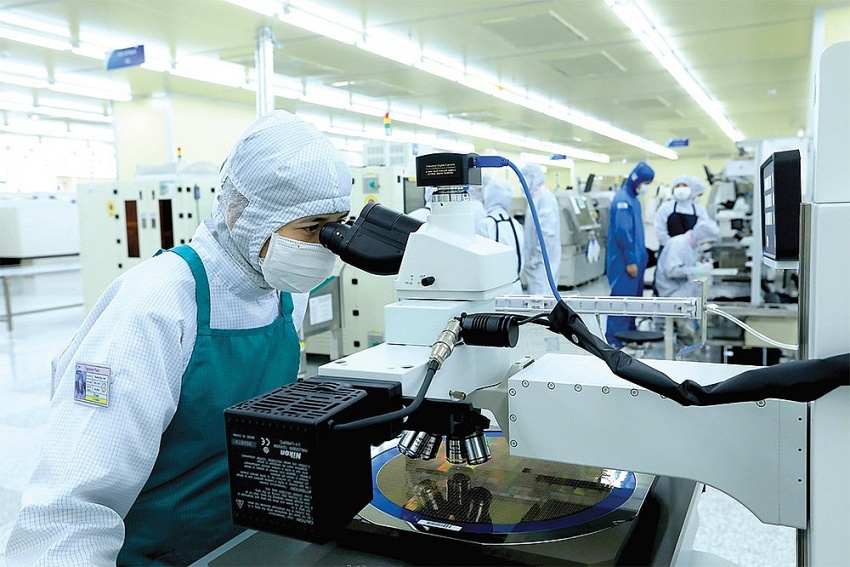
Photo: Le Toan
This is considered a key step of the ministry in its efforts to realise Resolution 57-NQ/TW of the Politburo on breakthroughs in science, technology, innovation and national digital transformation in the digital age.
The selected major issues focus on many important areas such as application of AI, Internet of Things (IoT), biotechnology and blockchain. In particular, they also include those on building a national biological data platform integrating AI, developing digital platforms and smart sensors for sustainable aquaculture, and researching and manufacturing advanced 5G equipment and 6G equipment.
The others focus on researching, manufacturing low-altitude satellites; developing Vietnamese-made AI models; building semiconductor chip manufacturing factories; building and deploying Vietnam's blockchain service network;and others.
These issues all originate from practical needs, having strategic implications for the country and with great potential for application in the future.
The decision clearly states that agencies and units under the ministry in charge of major issues actively coordinate, support Vietnamese digital technology enterprises to participate in effectively and practically.
"This is an open mechanism, demonstrating flexibility and high interaction between the state and enterprises. Enterprises are being provided with opportunities to contribute to the nation's development," according to one industry observer.
According to the MoST, science, technology, innovation and digital transformation are important driving forces helping Vietnam develop remarkably in the era of the fourth industrial revolution.
Developing strategic technology industries such as AI, biotechnology and renewable energy is not only important for Vietnam's sustainable development but also an opportunity for Vietnam to affirm its position on the global sci-tech map.
The list of 21 key strategic technology development plans
1. Building a national biological data platform integrating AI to serve research, development, and commercialisation of biotechnology products in Vietnam
2. Application of AI and IoT in animal health monitoring, disease tracing, and optimisation of livestock and veterinary chains in Vietnam
3. Developing digital platforms and smart sensors for sustainable aquaculture.
4. Building a national forest resources management and monitoring system based on digital platforms and remote sensing and AI technology.
5. Research on SNP Chip production, combining bioinformatics technology to enhance the economic value of crops, livestock and seafood through precision breeding.
6. Researching and developing AI and IoT digital platforms in long-term preservation technology for post-harvest agricultural products to stabilise the quality of agricultural products to meet export standards.
7. Research and development of biological additives and ecological concrete materials for coastal and island infrastructure projects, promoting sustainable development of marine ecosystems and contributing to the growth of the marine economy in Vietnam.
8. Developing smart equipment and systems for underground mining and strategic mineral processing, applying IoT, AI and clean technology, towards localisation and sustainable growth.
9. Building a comprehensive online management system for scientific and technological tasks funded by National Fund for sci-tech development in real time.
10. Researching and manufacturing advanced equipment, a core network ecosystem, and transmission network for 5G.
11. Researching and manufacturing 6G equipment.
12. Building a small-scale, high-tech semiconductor chip manufacturing plant for research, training, design, trial manufacturing, technology verification and production of specialised semiconductor chips in Vietnam.
13. Research and development of low-orbit satellites.
14. Building virtual assistants to support civil servants and public employees
15. Advancing domestic AI capabilities by developing homegrown models for language, image, sound, and data processing. This includes a large language model with at least 100 billion parameters, optimised for specialised domains like legal documents, finance, accounting, taxation, agriculture, and Vietnamese culture and history.
16. Developing city-scale digital twins and IoT systems featuring 3D maps of infrastructure, environment, transport, healthcare, industry and spatial data from underground to satellite levels.
17. Building an IoT connection and management platform to simulate, manage, monitor, and analyse data on maps to provide spatial management scenarios for digital transformation, green transformation, and smart cities.
18. Investing in an 80 MW cloud computing centre owned by Vietnam
19. Building and deploying a Vietnamese blockchain service network
20. Developing a 'blockchain as a service' platform to support businesses in applying blockchain to retrieve information on product and service management for production and business activities.
21. Building a system to exploit, analyse and industrial property map for national technology development and innovation
Source: VIR
Related News

MEMBER CORNER / PROMOTIONS
A CULINARY MASTERPIECE
Don't need a special occasion to treat yourself to a perfect Chinese dining experience. This October, Ngan Dinh Restaurant introduces an exquisite three-dish menu, promising to satisfy diners who appreciate culinary innovation and refined flavors. Enjoy 20% OFF a glass of house red/white wine, or Imported German Veltins Draught Beer/Maisel's Weisse Dunkel when ordering any of the above dishes!

MEMBER CORNER / PROMOTIONS
ONE YEAR OF PRIME MOMENTS — LET’S CELEBRATE!
Olivia’s Prime Saigon is turning one, and we’d love to celebrate this special milestone with you! Order any featured steak size and enjoy all its designated complimentary pasta, side dishes and sauces — with a combined value of up to 80% of your steak price! Thank you for being part of our journey. Here’s to great steaks, wonderful company, and many more prime moments together!
MEMBER CORNER / PROMOTIONS
SENTRYSAFE - PROTECT WHAT MATTERS MOST
From cash, important documents and records to valuable belongings, a quality safe gives you greater peace of mind against unexpected risks. SentrySafe - a trusted safe brand from the USA, suitable for homes, offices and various storage needs. Contact Sen Wai Vietnam for expert advice and to find the right safe for your needs.

MEMBER CORNER / PROMOTIONS
50% DISCOUNT FOR HKBAV MEMBER: EUGENE ONEGIN - EIFMAN BALLET OF ST. PETERSBURG WORLD TOUR 2026
Adapted from the classic novel in verse by acclaimed Russian poet Alexander Pushkin, Eugene Onegin explores timeless themes of love, pride, choices, and irreversible regret. Eifman's distinctive language of psychological ballet is brought to life through Tchaikovsky's music alongside contemporary rock by Alexander Sitkovetsky, creating an extraordinary artistic experience.
MEMBER CORNER / PROMOTIONS
COSMOPARK – ENERGY ADVANTAGES FOR POWER-INTENSIVE INDUSTRIES
As global corporations place increasing emphasis on energy security, renewable energy adoption, and carbon emissions reduction, electricity is no longer viewed merely as a component of technical infrastructure. For high-tech projects, data centers, and large-scale manufacturing facilities, reliable energy infrastructure has become a critical factor in investment location decisions.

VIETNAM ECONOMY INVESTMENT
FOREIGN INVESTORS TO BE WIDENED FOR MARKET ACCESS
Vietnam is moving to widen market access, improve investment incentives, and streamline procedures, with greater support tied to investors’ actual commitments and results, as part of the law on amending and supplementing a number of articles of the Law on Investment. The proposal was mentioned at the sixth session of the National Assembly Standing Committee in Hanoi on September 30, on amending the Law on Investment.
Events Sponsors






















