Want to be in the loop?
subscribe to
our notification
Business News
NEW R&D RULE COULD SPUR MILLIONS OF DOLLARS IN ADDITIONAL TECH INVESTMENT
If the proposed threshold is approved and takes effect, the five largest technology companies could add up to VNĐ7.6 trillion (US$291 million) in R&D funding annually.
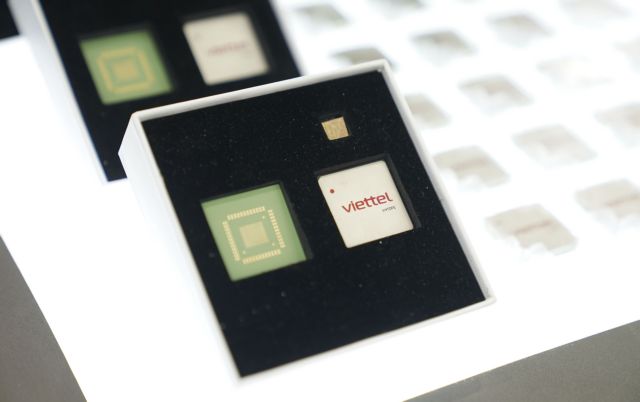
A 5G DFE chip developed by Viettel. Digital technology companies seeking to be seen as on par with firms in advanced economies could spend at least 3 per cent of their annual revenue on research and development. — VNA/VNS Photo
HÀ NỘI — Việt Nam’s proposed requirement that leading digital technology companies spend at least 3 per cent of their annual revenue on research and development (R&D) can help add hundreds of millions of dollars for innovation, as the country seeks to build globally competitive technology firms.
This is one of eight proposed criteria for Vietnamese digital technology companies seeking to be seen as on par with firms in advanced economies, according to a draft circular recently unveiled by the Ministry of Science and Technology for public comment.
Under the draft, qualifying companies would need annual revenue of at least US$1 billion, a workforce of at least 5,000, an established science and technology organisation, internationally recognised patents and R&D spending equivalent to at least 3 per cent of total revenue.
The proposed framework would make R&D spending a mandatory quantitative criterion for the first time.
According to the ministry, the 3 per cent threshold was selected after reviewing international experience and the current R&D spending of major Vietnamese technology companies.
Viettel, FPT and VNPT currently spend about 1 per cent of their revenue on R&D, while CMC spends around 2 per cent and MobiFone about 0.15 per cent, the ministry pointed out.
If the proposed threshold is approved and takes effect, the five largest technology companies could add up to VNĐ7.6 trillion ($291 million) in R&D funding annually. Viettel alone would need about VNĐ4.3 trillion more, followed by FPT with VNĐ1.3 trillion, VNPT with VNĐ1.2 trillion, MobiFone with VNĐ700 billion and CMC with VNĐ100 billion.
Việt Nam currently has nearly 80,000 digital technology companies with rising capital demand for R&D, not only for product development but also for research centres, laboratories, testing facilities and scientific and technological workers.
According to experts at Việt Nam National University Hà Nội, funding for R&D currently accounts for about 0.4-0.5 per cent of gross domestic product (GDP). The Ministry of Science and Technology is developing a plan to gradually raise total social investment in R&D to around 2 per cent of GDP in the next few years.
This means that businesses will need to substantially increase their R&D spending, particularly as companies seek to move deeper into technology value chains and commercialise research results. Such investments typically have long payback periods, but are crucial to building technological capabilities.
Vietnamese companies currently finance most R&D activities from their own resources, including retained earnings, operating cash flow and science and technology development funds.
FPT has for years allocated about 5 per cent of its previous year's pre-tax profit to R&D, while Viettel combines its science and technology development fund with retained profits to reinvest in core technologies, including 5G, semiconductors and artificial intelligence and defence technologies.
However, experts said relying solely on internal funding can place increasing pressure on companies as R&D needs grow, creating greater demand for bank credit and other financing channels.
The State Bank of Việt Nam has asked credit institutions to implement a VNĐ500 trillion credit programme for science and technology, innovation, digital transformation and strategic infrastructure, with the participation of 21 commercial banks offering interest rates 1-2 percentage points below normal levels to help businesses access capital.
The Ministry of Science and Technology has also proposed a pilot scheme to subsidise 50 per cent of loan interest costs through the National Technology Innovation Fund, with support capped at 6 per cent a year for five years. Banks would continue to assess and approve loans based on market principles.
Trần Văn Nhiên from Eximbank's legal and compliance department said further improvements to the legal framework for intangible assets are necessary to encourage banks to provide more funding for R&D projects.
While intellectual property rights are recognised by law as collateral, their value depends heavily on the commercial potential of technology and a company's capacity for innovation, he said.
Improving mechanisms for valuing, securing and handling intangible assets could therefore help channel more credit into R&D and broaden financing options for technology companies.
The proposed criteria are part of Việt Nam's broader efforts to build a stronger generation of globally competitive technology companies.
Under the Politburo’s Resolution 57-NQ-TW, the country aims to have at least five digital technology companies on par with those in advanced economies by 2030 and at least 10 by 2045.
At present, only Viettel and FPT have annual revenue exceeding $1 billion, according to the draft. — VNS
Source: VNS
Related News

MEMBER CORNER / PROMOTIONS
A CULINARY MASTERPIECE
Don't need a special occasion to treat yourself to a perfect Chinese dining experience. This October, Ngan Dinh Restaurant introduces an exquisite three-dish menu, promising to satisfy diners who appreciate culinary innovation and refined flavors. Enjoy 20% OFF a glass of house red/white wine, or Imported German Veltins Draught Beer/Maisel's Weisse Dunkel when ordering any of the above dishes!

MEMBER CORNER / PROMOTIONS
ONE YEAR OF PRIME MOMENTS — LET’S CELEBRATE!
Olivia’s Prime Saigon is turning one, and we’d love to celebrate this special milestone with you! Order any featured steak size and enjoy all its designated complimentary pasta, side dishes and sauces — with a combined value of up to 80% of your steak price! Thank you for being part of our journey. Here’s to great steaks, wonderful company, and many more prime moments together!

MEMBER CORNER / PROMOTIONS
SENTRYSAFE - PROTECT WHAT MATTERS MOST
From cash, important documents and records to valuable belongings, a quality safe gives you greater peace of mind against unexpected risks. SentrySafe - a trusted safe brand from the USA, suitable for homes, offices and various storage needs. Contact Sen Wai Vietnam for expert advice and to find the right safe for your needs.

MEMBER CORNER / PROMOTIONS
50% DISCOUNT FOR HKBAV MEMBER: EUGENE ONEGIN - EIFMAN BALLET OF ST. PETERSBURG WORLD TOUR 2026
Adapted from the classic novel in verse by acclaimed Russian poet Alexander Pushkin, Eugene Onegin explores timeless themes of love, pride, choices, and irreversible regret. Eifman's distinctive language of psychological ballet is brought to life through Tchaikovsky's music alongside contemporary rock by Alexander Sitkovetsky, creating an extraordinary artistic experience.

MEMBER CORNER / PROMOTIONS
COSMOPARK – ENERGY ADVANTAGES FOR POWER-INTENSIVE INDUSTRIES
As global corporations place increasing emphasis on energy security, renewable energy adoption, and carbon emissions reduction, electricity is no longer viewed merely as a component of technical infrastructure. For high-tech projects, data centers, and large-scale manufacturing facilities, reliable energy infrastructure has become a critical factor in investment location decisions.

VIETNAM ECONOMY INVESTMENT
FOREIGN INVESTORS TO BE WIDENED FOR MARKET ACCESS
Vietnam is moving to widen market access, improve investment incentives, and streamline procedures, with greater support tied to investors’ actual commitments and results, as part of the law on amending and supplementing a number of articles of the Law on Investment. The proposal was mentioned at the sixth session of the National Assembly Standing Committee in Hanoi on September 30, on amending the Law on Investment.
Events Sponsors






















