Want to be in the loop?
subscribe to
our notification
Business News
PRIVATE SECTOR TOUTED AS KEY DRIVER OF ECONOMIC GROWTH IN VIETNAM
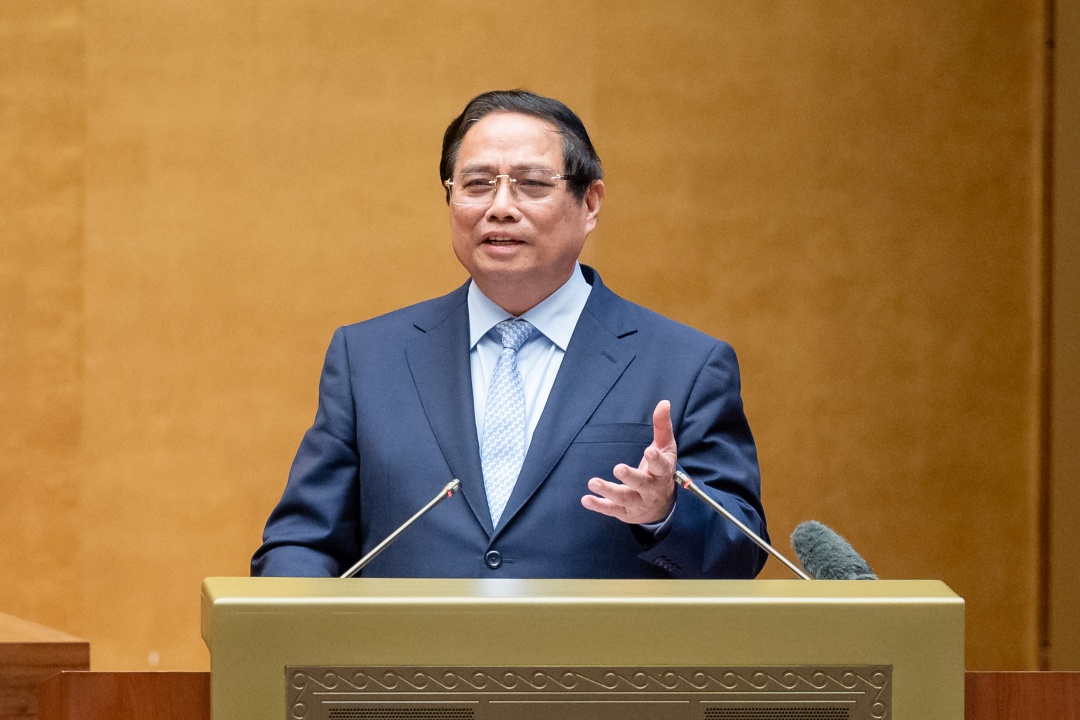
Vietnamese Prime Minister Pham Minh Chinh addresses a national conference on April 16, stressing the importance of science, technology, and innovation in shaping the country’s growth model - PHOTO: QUOCHOI.VN
HCMC – The private sector is seen as the most important engine of Vietnam’s economy in draft documents for the 14th National Congress of the Communist Party of Vietnam, according to Prime Minister Pham Minh Chinh.
Speaking at a national conference on April 16, Chinh highlighted updates in the draft political report, which lays out priorities for the country’s socio-economic development from 2026 to 2030.
A key focus is the continued development of a socialist-oriented market economy with the private sector, alongside the state and collective sectors, forming the core of an independent and self-reliant economy.
The report emphasizes transitioning to a new growth model driven by science, technology, innovation, and digital transformation. Policymakers aim to foster the digital economy, green economy, and circular economy while promoting entrepreneurship and the lawful accumulation of wealth.
Institutional reform is positioned as a foundation for future breakthroughs. The draft calls for improved lawmaking capacity, a more transparent and equitable legal environment, and expanded decentralization to give local governments more autonomy and responsibility. Strengthening governance and ensuring efficient allocation of resources are also key objectives.
In line with Resolution 57-NQ/TW, the Government plans to accelerate science and technology development, focusing on removing policy bottlenecks and aligning with international standards. Special incentives will be introduced to support innovation and digital transformation, especially in research and development.
On sustainability, the draft calls for integrated data systems to manage resources, protect the environment, and respond to climate change.
High-quality human resource development is another strategic priority, with plans to expand the startup ecosystem and attract talent. Building a capable leadership team across all levels of government is also emphasized.
Source: The Saigon Times
Related News

CHARITY / EXHIBITION / OTHER EVENTS
INVESTMENT OPPORTUNITIES IN CA MAU PROVINCE: 96 PROJECTS AND 20 STRATEGIC PROJECTS
We are pleased to share with you information on investment projects currently seeking investors in Ca Mau Province. Should your esteemed company or association be interested, we kindly invite you to review the project information and complete the registration form via the links provided. The Ho Chi Minh City Investment and Trade Promotion Centre (ITPC) will consolidate the expressions of interest and facilitate connections with the leadership of Ca Mau Province at a meeting tentatively scheduled for 13 November 2026 in Ho Chi Minh City.

MEMBER CORNER / PROMOTIONS
BẰNG KIỀU LIVESHOW - A SYMPHONY OF LOVE UNDER THE GOLDEN GLOW
A masterclass in live music that takes the audience on a soulful journey through immortal love songs, guided by the peerless artistry and emotive storytelling of renowned singer Bằng Kiều. The highlight of the night is his seamless musical chemistry with special guest Triệu Hồng Ngọc, promising passionate and deeply resonant duets inside the magnificent Grand Ballroom.

INFRASTRUCTURE / CONSTRUCTION / LOGISTIC / PORT
ĐÀ NẴNG GREEN-LIGHTS US$105 MILLION THAI DEVELOPMENT DEAL
The central city has approved an investment proposal by Thailand’s WHA Group to develop infrastructure for the 400ha WHA Đà Nẵng Industrial Park project on two communes of Thăng Bình and Đồng Dương, with an investment of more than VNĐ2.7 trillion (US$105 million). The city said it approved WHA Industrial Development International's status as an investor in the project, which is expected to take place between 2027 and 2034.

VIETNAM ECONOMY INVESTMENT
MOBILE PHONE EXPORTS RISE 20% TO $51.8 BILLION IN FIRST NINE MONTHS
Exports of mobile phones and components rose 20 per cent year-on-year to nearly US$51.8 billion in the first nine months of 2026, with China, the US and Republic of Korea accounting for more than half of the total. Shipments to the three markets reached a combined $26.18 billion, or 50.6 per cent of total exports of the product group during the period, according to data from the Vietnam Department of Customs under the Ministry of Finance.

INFRASTRUCTURE / CONSTRUCTION / LOGISTIC / PORT
VIỆT NAM-CAMBODIA TRADE GATHERS PACE TOWARDS $20 BILLION TARGET
Trade between Việt Nam and Cambodia continues to grow, remaining a bright spot and a key pillar of bilateral cooperation as the two countries aim to raise two-way trade to US$20 billion in the coming years. After setting a record of more than $11.3 billion last year, bilateral trade reached about $8.7 billion in the first eight months of this year, up 8.3 per cent year on year.

VIETNAM ECONOMY INVESTMENT
FRUIT AND VEGETABLE EXPORTS POISED TO HIT $10 BILLION IN 2026
Fruit and vegetable exports are on track to reach nearly US$10 billion in 2026, after rising 19.9 per cent year on year to nearly US$7.4 billion in the first nine months, driven by strong seasonal demand and abundant tropical fruit supplies. The Ministry of Agriculture and Environment said the growth reflected stronger international demand for fresh produce and processed agricultural products.
Events Sponsors






















