Want to be in the loop?
subscribe to
our notification
Business News
REACHING ECONOMIC TARGETS HINGES ON BALANCING GDP GROWTH AND INFLATION CONTROL
To maintain economic stability, the Deputy Prime Minister underscored the need for an uninterrupted supply of fuel, electricity, and essential goods.
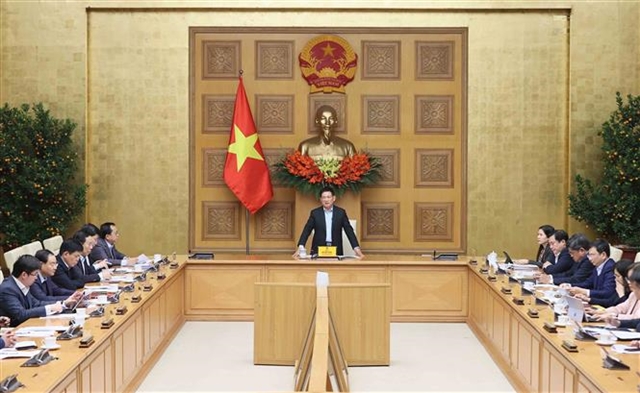
Deputy Prime Minister Hồ Đức Phớc at a meeting of the Price Management Steering Committee on February 6 in Hà Nội. — VNA/VNS Photo
HÀ NỘI — Việt Nam’s economic strategy for 2025 hinges on balancing robust GDP growth with stringent inflation controls, Deputy Prime Minister Hồ Đức Phớc said during a meeting of the Price Management Steering Committee on Thursday in Hà Nội.
Reviewing the economic performance of 2024 and outlining measures for the year ahead, the deputy PM reiterated the Government’s ambition to achieve at least 8 per cent GDP growth in 2025.
To curb inflationary pressures, the Ministry of Finance has put forward three inflation scenarios for 2025: inflation at 3.83 per cent, at 4.15 per cent and at 4.5 per cent. Phớc endorsed the mid-range target of 4.15 per cent, but urged a concerted effort to lower it further if possible. He directed ministries and relevant agencies to draft quarterly price management plans, which will be reviewed by the Ministry of Finance and the General Statistics Office.
Additionally, he emphasised the need for strict enforcement of the Price Law to prevent market manipulation, hoarding and price gouging. Transparency in pricing, he stressed, is key to maintaining consumer trust.
“Businesses must display and sell goods at listed prices. Whether prices are high or low is secondary; what matters is ensuring fair competition and consumer trust,” he said.
To maintain economic stability, the deputy PM underscored the need for an uninterrupted supply of fuel, electricity and essential goods. Any disruptions, he warned, could significantly impact production, trade and logistics. He called for proactive management of State-controlled commodities such as fuel, gold and land, advocating for timely interventions from the start of the year to mitigate market volatility.
Global market trends will also be closely monitored to allow for flexible policy adjustments. Coordination between monetary and fiscal policies will be strengthened, while stricter oversight on price disclosures and enforcement measures will be put in place to prevent violations.
Projections for 2025
Deputy Minister of Finance Lê Tấn Cận said Việt Nam’s average Consumer Price Index (CPI) in 2024 rose by 3.63 per cent, staying within Government targets. The primary contributors to inflation were food and dining services, which increased by 4.03 per cent and accounted for 1.35 per cent of the overall CPI rise; housing, utilities and construction materials, which grew by 5.2 per cent and contributed 0.98 per cent; and healthcare, which surged by 7.16 per cent, adding 0.39 per cent to inflation.
In January 2025, the CPI saw a month-on-month increase of 0.98 per cent and a year-on-year rise of 3.63 per cent, largely driven by adjustments in healthcare fees and rising food and transport costs.
Looking ahead, the Ministry of Finance has projected inflation rates of 3.83 per cent, 4.15 per cent or 4.5 per cent, while the General Statistics Office has forecast similar figures ranging between 3.8 per cent and 4.5 per cent. Meanwhile, the State Bank of Việt Nam has projected inflation to hover around 4 per cent, though it warned that exceeding the 4.5 per cent threshold remains a possibility should GDP growth surpass 8 per cent.
The Government plans to sustain reserves of essential goods and strategic stockpiles for disaster relief. Additionally, post-disaster agricultural recovery efforts will be expedited to prevent supply shortages. In line with broader economic reforms, State-managed services will gradually transition to market-based pricing to ensure sustainable fiscal policies while mitigating inflationary pressures. — VNS
Source: VNS
Related News

CHARITY / EXHIBITION / OTHER EVENTS
INVESTMENT OPPORTUNITIES IN CA MAU PROVINCE: 96 PROJECTS AND 20 STRATEGIC PROJECTS
We are pleased to share with you information on investment projects currently seeking investors in Ca Mau Province. Should your esteemed company or association be interested, we kindly invite you to review the project information and complete the registration form via the links provided. The Ho Chi Minh City Investment and Trade Promotion Centre (ITPC) will consolidate the expressions of interest and facilitate connections with the leadership of Ca Mau Province at a meeting tentatively scheduled for 13 November 2026 in Ho Chi Minh City.

MEMBER CORNER / PROMOTIONS
BẰNG KIỀU LIVESHOW - A SYMPHONY OF LOVE UNDER THE GOLDEN GLOW
A masterclass in live music that takes the audience on a soulful journey through immortal love songs, guided by the peerless artistry and emotive storytelling of renowned singer Bằng Kiều. The highlight of the night is his seamless musical chemistry with special guest Triệu Hồng Ngọc, promising passionate and deeply resonant duets inside the magnificent Grand Ballroom.

INFRASTRUCTURE / CONSTRUCTION / LOGISTIC / PORT
ĐÀ NẴNG GREEN-LIGHTS US$105 MILLION THAI DEVELOPMENT DEAL
The central city has approved an investment proposal by Thailand’s WHA Group to develop infrastructure for the 400ha WHA Đà Nẵng Industrial Park project on two communes of Thăng Bình and Đồng Dương, with an investment of more than VNĐ2.7 trillion (US$105 million). The city said it approved WHA Industrial Development International's status as an investor in the project, which is expected to take place between 2027 and 2034.

VIETNAM ECONOMY INVESTMENT
MOBILE PHONE EXPORTS RISE 20% TO $51.8 BILLION IN FIRST NINE MONTHS
Exports of mobile phones and components rose 20 per cent year-on-year to nearly US$51.8 billion in the first nine months of 2026, with China, the US and Republic of Korea accounting for more than half of the total. Shipments to the three markets reached a combined $26.18 billion, or 50.6 per cent of total exports of the product group during the period, according to data from the Vietnam Department of Customs under the Ministry of Finance.

INFRASTRUCTURE / CONSTRUCTION / LOGISTIC / PORT
VIỆT NAM-CAMBODIA TRADE GATHERS PACE TOWARDS $20 BILLION TARGET
Trade between Việt Nam and Cambodia continues to grow, remaining a bright spot and a key pillar of bilateral cooperation as the two countries aim to raise two-way trade to US$20 billion in the coming years. After setting a record of more than $11.3 billion last year, bilateral trade reached about $8.7 billion in the first eight months of this year, up 8.3 per cent year on year.

VIETNAM ECONOMY INVESTMENT
FRUIT AND VEGETABLE EXPORTS POISED TO HIT $10 BILLION IN 2026
Fruit and vegetable exports are on track to reach nearly US$10 billion in 2026, after rising 19.9 per cent year on year to nearly US$7.4 billion in the first nine months, driven by strong seasonal demand and abundant tropical fruit supplies. The Ministry of Agriculture and Environment said the growth reflected stronger international demand for fresh produce and processed agricultural products.
Events Sponsors






















