Want to be in the loop?
subscribe to
our notification
Business News
REAL ESTATE FIRMS AGGRESSIVELY RESTRUCTURING BOND DEBT
Real estate enterprises are facing significant debt maturities of nearly VNĐ59 trillion (US$2.3 billion) and a rapidly rising delinquency rate in the sector.
From the start of 2024 to July 5, the market saw 133 private placements and ten bond public offerings, totalling over VNĐ140 trillion. 65.6 per cent of this value was from the banking sector, while real estate bonds accounted for only 24.6 per cent, or over VNĐ34.5 trillion.
Real estate bond issuance activity picked up in June, with notable offerings from Vinhomes (VNĐ2.5 trillion), Becamex (VNĐ800 billion), Thiên Hà - Băng Dương Construction Investment Company (VNĐ600 billion) and Nam Long Group (VNĐ550 billion).
While real estate bond issuance value has recovered year-on-year, its proportion of total issuances has dropped sharply - from nearly 55 per cent in the first half of 2023 to just 25 per cent in the first half of 2024.
This is concerning, as real estate enterprises are facing significant debt maturities and a rapidly rising delinquency rate in the sector.
In the first week of July, nine companies announced delays in paying the principal and interest on their bonds, along with changes to the bond terms - primarily extending the maturity by 12-24 months. These companies were mostly from the real estate sector, including Novaland, Gia Đức Real Estate Company, Vĩnh Xuân Real Estate Company and Ngọc Minh Real Estate and Investment Company.
This followed a similar trend in June, when numerous real estate enterprises had announced delays in bond payments or requested to restructure their bonds.
In the latter half of 2024, it is estimated that around VNĐ140 trillion worth of bonds will mature, with the majority (nearly VNĐ59 trillion, accounting for 42 per cent) being real estate bonds. This group of real estate bonds is facing the highest debt repayment pressures.
Data from FiinGroup showed that as of May, the delinquency rate on bonds, including corporate bonds that have been restructured, or had their maturity extended, was close to 18 per cent.
For the non-bank corporate bond segment specifically, the rate was nearly 26 per cent. The total value of corporate bonds that are problematic was around VNĐ215 trillion.
The real estate sector has the largest share of delinquent bonds, with the delinquency rate as high as 42.5 per cent. However, encouragingly, in the first five months, the rate of problematic corporate bonds has been slowing compared to 2023.
High-interest loans
In the first half of this year, real estate companies have been actively raising funds by issuing bonds with average yields of 9-12 per cent per annum. These bond issuances have mainly involved large, reputable, real estate developers such as Vinhomes, Nam Long and Khang Điền.
For the high-risk group of real estate companies facing financial difficulties, the bond yields can reach as high as 20-30 per cent, or even up to 50 per cent. These high-yield bonds are typically associated with low-liquidity.
"Real estate companies have faced liquidity challenges since the second half of 2023. As a result, their corporate bonds are being traded with yields as high as 20-25 per cent. These high-yield bonds are typically issued by companies struggling with project execution," analysts from FiinGroup said.
"These companies will be under significant financial pressure over the next 12-18 months and face obstacles in refinancing or raising new capital. This reflects the risk appetite of investors purchasing these high-yield bonds."
The willingness to raise funds through high-interest bonds also suggests these companies are finding it difficult to access bank credit, especially without sufficient collateral or debt repayment capability.
Nevertheless, Nguyễn Đình Duy, a senior analyst at the Vietnam Investor Service (VIS Rating), believes real estate firms will find it easier to access capital in the second half of 2024.
New real estate laws effective August 1, 2024 will help investors resolve land valuation and usage issues, allowing them to secure financing for new projects.
Bond issuances are expected to recover, and real estate lending is forecast to grow 16-18 per cent in 2024. Many listed developers also plan to raise around VNĐ26 trillionin new equity this year.
Duy said that these factors will help alleviate liquidity challenges for investors facing heavy debt maturities in 2024-2025.
Source: VNS
Related News

INFRASTRUCTURE / CONSTRUCTION / LOGISTIC / PORT
VIỆT NAM-CAMBODIA TRADE GATHERS PACE TOWARDS $20 BILLION TARGET
Trade between Việt Nam and Cambodia continues to grow, remaining a bright spot and a key pillar of bilateral cooperation as the two countries aim to raise two-way trade to US$20 billion in the coming years. After setting a record of more than $11.3 billion last year, bilateral trade reached about $8.7 billion in the first eight months of this year, up 8.3 per cent year on year.
TECHNOLOGY
AI BEGINNING TO RESHAPE RECRUITMENT CRITERIA
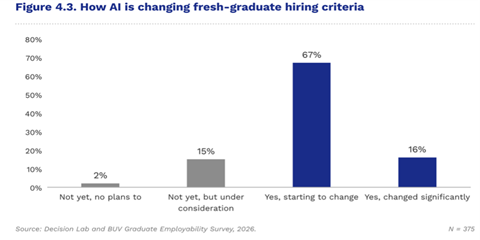
Digital literacy is the only capability area in which fresh graduates meet employers’ expectations, according to a new report. Yet, it is also the standard rising fastest, as businesses increasingly expect new hires to use AI effectively in the workplace. Some 83 per cent of employers say AI has changed, or is beginning to change, their hiring criteria, while 94 per cent report higher expectations for digital and AI capabilities than they had two to three years ago.

INFRASTRUCTURE / CONSTRUCTION / LOGISTIC / PORT
ĐÀ NẴNG GREEN-LIGHTS US$105 MILLION THAI DEVELOPMENT DEAL
The central city has approved an investment proposal by Thailand’s WHA Group to develop infrastructure for the 400ha WHA Đà Nẵng Industrial Park project on two communes of Thăng Bình and Đồng Dương, with an investment of more than VNĐ2.7 trillion (US$105 million). The city said it approved WHA Industrial Development International's status as an investor in the project, which is expected to take place between 2027 and 2034.

VIETNAM ECONOMY INVESTMENT
MOBILE PHONE EXPORTS RISE 20% TO $51.8 BILLION IN FIRST NINE MONTHS
Exports of mobile phones and components rose 20 per cent year-on-year to nearly US$51.8 billion in the first nine months of 2026, with China, the US and Republic of Korea accounting for more than half of the total. Shipments to the three markets reached a combined $26.18 billion, or 50.6 per cent of total exports of the product group during the period, according to data from the Vietnam Department of Customs under the Ministry of Finance.

VIETNAM ECONOMY INVESTMENT
FRUIT AND VEGETABLE EXPORTS POISED TO HIT $10 BILLION IN 2026
Fruit and vegetable exports are on track to reach nearly US$10 billion in 2026, after rising 19.9 per cent year on year to nearly US$7.4 billion in the first nine months, driven by strong seasonal demand and abundant tropical fruit supplies. The Ministry of Agriculture and Environment said the growth reflected stronger international demand for fresh produce and processed agricultural products.

GARMENT / TEXTILE
TEXTILE EXPORTS FACE DUAL CHALLENGES OF SUSTAINING ORDERS AND BOOSTING EFFICIENCY AMID GROWING COMPETITION
Data shows that the textile and garment sector maintained its growth momentum in the first nine months of this year. The industry's total export turnover reached an estimated US$35.721 billion in the first nine months of this year, up 3.3 per cent year-on-year. Despite posting encouraging export figures, Vietnamese textile and garment enterprises continue to navigate unpredictable market variables.
Events Sponsors






















