Want to be in the loop?
subscribe to
our notification
Business News
RICE EXPORTS EXPECTED TO REACH 7.73 MILLION TONNES IN 2026
The total output this year is expected to be slightly higher than in 2025, at around 45.6 million tonnes, thanks to higher average yields of 6.14 tonnes per hectare.
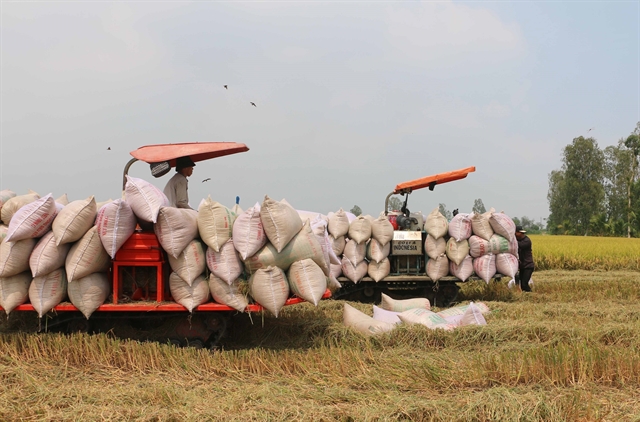
Farmers harvest rice in An Giang Province. Việt Nam could export an estimated volume of 7.73 million tonnes of rice in 2026. — VNA/VNS Photo Công Mạo
HÀ NỘI — Việt Nam could export an estimated volume of 7.73 million tonnes of rice in 2026, with the bulk of supply coming from the Cửu Long (Mekong) Delta, according to the Ministry of Agriculture and Environment.
In a recent document sent to the Ministry of Industry and Trade as basis for managing rice exports in 2026, the ministry pointed out that the total rice planting area nationwide dropped by around 36,100ha to 7.09 million ha last year.
However, the total output of raw unhusked rice (paddy) this year is expected to be slightly higher than in 2025, at around 45.6 million tonnes, thanks to higher average yields of 6.14 tonnes per hectare.
The Mekong Delta will continue to play an important role in export supply, with rice-growing areas in the region and parts of Tây Ninh Province estimated at about 3.84 million ha and a yield of around 24.34 million tonnes of paddy.
There will be an estimated 15.46 million tonnes of marketable paddy in 2026, equivalent to around 7.73 million tonnes of rice, available for export, the ministry said.
High-quality and fragrant rice exports are expected to add up to around 5.8 million tonnes, or 75 per cent of export volume. Glutinous rice exports are projected at around 773,000 tonnes, or 10 per cent, with the remaining 15 per cent used mainly for processing.
Rice exports in the first half of 2026 are forecast to reach about four million tonnes, concentrated in January, March and April, while shipments in the second half are expected to hit around 3.7 million tonnes, peaking in July, August and September, in line with major harvest periods, the ministry said.
The ministry called for stricter inventory reporting and the development of digital monitoring and early warning tools to manage supply and demand risks and support flexible export management, while safeguarding food security.
Rice exporters are urged to be ready to supply the domestic market when required for price stabilisation. Trade promotion, market and product diversification and digital transformation in management should also be stepped up, according to the ministry.
Closer coordination with local authorities to standardise rice procurement, strengthen supply chain links through transparent contracts, require exporters to publicise prices and prevent price manipulation and hoarding is also needed.
Customs statistics show that Việt Nam exported 8.06 million tonnes of rice worth US$$4.1 billion in 2025, down 10.8 per cent in volume and 27.6 per cent in value from 2024. — VNS
Source: VNS
Related News

INFRASTRUCTURE / CONSTRUCTION / LOGISTIC / PORT
VIỆT NAM-CAMBODIA TRADE GATHERS PACE TOWARDS $20 BILLION TARGET
Trade between Việt Nam and Cambodia continues to grow, remaining a bright spot and a key pillar of bilateral cooperation as the two countries aim to raise two-way trade to US$20 billion in the coming years. After setting a record of more than $11.3 billion last year, bilateral trade reached about $8.7 billion in the first eight months of this year, up 8.3 per cent year on year.
TECHNOLOGY
AI BEGINNING TO RESHAPE RECRUITMENT CRITERIA
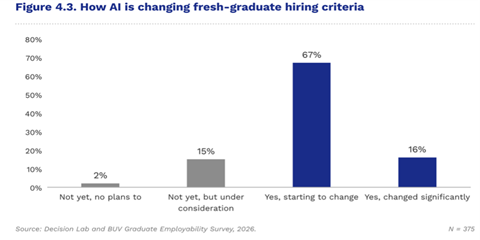
Digital literacy is the only capability area in which fresh graduates meet employers’ expectations, according to a new report. Yet, it is also the standard rising fastest, as businesses increasingly expect new hires to use AI effectively in the workplace. Some 83 per cent of employers say AI has changed, or is beginning to change, their hiring criteria, while 94 per cent report higher expectations for digital and AI capabilities than they had two to three years ago.

INFRASTRUCTURE / CONSTRUCTION / LOGISTIC / PORT
ĐÀ NẴNG GREEN-LIGHTS US$105 MILLION THAI DEVELOPMENT DEAL
The central city has approved an investment proposal by Thailand’s WHA Group to develop infrastructure for the 400ha WHA Đà Nẵng Industrial Park project on two communes of Thăng Bình and Đồng Dương, with an investment of more than VNĐ2.7 trillion (US$105 million). The city said it approved WHA Industrial Development International's status as an investor in the project, which is expected to take place between 2027 and 2034.

VIETNAM ECONOMY INVESTMENT
MOBILE PHONE EXPORTS RISE 20% TO $51.8 BILLION IN FIRST NINE MONTHS
Exports of mobile phones and components rose 20 per cent year-on-year to nearly US$51.8 billion in the first nine months of 2026, with China, the US and Republic of Korea accounting for more than half of the total. Shipments to the three markets reached a combined $26.18 billion, or 50.6 per cent of total exports of the product group during the period, according to data from the Vietnam Department of Customs under the Ministry of Finance.

VIETNAM ECONOMY INVESTMENT
FRUIT AND VEGETABLE EXPORTS POISED TO HIT $10 BILLION IN 2026
Fruit and vegetable exports are on track to reach nearly US$10 billion in 2026, after rising 19.9 per cent year on year to nearly US$7.4 billion in the first nine months, driven by strong seasonal demand and abundant tropical fruit supplies. The Ministry of Agriculture and Environment said the growth reflected stronger international demand for fresh produce and processed agricultural products.
GARMENT / TEXTILE
TEXTILE EXPORTS FACE DUAL CHALLENGES OF SUSTAINING ORDERS AND BOOSTING EFFICIENCY AMID GROWING COMPETITION
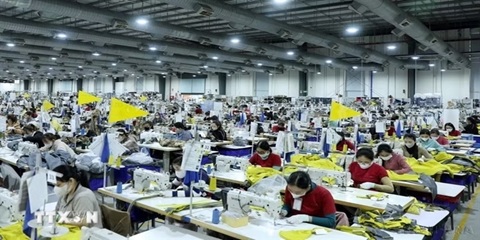
Data shows that the textile and garment sector maintained its growth momentum in the first nine months of this year. The industry's total export turnover reached an estimated US$35.721 billion in the first nine months of this year, up 3.3 per cent year-on-year. Despite posting encouraging export figures, Vietnamese textile and garment enterprises continue to navigate unpredictable market variables.
Events Sponsors






















