Want to be in the loop?
subscribe to
our notification
Business News
RISE IN EXPORTS HELPS BOLSTER ECONOMIC GROWTH
Due to the recovery of production and export activities, businesses have stepped up the import of raw materials to serve the production of export orders.
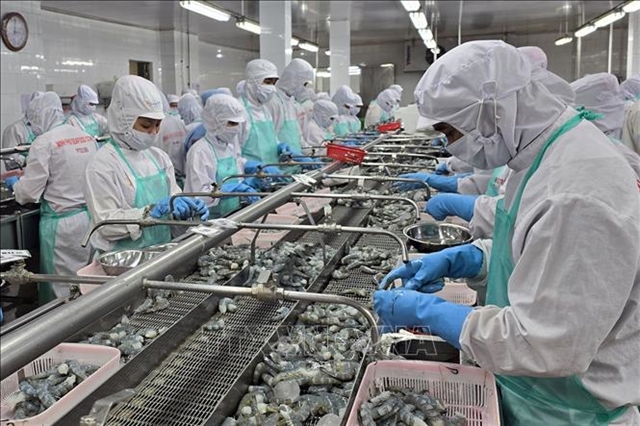
Processing frozen shrimp for export at Minh Phú Company in Cà Mau Province. — VNA/VNS Photo
HÀ NỘI — The country is showing very positive economic signs after achieving an estimated export turnover of US$261.8 billion by the end of last month, marking growth of 14.6 per cent over the same period last year and exceeding set targets.
Nguyễn Anh Sơn, director of the Agency of Foreign Trade (AFT) under the Ministry of Industry and Trade, provided the export data estimates, going on to note that average monthly export turnover thus far this year reached $37.4 billion, with both May and June surpassing $39.5 billion.
In July alone, exports were expected to reach new heights of more than $41.6 billion.
Meanwhile, the import turnover of goods in the past seven months was estimated at $252.1 billion, up 17.9 per cent over the same period last year.
Due to the recovery of production and export activities, businesses had stepped up the import of raw materials to serve the production of export orders.
The trade balance over the past seven months was estimated at a surplus of $9.7 billion. This figure was 23 per cent lower than the $12.6 billion recorded in the same period last year.
However, a moderate trade surplus could increase foreign exchange reserves, stabilise monetary policy and contribute to sustainable import and export development in the medium and long term, said Sơn.
Việt Nam faces many challenges from increasingly fierce strategic competition and trade conflicts between major countries over the past several months, causing cracks and breaks in the global production and supply chain, say experts.
A growing trend of trade protectionism, along with technical standards and climate-related regulations, has created several non-tariff barriers for imported goods.
This has had a direct and adverse impact on many countries, particularly those with high economic openness like Việt Nam, say experts.
To boost imports and exports, Minister of Industry and Trade Nguyễn Hồng Diên has urged the ministry’s functional units to enhance their consultation efforts, refine mechanisms and policies, and improve decrees and circulars to effectively internalise international commitments under the FTAs that Việt Nam has signed.
It is also crucial to strengthen the connection that has helped domestic enterprises integrate into the production and supply chains of FDI companies and large global corporations, thereby creating a market for industrial development, according to the minister.
Particularly essential is enhancing market information dissemination and ensuring the timely provision of market demand data, regulations and new policies from local markets, as well as offering policy consultations to enterprises, associations and import-export sectors.
There should also be continued innovation and improvement in trade promotion effectiveness to help accelerate the development of e-commerce, especially cross-border e-commerce, expand supply chains and facilitate the circulation of goods.
At the same time, efforts must be made to speed up negotiations on upgrading existing FTAs and signing new deals with potential partners to diversify products, supply chains and export markets.
Additionally, strengthening trade defence capabilities, enhancing early warning systems for potential lawsuits in foreign markets and providing guidance to enterprises and associations on how to respond promptly and effectively to trade disputes are needed to protect the legitimate interests of Vietnamese businesses in international trade.
Diên urged ministries, sectors and localities to continue coordinating efforts to remove obstacles and create favourable conditions to help boost production and exports.
Active negotiations should also be pursued to further open export markets for Vietnamese goods, especially agricultural and seafood products, the minister added.
At the same time, solutions and policies should be implemented to direct credit towards business production, prioritise export and import activities and facilitate enterprises' access to credit for production and export purposes.
For export-import enterprises, associations and sectors must closely monitor the market and respond flexibly to market demands in order to organise appropriate and efficient production and export plans.
They should also strengthen official export activities linked to product branding as well as cooperate with relevant departments to receive up-to-date information on market demands, regulations and new policies from foreign markets, along with providing skills training to more easily access target markets.
“In the context of a world economy full of volatility, each container of Vietnamese export goods carries not only commercial value, but also the identity, prestige and aspirations of a nation that is transforming rapidly and confidently stepping into an era of deeper integration,” said the minister. — VNS
Source: VNS
Related News

MEMBER CORNER / PROMOTIONS
BẰNG KIỀU LIVESHOW - A SYMPHONY OF LOVE UNDER THE GOLDEN GLOW
A masterclass in live music that takes the audience on a soulful journey through immortal love songs, guided by the peerless artistry and emotive storytelling of renowned singer Bằng Kiều. The highlight of the night is his seamless musical chemistry with special guest Triệu Hồng Ngọc, promising passionate and deeply resonant duets inside the magnificent Grand Ballroom.

INFRASTRUCTURE / CONSTRUCTION / LOGISTIC / PORT
ĐÀ NẴNG GREEN-LIGHTS US$105 MILLION THAI DEVELOPMENT DEAL
The central city has approved an investment proposal by Thailand’s WHA Group to develop infrastructure for the 400ha WHA Đà Nẵng Industrial Park project on two communes of Thăng Bình and Đồng Dương, with an investment of more than VNĐ2.7 trillion (US$105 million). The city said it approved WHA Industrial Development International's status as an investor in the project, which is expected to take place between 2027 and 2034.

VIETNAM ECONOMY INVESTMENT
MOBILE PHONE EXPORTS RISE 20% TO $51.8 BILLION IN FIRST NINE MONTHS
Exports of mobile phones and components rose 20 per cent year-on-year to nearly US$51.8 billion in the first nine months of 2026, with China, the US and Republic of Korea accounting for more than half of the total. Shipments to the three markets reached a combined $26.18 billion, or 50.6 per cent of total exports of the product group during the period, according to data from the Vietnam Department of Customs under the Ministry of Finance.

INFRASTRUCTURE / CONSTRUCTION / LOGISTIC / PORT
VIỆT NAM-CAMBODIA TRADE GATHERS PACE TOWARDS $20 BILLION TARGET
Trade between Việt Nam and Cambodia continues to grow, remaining a bright spot and a key pillar of bilateral cooperation as the two countries aim to raise two-way trade to US$20 billion in the coming years. After setting a record of more than $11.3 billion last year, bilateral trade reached about $8.7 billion in the first eight months of this year, up 8.3 per cent year on year.

VIETNAM ECONOMY INVESTMENT
FRUIT AND VEGETABLE EXPORTS POISED TO HIT $10 BILLION IN 2026
Fruit and vegetable exports are on track to reach nearly US$10 billion in 2026, after rising 19.9 per cent year on year to nearly US$7.4 billion in the first nine months, driven by strong seasonal demand and abundant tropical fruit supplies. The Ministry of Agriculture and Environment said the growth reflected stronger international demand for fresh produce and processed agricultural products.
GARMENT / TEXTILE
TEXTILE EXPORTS FACE DUAL CHALLENGES OF SUSTAINING ORDERS AND BOOSTING EFFICIENCY AMID GROWING COMPETITION
Data shows that the textile and garment sector maintained its growth momentum in the first nine months of this year. The industry's total export turnover reached an estimated US$35.721 billion in the first nine months of this year, up 3.3 per cent year-on-year. Despite posting encouraging export figures, Vietnamese textile and garment enterprises continue to navigate unpredictable market variables.
Events Sponsors






















