Want to be in the loop?
subscribe to
our notification
Business News
SEAFOOD EXPORTS RISE SHARPLY IN FIRST FIVE MONTHS
According to the Việt Nam Association of Seafood Exporters and Producers (VASEP), seafood exports to China surged by 57 per cent year-on-year, reaching US$716 million. As of the first four months of 2025, China overtook the US to become Việt Nam’s largest seafood export market.
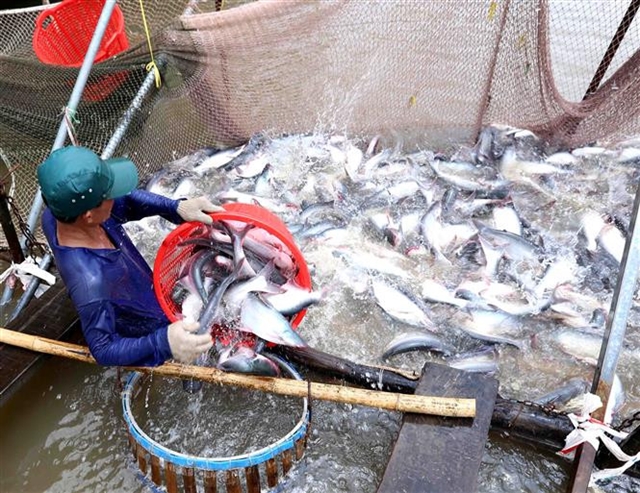
A fish farm in Cần Thơ Province. VNA/VNS Photo
HÀ NỘI - Việt Nam’s seafood export revenue reached US$4.07 billion in the first five months of 2025, marking a 14 per cent increase compared to last year.
China, the United States and Japan remained the country’s top three seafood export markets, accounting for 20 per cent, 16 per cent, and 15 per cent of total exports, respectively.
Shrimp and tra fish continued to be the country’s key exports.
The European Union emerged as a strong market, with imports of whiteleg shrimp, including frozen and value-added processed products, reaching 376,875 tonnes in 2024, up four per cent from 2023.
Việt Nam has seen a partial recovery in shipments to the EU. However, intense competition from Ecuador and India poses a significant challenge, prompting the country to focus on high-value products and market diversification to maintain its advantage and avoid disruptions.
According to the Việt Nam Association of Seafood Exporters and Producers (VASEP), seafood exports to China surged by 57 per cent year-on-year, reaching US$716 million. As of the first four months of 2025, China overtook the US to become Việt Nam’s largest seafood export market.
VASEP experts pointed out that climate change, water pollution and disease outbreaks are affecting the yield and quality of shrimp production. In addition, the global seafood market is becoming increasingly competitive, with strong players like Ecuador, India and Indonesia. As a result, Việt Nam’s seafood sector must improve output and quality to expand its presence in potential markets.
VASEP’s Communications Director, Lê Hằng, noted that exports to the US may see strong growth. She advised businesses to factor in rising transportation and logistics costs to reduce risks. In the meantime, exporters and US importers are urged to step up trade activities.
Diversification is key
Trình Trung Phi, Deputy Technical Director of commercial shrimp operations at Việt Úc Group, said that high production costs of Vietnamese seafood result from multilayered production processes. At the same time, international standards require not only lower prices but also socially responsible production. This presents a considerable challenge for the industry.
Economic experts have emphasised the need for the Government and businesses to invest in logistics infrastructure, technology, product diversification, and sustainable supply chains. These measures would help reduce costs and enhance profitability.
VASEP has proposed a series of initiatives for the tra fish segment, which must adapt to evolving global consumption trends. Previously overlooked niche markets are now being explored as potential targets.
“Enterprises should not limit themselves to producing frozen fillets. They need to diversify into value-added products such as fish balls, sausages, seasoned tra fish, canned braised fish, fish rolls and tra sushi to meet the growing demand for ready-to-eat and convenience foods, particularly in Asian urban centres like Japan, South Korea, Singapore and Malaysia,” VASEP said.
“Additionally, by-products, such as crispy fish skin, fish oil, collagen, gelatin and animal feed, are emerging as new trends.”
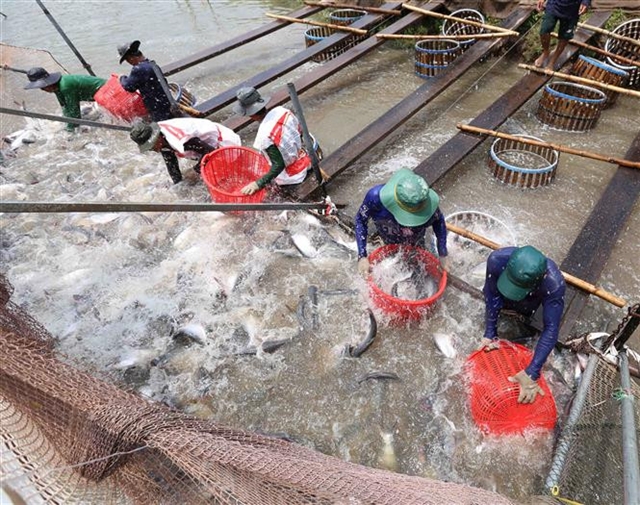
Farmers harvesting fish in Cần Thơ Province. VNA/VNS Photo
According to VASEP, consumers in the EU and North America are increasingly prioritising certified, eco-friendly and sustainable products. Tra fish raised under organic standards or certified by ASC, BAP, GlobalG.A.P, or RAS (Recirculating Aquaculture Systems) can command prices up to double those of conventional products.
VASEP also identified promising niche markets, including Islamic countries, Africa, and South America (excluding Brazil). Việt Nam has made initial inroads into the Brazilian market with tra fish exports, although the South American market remains largely untapped.
These regions offer favourable conditions for seafood consumption due to local tastes and demand for convenient food. Negotiations on a potential FTA between Việt Nam and the Mercosur bloc are expected to unlock export opportunities.
Deputy Minister of Agriculture and Rural Development Phùng Đức Tiến stressed that market diversification is not just an immediate necessity, but a long-term strategic goal. He urged enterprises to identify and develop high-potential products, enhance quality control, reduce production costs and strengthen processing capacity and trade promotion.
“Businesses must meet the diverse standards of export markets, including stringent ones like Halal. With proper preparation, we can overcome these trade barriers,” he added. VNS
Source: VNS
Related News

CHARITY / EXHIBITION / OTHER EVENTS
INVESTMENT OPPORTUNITIES IN CA MAU PROVINCE: 96 PROJECTS AND 20 STRATEGIC PROJECTS
We are pleased to share with you information on investment projects currently seeking investors in Ca Mau Province. Should your esteemed company or association be interested, we kindly invite you to review the project information and complete the registration form via the links provided. The Ho Chi Minh City Investment and Trade Promotion Centre (ITPC) will consolidate the expressions of interest and facilitate connections with the leadership of Ca Mau Province at a meeting tentatively scheduled for 13 November 2026 in Ho Chi Minh City.

MEMBER CORNER / PROMOTIONS
BẰNG KIỀU LIVESHOW - A SYMPHONY OF LOVE UNDER THE GOLDEN GLOW
A masterclass in live music that takes the audience on a soulful journey through immortal love songs, guided by the peerless artistry and emotive storytelling of renowned singer Bằng Kiều. The highlight of the night is his seamless musical chemistry with special guest Triệu Hồng Ngọc, promising passionate and deeply resonant duets inside the magnificent Grand Ballroom.

INFRASTRUCTURE / CONSTRUCTION / LOGISTIC / PORT
ĐÀ NẴNG GREEN-LIGHTS US$105 MILLION THAI DEVELOPMENT DEAL
The central city has approved an investment proposal by Thailand’s WHA Group to develop infrastructure for the 400ha WHA Đà Nẵng Industrial Park project on two communes of Thăng Bình and Đồng Dương, with an investment of more than VNĐ2.7 trillion (US$105 million). The city said it approved WHA Industrial Development International's status as an investor in the project, which is expected to take place between 2027 and 2034.

VIETNAM ECONOMY INVESTMENT
MOBILE PHONE EXPORTS RISE 20% TO $51.8 BILLION IN FIRST NINE MONTHS
Exports of mobile phones and components rose 20 per cent year-on-year to nearly US$51.8 billion in the first nine months of 2026, with China, the US and Republic of Korea accounting for more than half of the total. Shipments to the three markets reached a combined $26.18 billion, or 50.6 per cent of total exports of the product group during the period, according to data from the Vietnam Department of Customs under the Ministry of Finance.

INFRASTRUCTURE / CONSTRUCTION / LOGISTIC / PORT
VIỆT NAM-CAMBODIA TRADE GATHERS PACE TOWARDS $20 BILLION TARGET
Trade between Việt Nam and Cambodia continues to grow, remaining a bright spot and a key pillar of bilateral cooperation as the two countries aim to raise two-way trade to US$20 billion in the coming years. After setting a record of more than $11.3 billion last year, bilateral trade reached about $8.7 billion in the first eight months of this year, up 8.3 per cent year on year.

VIETNAM ECONOMY INVESTMENT
FRUIT AND VEGETABLE EXPORTS POISED TO HIT $10 BILLION IN 2026
Fruit and vegetable exports are on track to reach nearly US$10 billion in 2026, after rising 19.9 per cent year on year to nearly US$7.4 billion in the first nine months, driven by strong seasonal demand and abundant tropical fruit supplies. The Ministry of Agriculture and Environment said the growth reflected stronger international demand for fresh produce and processed agricultural products.
Events Sponsors






















