Want to be in the loop?
subscribe to
our notification
Business News
VIỆT NAM-EU TRADE REACHES $300 BILLION AFTER FIVE YEARS
In an era marked by rising global tensions and trade fragmentation, the EVFTA stands as a testament to inclusive, rules-based cooperation – one rooted in shared values, sustainability and long-term strategic alignment.
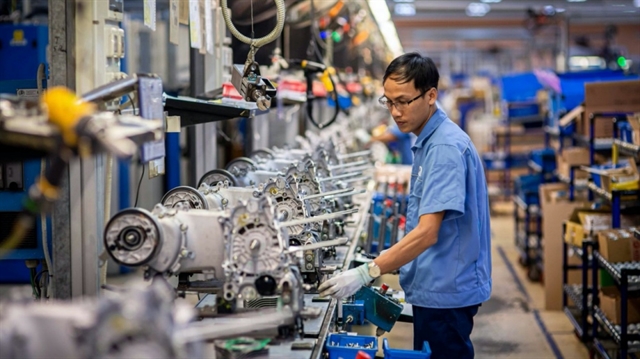
An assembly line at Piaggio Vietnam. Since the EVFTA's implementation, EU-Việt Nam trade has grown significantly. — Photo tapchicongthuong.vn
HÀ NỘI — Five years since its entry into force, the EU-Việt Nam Free Trade Agreement (EVFTA) has catalysed nearly US$300 billion in two-way trade, establishing Việt Nam as the EU’s top trading partner in ASEAN and its 16th largest globally.
In an era marked by rising global tensions and trade fragmentation, the EVFTA stands as a testament to inclusive, rules-based cooperation – one rooted in shared values, sustainability and long-term strategic alignment.
From the earliest days of negotiation, the European Chamber of Commerce in Việt Nam (EuroCham) has stood alongside both the European Union and the Government of Việt Nam, advocating for an agreement that is both ambitious and practical. Today, EuroCham continues to champion the EVFTA’s core values: promoting fair trade, driving business growth, shaping forward-looking policies and bridging stakeholders across Việt Nam and Europe.
Signed on June 30, 2019 and entering into force on August 1, 2020, the EVFTA is one of the EU’s most comprehensive and ambitious trade agreements with a developing nation. It has already eliminated over 70 per cent of tariffs on various goods, with the remaining reductions – up to 99 per cent – to be phased in over the next few years. Beyond tariff liberalisation, the agreement also improves market access, strengthens intellectual property protection and enhances regulatory transparency.
It also fosters the long-term alignment of values and standards, a point EuroCham Chairman Bruno Jaspaert highlighted as central to the agreement’s success.
“In today’s climate of mounting geopolitical uncertainty and unilateral tariffs, the EVFTA stands as a beacon of trust and cooperation. This year, August 1 not only marks the EVFTA’s fifth anniversary, but also a pivotal moment in the global trade landscape," he said.
“As the world turns its attention to the fine print of new trade deals and the real enforcement of ‘reciprocal tariffs’ from the US, the EVFTA offers clarity and certainty. Its detailed provisions and mutual commitments between Việt Nam and the EU show that aligned standards and open markets can deliver concrete growth and shared prosperity.”
Since its implementation, EU-Việt Nam trade has grown significantly. Preliminary data from Việt Nam’s National Statistics Office shows that EU-Việt Nam two-way trade reached $298 billion between August 2020 and May 2025 alone. This five-year figure accounts for nearly 40 per cent of the $815 billion in cumulative trade recorded over 30 years of economic and trade cooperation since 1995, powerful proof of the EVFTA’s impact.
Việt Nam now leads ASEAN and comes 16th in the world in terms of trade with the EU, exporting everything from electronics and textiles to furniture and agri-food products. In return, Europe is Việt Nam’s third largest exporting destination and fourth largest source of imports, supplying high-tech machinery, vehicles, pharmaceuticals and green technology.
The latest EuroCham Business Confidence Index (BCI) from Q2 2025 shows that 66 per cent of surveyed businesses are actively involved in EU-Việt Nam trade, and almost all (98.2 per cent) are aware of the EVFTA. Half reported moderate to significant benefits from the agreement, a number expected to rise further as more tariff reductions take full effect.
It's not just large corporations reaping the rewards, either. Small and medium-sized enterprises are also reporting benefits from the agreement. The proportion of businesses citing tariff reductions as a key advantage surged from 29 per cent in Q2 2024 to 61 per cent in Q2 2025. Among those able to quantify their gains from the EVFTA, the average boost to the bottom line was 8.7 per cent, with top-performing firms reporting increases of up to 25 per cent.
Seizing opportunities and managing issues
Beyond tariff reductions, the EVFTA has opened new doors for European businesses to tap into Việt Nam’s rapidly growing domestic market, from public-private partnerships to incentivised foreign direct investment. With a population of 100 million, including a 55-million-strong workforce, Việt Nam offers European firms wide-ranging opportunities for deeper supply chain integration and long-term market expansion.
In sectors like sustainable agriculture, digitalisation and green energy, European expertise complements Việt Nam’s resource base and development priorities. For instance, European innovations in digitalised, sustainable farming are enhancing productivity and quality across Việt Nam’s agri-food and aquaculture sectors – areas where Việt Nam remains a vital supplier to the European market. At the same time, the EVFTA positions Việt Nam as a reliable alternative hub in an increasingly disrupted global trade environment.
On the other side of the equation, the EU remains a highly attractive destination for Vietnamese exporters. With a combined GDP of $29 trillion in purchasing power parity terms and a population of over 450 million consumers, the EU is the world’s largest single market. Governed by transparent rules and predictable regulations, it offers a GDP per capita of more than $43,000, according to a World Bank report in 2024 – making it a premium market for high-quality Vietnamese goods.
Yet even as benefits grow, challenges persist. Nearly 37 per cent of surveyed firms reported customs valuation discrepancies, while others cited unclear regulations, inconsistent enforcement and lack of alignment between EU and Vietnamese authorities. These frictions limit the full potential of the agreement.
EuroCham Vice-Chair in charge of advocacy Jean-Jacques Bouflet, who was among the EU’s lead negotiators for the EVFTA, remarked on the evolving nature of the agreement.
“When we negotiated the EVFTA, every clause was designed to ensure both productivity and integrity. We anticipated complexity and worked hard to strike the right balance. But implementation is always a journey. It requires continual adjustment, constructive discussions and a business-focused mindset,” he said.
As EuroCham’s 2025 Whitebook stresses, progress must be institutionalised. Deeper cooperation will require further progress on customs alignment, streamlined procedures, regulatory consistency and fair enforcement. Effective EVFTA implementation is more than meeting treaty obligations – it is a catalyst for broader reform, market expansion and long-term resilience. — VNS
Source: VNS
Related News

CHARITY / EXHIBITION / OTHER EVENTS
INVESTMENT OPPORTUNITIES IN CA MAU PROVINCE: 96 PROJECTS AND 20 STRATEGIC PROJECTS
We are pleased to share with you information on investment projects currently seeking investors in Ca Mau Province. Should your esteemed company or association be interested, we kindly invite you to review the project information and complete the registration form via the links provided. The Ho Chi Minh City Investment and Trade Promotion Centre (ITPC) will consolidate the expressions of interest and facilitate connections with the leadership of Ca Mau Province at a meeting tentatively scheduled for 13 November 2026 in Ho Chi Minh City.

MEMBER CORNER / PROMOTIONS
BẰNG KIỀU LIVESHOW - A SYMPHONY OF LOVE UNDER THE GOLDEN GLOW
A masterclass in live music that takes the audience on a soulful journey through immortal love songs, guided by the peerless artistry and emotive storytelling of renowned singer Bằng Kiều. The highlight of the night is his seamless musical chemistry with special guest Triệu Hồng Ngọc, promising passionate and deeply resonant duets inside the magnificent Grand Ballroom.

INFRASTRUCTURE / CONSTRUCTION / LOGISTIC / PORT
ĐÀ NẴNG GREEN-LIGHTS US$105 MILLION THAI DEVELOPMENT DEAL
The central city has approved an investment proposal by Thailand’s WHA Group to develop infrastructure for the 400ha WHA Đà Nẵng Industrial Park project on two communes of Thăng Bình and Đồng Dương, with an investment of more than VNĐ2.7 trillion (US$105 million). The city said it approved WHA Industrial Development International's status as an investor in the project, which is expected to take place between 2027 and 2034.

VIETNAM ECONOMY INVESTMENT
MOBILE PHONE EXPORTS RISE 20% TO $51.8 BILLION IN FIRST NINE MONTHS
Exports of mobile phones and components rose 20 per cent year-on-year to nearly US$51.8 billion in the first nine months of 2026, with China, the US and Republic of Korea accounting for more than half of the total. Shipments to the three markets reached a combined $26.18 billion, or 50.6 per cent of total exports of the product group during the period, according to data from the Vietnam Department of Customs under the Ministry of Finance.

INFRASTRUCTURE / CONSTRUCTION / LOGISTIC / PORT
VIỆT NAM-CAMBODIA TRADE GATHERS PACE TOWARDS $20 BILLION TARGET
Trade between Việt Nam and Cambodia continues to grow, remaining a bright spot and a key pillar of bilateral cooperation as the two countries aim to raise two-way trade to US$20 billion in the coming years. After setting a record of more than $11.3 billion last year, bilateral trade reached about $8.7 billion in the first eight months of this year, up 8.3 per cent year on year.

VIETNAM ECONOMY INVESTMENT
FRUIT AND VEGETABLE EXPORTS POISED TO HIT $10 BILLION IN 2026
Fruit and vegetable exports are on track to reach nearly US$10 billion in 2026, after rising 19.9 per cent year on year to nearly US$7.4 billion in the first nine months, driven by strong seasonal demand and abundant tropical fruit supplies. The Ministry of Agriculture and Environment said the growth reflected stronger international demand for fresh produce and processed agricultural products.
Events Sponsors






















