Want to be in the loop?
subscribe to
our notification
Business News
VIỆT NAM’S AUTO IMPORTS SURGE PAST US$2 BILLION
Data from the General Department of Customs shows that 96,264 CBU vehicles were imported into Việt Nam from January to June 15, with a total value exceeding $2 billion.
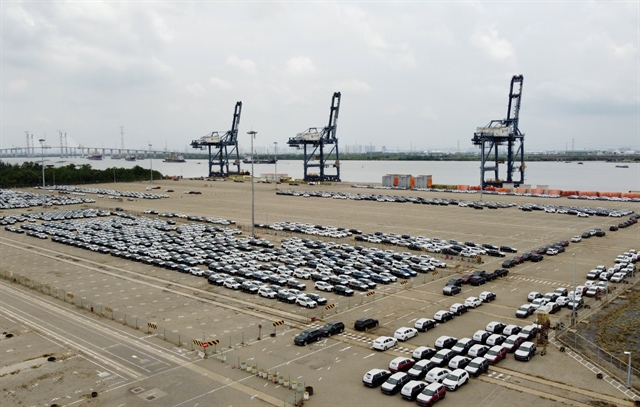
Imported cars at Sài Gòn Port. The imports accounted for 68,280 units sold in the first five months - up 29 per cent year-on-year, outpacing the 13 per cent growth of locally assembled cars. — VNA/VNS Photo Trung Tuyến
HÀ NỘI — Việt Nam’s automotive market is seeing a strong inflow of imported vehicles, with the total value of completely built-up (CBU) auto imports surpassing US$2 billion as of mid-June.
However, amid rising supply and stagnant demand, the industry is facing continued inventory pressure and widespread price cuts.
Data from the General Department of Customs shows that 96,264 CBU vehicles were imported into Việt Nam from January to June 15, with a total value exceeding $2 billion. In the first half of June alone, more than 12,200 vehicles worth $253 million entered the country.
This represents a significant year-on-year increase in both volume and value, confirming a continuing consumer shift towards imported cars. According to the Việt Nam Automobile Manufacturers’ Association (VAMA), imports accounted for 68,280 units sold in the first five months - up 29 per cent year-on-year, outpacing the 13 per cent growth of locally assembled cars.
Despite the increasing import numbers, Việt Nam’s auto market is facing a growing imbalance between supply and demand.
Figures from the General Statistics Office estimate that around 56,200 new vehicles (both imported and domestically assembled) were added to the market in May alone, slightly down 0.7 per cent from April. Total production by local manufacturers reached approximately 183,400 units in the first five months of 2025, a sharp 70.3 per cent increase compared to the same period in 2024.
At the same time, imported vehicle volume in the first five months hit 84,045 units, up 43.3 per cent. This means that by the end of May, a combined total of 267,400 new cars had been added to the market.
However, only 207,000 units were sold in the same period, leaving an estimated 60,000 unsold cars, twice the total number of VAMA member sales in May (29,210 units). Inventory build-up has persisted since 2024, when oversupply exceeded 110,000 vehicles.
With the market yet to rebound decisively, manufacturers and dealers have continued to offer steep discounts and incentives to clear out older inventory, including many 2024-model vehicles still on showroom floors, and in some cases, even 2023 units.
This price-cutting wave has affected all segments from Japanese and South Korean brands to Chinese and European models. Analysts expect the situation to continue through the Ghost Month (August), a traditional low season for car sales in Việt Nam.
US imports see hope in tariff talks, but still face hurdles
Amid this challenging backdrop, trade negotiations between Việt Nam and the US have raised expectations of a potential zero import tariff on American-made vehicles. Such a move could lower prices and increase competitiveness for US brands.
Industry experts say the impact may be limited.
Trần Thúy Hằng, an import specialist, told online newspaper Vietnamnet.vn that even with a zero per cent import tariff, US cars will still be more expensive due to high shipping and insurance costs compared to ASEAN models.
Take the Jeep Wrangler, for example. With a CIF price of over $75,000, its post-tax retail price in Việt Nam would still be around VNĐ3.2 billion, only 13–15 per cent lower than current prices.
Ford Explorer and Mercedes-Benz GLE, both imported from the US, may benefit more. Price reductions of up to 20 per cent could save consumers hundreds of millions of đồng, potentially enhancing their appeal in the SUV and luxury segments. Still, overall market impact is expected to remain small in the short term, as most US imports are limited in volume and lie in premium categories.
Longer-term, the presence of more competitive American vehicles could add diversity and increase pressure on other importers and local assemblers, especially as new models and brands enter the scene.
June saw the arrival of several new models, including the Isuzu mu-X 2025, BMW X5 and 5 Series, Hyundai Creta 2025, Tucson N Line and possibly the Suzuki Swift 2025 and Skoda Kushaq. These launches are expected to refresh customer interest and may help absorb some of the excess supply.
For now, however, experts agree that the ongoing oversupply and lukewarm demand will likely prolong the current price war well into the second half of the year. — VNS
Source: VNS
Related News

CHARITY / EXHIBITION / OTHER EVENTS
INVESTMENT OPPORTUNITIES IN CA MAU PROVINCE: 96 PROJECTS AND 20 STRATEGIC PROJECTS
We are pleased to share with you information on investment projects currently seeking investors in Ca Mau Province. Should your esteemed company or association be interested, we kindly invite you to review the project information and complete the registration form via the links provided. The Ho Chi Minh City Investment and Trade Promotion Centre (ITPC) will consolidate the expressions of interest and facilitate connections with the leadership of Ca Mau Province at a meeting tentatively scheduled for 13 November 2026 in Ho Chi Minh City.

MEMBER CORNER / PROMOTIONS
BẰNG KIỀU LIVESHOW - A SYMPHONY OF LOVE UNDER THE GOLDEN GLOW
A masterclass in live music that takes the audience on a soulful journey through immortal love songs, guided by the peerless artistry and emotive storytelling of renowned singer Bằng Kiều. The highlight of the night is his seamless musical chemistry with special guest Triệu Hồng Ngọc, promising passionate and deeply resonant duets inside the magnificent Grand Ballroom.

INFRASTRUCTURE / CONSTRUCTION / LOGISTIC / PORT
ĐÀ NẴNG GREEN-LIGHTS US$105 MILLION THAI DEVELOPMENT DEAL
The central city has approved an investment proposal by Thailand’s WHA Group to develop infrastructure for the 400ha WHA Đà Nẵng Industrial Park project on two communes of Thăng Bình and Đồng Dương, with an investment of more than VNĐ2.7 trillion (US$105 million). The city said it approved WHA Industrial Development International's status as an investor in the project, which is expected to take place between 2027 and 2034.

VIETNAM ECONOMY INVESTMENT
MOBILE PHONE EXPORTS RISE 20% TO $51.8 BILLION IN FIRST NINE MONTHS
Exports of mobile phones and components rose 20 per cent year-on-year to nearly US$51.8 billion in the first nine months of 2026, with China, the US and Republic of Korea accounting for more than half of the total. Shipments to the three markets reached a combined $26.18 billion, or 50.6 per cent of total exports of the product group during the period, according to data from the Vietnam Department of Customs under the Ministry of Finance.

INFRASTRUCTURE / CONSTRUCTION / LOGISTIC / PORT
VIỆT NAM-CAMBODIA TRADE GATHERS PACE TOWARDS $20 BILLION TARGET
Trade between Việt Nam and Cambodia continues to grow, remaining a bright spot and a key pillar of bilateral cooperation as the two countries aim to raise two-way trade to US$20 billion in the coming years. After setting a record of more than $11.3 billion last year, bilateral trade reached about $8.7 billion in the first eight months of this year, up 8.3 per cent year on year.

VIETNAM ECONOMY INVESTMENT
FRUIT AND VEGETABLE EXPORTS POISED TO HIT $10 BILLION IN 2026
Fruit and vegetable exports are on track to reach nearly US$10 billion in 2026, after rising 19.9 per cent year on year to nearly US$7.4 billion in the first nine months, driven by strong seasonal demand and abundant tropical fruit supplies. The Ministry of Agriculture and Environment said the growth reflected stronger international demand for fresh produce and processed agricultural products.
Events Sponsors






















