Want to be in the loop?
subscribe to
our notification
Business News
VIỆT NAM SEEKS TO EXPAND FRUIT EXPORTS TO CHINA THROUGH QUALITY AND VALUE
China has become Việt Nam's largest agricultural export market, with fruit and vegetable exports reaching about US$5.5 billion last year, accounting for 64 per cent of the country's total exports of the products.
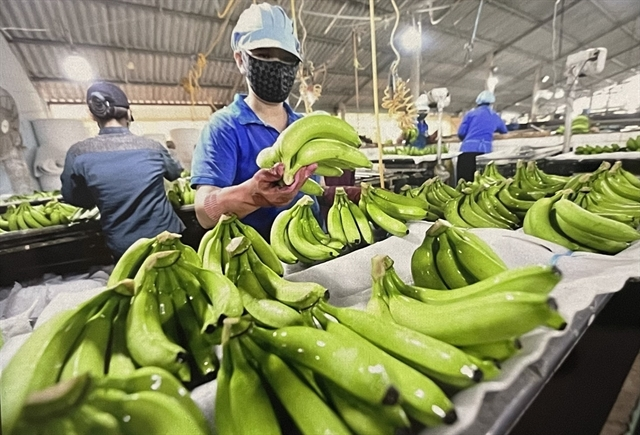
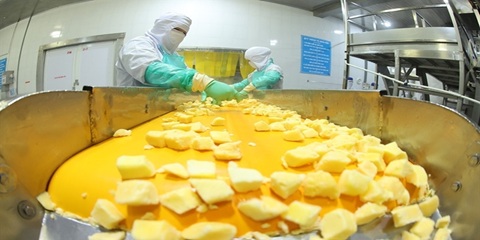
Bananas processed for export. — VNA/VNS Photo
HÀ NỘI — Despite strong performance, industry experts said there was still considerable room to expand Việt Nam's fruit and vegetable exports to China.
However, they noted that this would depend on Vietnamese producers improving product quality, traceability, processing capacity and logistics to meet China's increasingly stringent import requirements.
China has become Việt Nam's largest agricultural export market, with fruit and vegetable exports reaching about US$5.5 billion last year, accounting for 64 per cent of the country's total exports of the products.
China remained Việt Nam's largest export market for fruits and vegetables in the first half of this year, accounting for 51.2 per cent of total fruit and vegetable export value.
Exports to China were estimated at approximately $1.87 billion during the six-month period. In May alone, fruit and vegetable exports to China reached $398.07 million, up 55.7 per cent from the previous month and 19.8 per cent year-on-year.
Việt Nam was also China's second-largest supplier of fruits and vegetables, holding a 22.55 per cent market share.
Việt Nam currently has about 20 fruit and vegetable products approved for official export to China, including durian, bananas, jackfruit, dragon fruit, longan, rambutan, mangoes, lychees, watermelon, mangosteen, passion fruit and fresh chilli peppers.
Phạm Quốc Liêm, chairman of Unifarm, said that the banana industry illustrated both the opportunities and challenges facing Vietnamese produce.
China imports around $1 billion worth of bananas annually, while Việt Nam aims to increase banana exports from more than $400 million to $1 billion in the coming years.
Achieving that target would require more than expanding production, he said. Instead, the industry must improve value across the entire supply chain, from seed varieties and cultivation to harvesting, storage, processing and marketing.
Nguyễn Quốc Mạnh, deputy director of the Plant Production and Protection Department under the Ministry of Agriculture and Environment, said China had tightened, and was expected to continue tightening, its management of growing-area codes, packing-house registration and phytosanitary requirements.
He said Việt Nam's fruit and vegetable sector needed to shift from a volume-based growth model to one driven by quality, value and sustainable development.
For the Chinese market, the focus should go beyond exporting fresh produce to promoting processing and deep processing, developing standardised growing areas, strengthening product traceability and improving logistics infrastructure.
Sharing the same view, Đinh Cao Khuê, vice chairman of the Vietnam Fruit and Vegetable Association, said China's rapidly expanding middle class, food and beverage industry and modern retail sector were reshaping consumer demand.
Instead of importing only fresh fruit, Chinese companies were increasingly seeking fruit juice concentrates, juices, fruit purées, frozen fruits and vegetables, canned products and ingredients for the food processing industry, he said.
These product segments offered higher added value, were less dependent on seasonal harvests and enjoyed more stable demand, he added.
According to Quân đội Nhân dân (People's Army) online newspaper, Zhang Lin, president of the Hồ Chí Minh City Chapter of the Chinese Business Association in Việt Nam, said improvements in transport infrastructure and logistics were creating new opportunities for agricultural trade between the two countries.
He noted that multimodal transport networks integrating road, rail, sea and air freight, together with modern logistics centres and cold-storage facilities at border gates, were helping shorten delivery times, improve customs clearance efficiency and reduce costs for businesses.
He added that digital transformation was becoming a key driver of green agricultural development, with smart customs systems, smart border gates and QR code-based traceability technologies improving transparency, strengthening quality control and enhancing consumer confidence in agricultural products.
To maximise Việt Nam's competitive advantages, Zhang proposed three key priorities for the country's agricultural sector, including fruit and vegetables.
These include expanding the application of digital technologies in agricultural production, strengthening quality management and traceability, and building green agricultural brands.
He also called for a greater role for agribusinesses in market development, research and development, and investment in deep processing to increase added value.
In addition, he urged closer cooperation in processing, warehousing and logistics to strengthen the resilience of the supply chain, while promoting the harmonisation of standards and policies and greater exchanges of experience in smart and sustainable agriculture. — VNS
Source: VNS
Related News

INFRASTRUCTURE / CONSTRUCTION / LOGISTIC / PORT
VIỆT NAM-CAMBODIA TRADE GATHERS PACE TOWARDS $20 BILLION TARGET
Trade between Việt Nam and Cambodia continues to grow, remaining a bright spot and a key pillar of bilateral cooperation as the two countries aim to raise two-way trade to US$20 billion in the coming years. After setting a record of more than $11.3 billion last year, bilateral trade reached about $8.7 billion in the first eight months of this year, up 8.3 per cent year on year.
TECHNOLOGY
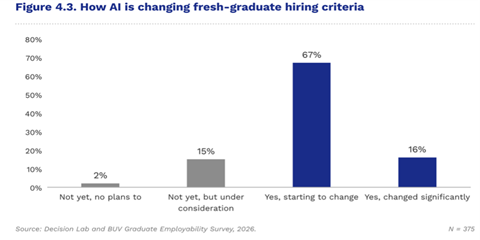
AI BEGINNING TO RESHAPE RECRUITMENT CRITERIA
Digital literacy is the only capability area in which fresh graduates meet employers’ expectations, according to a new report. Yet, it is also the standard rising fastest, as businesses increasingly expect new hires to use AI effectively in the workplace. Some 83 per cent of employers say AI has changed, or is beginning to change, their hiring criteria, while 94 per cent report higher expectations for digital and AI capabilities than they had two to three years ago.
INFRASTRUCTURE / CONSTRUCTION / LOGISTIC / PORT
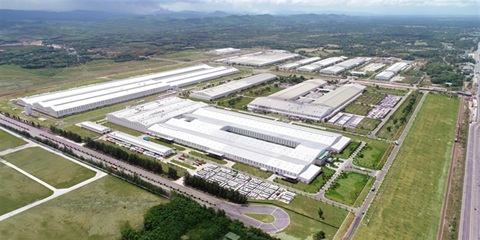
ĐÀ NẴNG GREEN-LIGHTS US$105 MILLION THAI DEVELOPMENT DEAL
The central city has approved an investment proposal by Thailand’s WHA Group to develop infrastructure for the 400ha WHA Đà Nẵng Industrial Park project on two communes of Thăng Bình and Đồng Dương, with an investment of more than VNĐ2.7 trillion (US$105 million). The city said it approved WHA Industrial Development International's status as an investor in the project, which is expected to take place between 2027 and 2034.
VIETNAM ECONOMY INVESTMENT
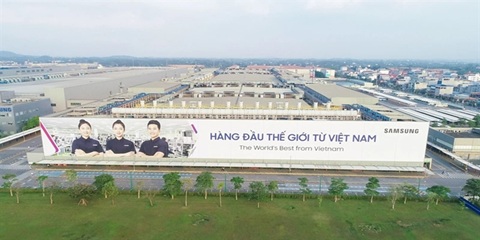
MOBILE PHONE EXPORTS RISE 20% TO $51.8 BILLION IN FIRST NINE MONTHS
Exports of mobile phones and components rose 20 per cent year-on-year to nearly US$51.8 billion in the first nine months of 2026, with China, the US and Republic of Korea accounting for more than half of the total. Shipments to the three markets reached a combined $26.18 billion, or 50.6 per cent of total exports of the product group during the period, according to data from the Vietnam Department of Customs under the Ministry of Finance.
VIETNAM ECONOMY INVESTMENT
FRUIT AND VEGETABLE EXPORTS POISED TO HIT $10 BILLION IN 2026
Fruit and vegetable exports are on track to reach nearly US$10 billion in 2026, after rising 19.9 per cent year on year to nearly US$7.4 billion in the first nine months, driven by strong seasonal demand and abundant tropical fruit supplies. The Ministry of Agriculture and Environment said the growth reflected stronger international demand for fresh produce and processed agricultural products.
GARMENT / TEXTILE
TEXTILE EXPORTS FACE DUAL CHALLENGES OF SUSTAINING ORDERS AND BOOSTING EFFICIENCY AMID GROWING COMPETITION
Data shows that the textile and garment sector maintained its growth momentum in the first nine months of this year. The industry's total export turnover reached an estimated US$35.721 billion in the first nine months of this year, up 3.3 per cent year-on-year. Despite posting encouraging export figures, Vietnamese textile and garment enterprises continue to navigate unpredictable market variables.
Events Sponsors






















