Want to be in the loop?
subscribe to
our notification
Business News
VIETNAM HOLDS FIRM ON 2025 GDP GROWTH TARGET OF 8% OR HIGHER
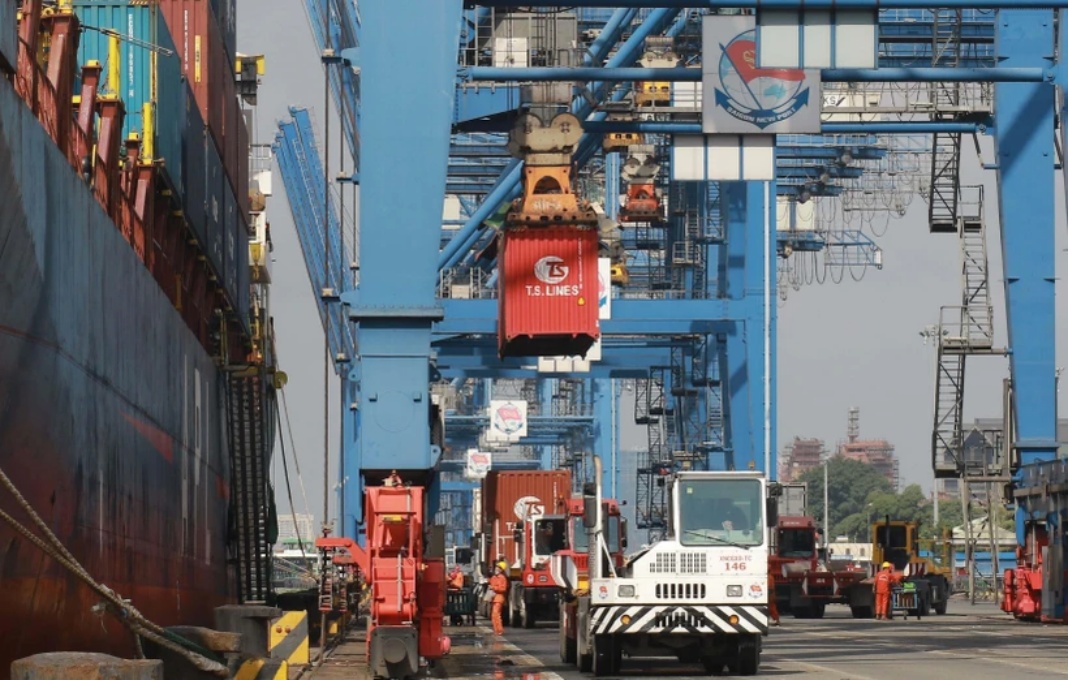
Shipping containers are loaded onto a ship at a local port – PHOTO: VNA
HCMC – The Government of Vietnam has reaffirmed its commitment to achieving a GDP growth rate of 8% or higher in 2025, with a strong focus on macroeconomic stability and restructuring.
The Government on April 10 issued Resolution No. 77/NQ-CP in this regard following the monthly cabinet meeting for March and a teleconference with provincial authorities.
The resolution outlines key policy directions amid heightened global uncertainties and internal economic challenges.
The resolution notes that the global economic and political landscape remains complex and volatile, with ongoing military conflicts, escalating trade tensions, and disrupted global value chains. Domestically, the country faces increasing challenges such as extreme weather, electricity supply risks, and inflationary pressure.
The Government has asked ministers, heads of agencies, and local authorities to stay focused on implementing existing resolutions and directives, particularly Resolutions 01/NQ-CP, 02/NQ-CP, and 25/NQ-CP, as well as the prime minister’s instructions.
Among the key priorities outlined in the resolution are:
Prioritize efforts to vigorously promote high growth in tandem with maintaining macroeconomic stability, controlling inflation, and ensuring the major balances of the economy. Policies must be proactive, flexible, and responsive to arising issues, with the steadfast aim of achieving GDP growth of 8% or above this year.
Urgently complete the two-tier local government model; streamline the administrative apparatus in parallel with institutional improvement, aiming to enhance the effectiveness and efficiency of state management. Prepare thoroughly the content to be submitted to the 11th plenum of the 13th Party Central Committee and the 9th sitting of the 15th National Assembly.
Accelerate the disbursement of public investment capital; implement the three national target programs; and develop strategic, modern, and synchronous infrastructure. Public investment must take the lead in activating and effectively mobilizing social resources.
Strongly develop key economic sectors, especially processing and manufacturing industries and energy. Promote sustainable, high-quality agricultural production. Ensure national energy security and food security.
Expand and diversify export markets, goods, and supply chains; fully tap into the domestic market and stimulate tourism. Strengthen efforts to combat smuggling, trade fraud, counterfeit goods, and origin-related violations.
Focus on the development of science and technology, innovation, and emerging industries and sectors; promote comprehensive national digital transformation. Pursue substantial and meaningful administrative reform, remove obstacles for production and business activities, and enhance the competitiveness of the economy.
Effectively and promptly implement social security policies; improve the quality of public healthcare and human resources.
Strengthen national defense and security capabilities, maintain independence and sovereignty, ensure political security, public order, and social safety. Intensify anti-corruption, anti-negativity, and anti-waste efforts. Substantively and effectively carry out foreign affairs activities. Prepare thoroughly for the commemoration of major national holidays and events.
Continue to step up communication and public information efforts, especially in policy communication. Inspire motivation, build public trust and consensus, and foster a new momentum for national development.
Source: The Saigon Times
Related News

CHARITY / EXHIBITION / OTHER EVENTS
INVESTMENT OPPORTUNITIES IN CA MAU PROVINCE: 96 PROJECTS AND 20 STRATEGIC PROJECTS
We are pleased to share with you information on investment projects currently seeking investors in Ca Mau Province. Should your esteemed company or association be interested, we kindly invite you to review the project information and complete the registration form via the links provided. The Ho Chi Minh City Investment and Trade Promotion Centre (ITPC) will consolidate the expressions of interest and facilitate connections with the leadership of Ca Mau Province at a meeting tentatively scheduled for 13 November 2026 in Ho Chi Minh City.

MEMBER CORNER / PROMOTIONS
BẰNG KIỀU LIVESHOW - A SYMPHONY OF LOVE UNDER THE GOLDEN GLOW
A masterclass in live music that takes the audience on a soulful journey through immortal love songs, guided by the peerless artistry and emotive storytelling of renowned singer Bằng Kiều. The highlight of the night is his seamless musical chemistry with special guest Triệu Hồng Ngọc, promising passionate and deeply resonant duets inside the magnificent Grand Ballroom.

INFRASTRUCTURE / CONSTRUCTION / LOGISTIC / PORT
ĐÀ NẴNG GREEN-LIGHTS US$105 MILLION THAI DEVELOPMENT DEAL
The central city has approved an investment proposal by Thailand’s WHA Group to develop infrastructure for the 400ha WHA Đà Nẵng Industrial Park project on two communes of Thăng Bình and Đồng Dương, with an investment of more than VNĐ2.7 trillion (US$105 million). The city said it approved WHA Industrial Development International's status as an investor in the project, which is expected to take place between 2027 and 2034.

VIETNAM ECONOMY INVESTMENT
MOBILE PHONE EXPORTS RISE 20% TO $51.8 BILLION IN FIRST NINE MONTHS
Exports of mobile phones and components rose 20 per cent year-on-year to nearly US$51.8 billion in the first nine months of 2026, with China, the US and Republic of Korea accounting for more than half of the total. Shipments to the three markets reached a combined $26.18 billion, or 50.6 per cent of total exports of the product group during the period, according to data from the Vietnam Department of Customs under the Ministry of Finance.

INFRASTRUCTURE / CONSTRUCTION / LOGISTIC / PORT
VIỆT NAM-CAMBODIA TRADE GATHERS PACE TOWARDS $20 BILLION TARGET
Trade between Việt Nam and Cambodia continues to grow, remaining a bright spot and a key pillar of bilateral cooperation as the two countries aim to raise two-way trade to US$20 billion in the coming years. After setting a record of more than $11.3 billion last year, bilateral trade reached about $8.7 billion in the first eight months of this year, up 8.3 per cent year on year.

VIETNAM ECONOMY INVESTMENT
FRUIT AND VEGETABLE EXPORTS POISED TO HIT $10 BILLION IN 2026
Fruit and vegetable exports are on track to reach nearly US$10 billion in 2026, after rising 19.9 per cent year on year to nearly US$7.4 billion in the first nine months, driven by strong seasonal demand and abundant tropical fruit supplies. The Ministry of Agriculture and Environment said the growth reflected stronger international demand for fresh produce and processed agricultural products.
Events Sponsors






















