Want to be in the loop?
subscribe to
our notification
Business News
VIETNAM TAKES STEPS TO REALISE 8.3–8.5% GROWTH TARGET IN 2025
Việt Nam is stepping up efforts to achieve an ambitious GDP growth target of 8.3–8.5 per cent this year, despite global uncertainties and divergent economic forecasts.
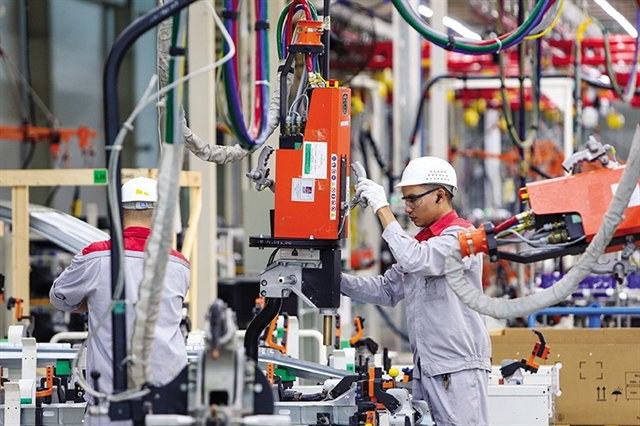
Authorities are focusing on boosting traditional growth drivers such as investment, consumption, and exports. — VNA/VNS Photo
HÀ NỘI — Việt Nam is stepping up efforts to achieve an ambitious GDP growth target of 8.3–8.5 per cent this year, despite global uncertainties and divergent economic forecasts.
Authorities are focusing on boosting traditional growth drivers such as investment, consumption and exports while implementing a broad array of policy measures to maintain economic momentum.
Recent GDP projections for Việt Nam in the second half of 2025 show a wide divergence.
The Asian Development Bank (ADB) and the Standard Chartered have revised their forecasts downward to 6.3 per cent and 6.1 per cent, respectively, citing external risks, particularly from rising trade tensions and new US tariff policies scheduled to take effect on August 1.
In contrast, several financial institutions remain upbeat. The United Overseas Bank (UOB) raised its projection from 6 per cent to 6.9 per cent, CitiGroup revised its forecast from 6.6 per cent to 7 per cent, and Maybank increased its projection to 7.3 per cent. Meanwhile, the BIDV Research Group anticipated the country's growth could reach 7.5–7.7 per cent in a base scenario and as high as 7.8-8.1 per cent under an optimistic scenario.
This disparity underscores continued uncertainties in the global economic environment and challenges facing Việt Nam, especially as the US's new tariffs are expected to impact major export sectors like electronics, textiles, furniture, and aquatic products.
Despite these headwinds, the Ministry of Finance has proposed a bold economic growth scenario of 8.3–8.5 per cent for 2025, which was approved by Prime Minister Phạm Minh Chính. This target is seen as achievable and essential to lay the groundwork for potential double-digit growth in the coming year.
Traditional economic engines
To support this effort, the government plans to leverage traditional economic engines. The Ministry of Finance estimates that total social investment in the second half of the year could reach US$111 billion, with retail and service revenue growing by at least 13 per cent, and total trade volume increasing by 17 per cent or more.
PM Chính has stressed that the growth target is “not impossible” and must be pursued decisively. Key policy directions include accelerating public investment disbursement, mobilising social investment, stimulating domestic consumption, and negotiating trade agreements, particularly with the US, to ease export pressures.
The second half of the year offers a seasonal advantage, with heightened domestic and international demand expected during the year-end shopping period. The government is working to ensure these trends are translated into real economic gains.
Measures being rolled out include cracking down on smuggling and trade fraud, developing tourism products to attract foreign visitors, and ensuring timely compensation and policy implementation for public employees affected by administrative restructuring.
To stimulate domestic demand, fiscal policy is being loosened. The Ministry of Finance is implementing tax relief measures, including a 2 per cent VAT cut and a proposal to increase personal income tax deductions. Additionally, financial support for civil servants is being expedited to enhance household consumption.
Albert Park, chief economist at ADB said that despite the increased risks from tariff uncertainties, domestic reforms, if implemented effectively and quickly, can mitigate these risks by strengthening domestic factors. This will also positively support Việt Nam’s economic growth in 2025. — VNS
Source: VNS
Related News

CHARITY / EXHIBITION / OTHER EVENTS
INVESTMENT OPPORTUNITIES IN CA MAU PROVINCE: 96 PROJECTS AND 20 STRATEGIC PROJECTS
We are pleased to share with you information on investment projects currently seeking investors in Ca Mau Province. Should your esteemed company or association be interested, we kindly invite you to review the project information and complete the registration form via the links provided. The Ho Chi Minh City Investment and Trade Promotion Centre (ITPC) will consolidate the expressions of interest and facilitate connections with the leadership of Ca Mau Province at a meeting tentatively scheduled for 13 November 2026 in Ho Chi Minh City.

MEMBER CORNER / PROMOTIONS
BẰNG KIỀU LIVESHOW - A SYMPHONY OF LOVE UNDER THE GOLDEN GLOW
A masterclass in live music that takes the audience on a soulful journey through immortal love songs, guided by the peerless artistry and emotive storytelling of renowned singer Bằng Kiều. The highlight of the night is his seamless musical chemistry with special guest Triệu Hồng Ngọc, promising passionate and deeply resonant duets inside the magnificent Grand Ballroom.

INFRASTRUCTURE / CONSTRUCTION / LOGISTIC / PORT
ĐÀ NẴNG GREEN-LIGHTS US$105 MILLION THAI DEVELOPMENT DEAL
The central city has approved an investment proposal by Thailand’s WHA Group to develop infrastructure for the 400ha WHA Đà Nẵng Industrial Park project on two communes of Thăng Bình and Đồng Dương, with an investment of more than VNĐ2.7 trillion (US$105 million). The city said it approved WHA Industrial Development International's status as an investor in the project, which is expected to take place between 2027 and 2034.

VIETNAM ECONOMY INVESTMENT
MOBILE PHONE EXPORTS RISE 20% TO $51.8 BILLION IN FIRST NINE MONTHS
Exports of mobile phones and components rose 20 per cent year-on-year to nearly US$51.8 billion in the first nine months of 2026, with China, the US and Republic of Korea accounting for more than half of the total. Shipments to the three markets reached a combined $26.18 billion, or 50.6 per cent of total exports of the product group during the period, according to data from the Vietnam Department of Customs under the Ministry of Finance.

INFRASTRUCTURE / CONSTRUCTION / LOGISTIC / PORT
VIỆT NAM-CAMBODIA TRADE GATHERS PACE TOWARDS $20 BILLION TARGET
Trade between Việt Nam and Cambodia continues to grow, remaining a bright spot and a key pillar of bilateral cooperation as the two countries aim to raise two-way trade to US$20 billion in the coming years. After setting a record of more than $11.3 billion last year, bilateral trade reached about $8.7 billion in the first eight months of this year, up 8.3 per cent year on year.

VIETNAM ECONOMY INVESTMENT
FRUIT AND VEGETABLE EXPORTS POISED TO HIT $10 BILLION IN 2026
Fruit and vegetable exports are on track to reach nearly US$10 billion in 2026, after rising 19.9 per cent year on year to nearly US$7.4 billion in the first nine months, driven by strong seasonal demand and abundant tropical fruit supplies. The Ministry of Agriculture and Environment said the growth reflected stronger international demand for fresh produce and processed agricultural products.
Events Sponsors






















