Want to be in the loop?
subscribe to
our notification
Business News
VIETNAMESE FIRMS TACKLE US TARIFFS WITH SMART STRATEGIES AND GROWTH
The United States recently imposed a 20 per cent countervailing tax on goods from Việt Nam, prompting many firms to proactively restructure operations, standardise production, and diversify export markets to maintain growth momentum.
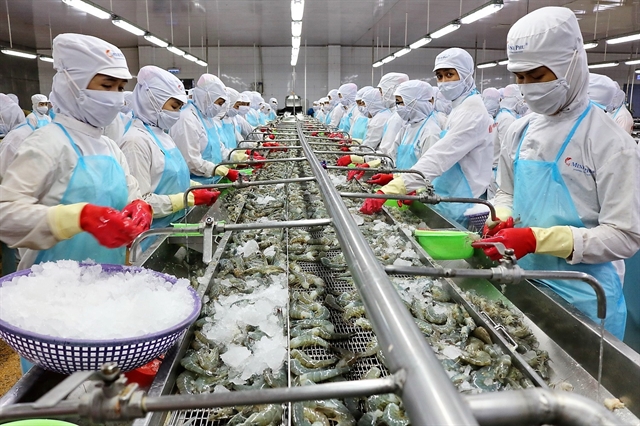
Shrimp processing line for export of Minh Phú Group. — Photo baovephapluat.vn
HÀ NỘI — The United States recently imposed a 20 per cent countervailing tax on goods originating from Việt Nam, a level that presents challenges but remains manageable for domestic enterprises.
Many Vietnamese firms are responding proactively by restructuring operations, standardising production and diversifying export markets to maintain growth momentum amid these new trade barriers.
Nguyễn Phương Lam, director of the Việt Nam Chamber of Commerce and Industry’s Mekong Delta branch, noted that the 20 per cent tariff is a significant reduction from the previous 46 per cent. He added that the gap between Việt Nam and other Southeast Asian nations is now only around one percentage point.
“Compared with regional countries, a 20 per cent tax is not excessively high and can be considered acceptable. More importantly, Việt Nam’s exports to the US have exceeded US$119 billion, far surpassing many Southeast Asian nations which only reach $30–40 billion,” Lam emphasised.
Experts agree this outcome reflects the Government’s effective negotiation efforts. However, enterprises must now adopt both short-term and long-term adaptation strategies to remain competitive.
Many businesses have already taken steps. Minh Phú Seafood Corporation – Hậu Giang, which exports shrimp to 50 countries, reported that the US accounted for only 14.7 per cent of its sales, with Japan leading at 24.1 per cent.
General director Lê Thị Minh Phú said, “We hope the Government will continue negotiations for further tax reductions. At the same time, we have expanded into other potential markets to maintain stable growth.”
In agriculture, Cửu Long Orchard JSC general director Lê Văn Đồng said: “The US market values quality over quantity. The decisive factor is not the tariff rate but competitiveness through product quality. We are targeting the premium segment, where customers prioritise health and branding.”
Technology companies are also adapting swiftly. Deputy director of VNPT Technology’s business centre Trần Đức Hòa outlined four solutions: optimising supply chains, boosting localisation, diversifying markets and developing high-tech products to ease pricing pressures.
Principal country economist of the Asian Development Bank in Việt Nam Nguyễn Bá Hùng highlighted that domestic reforms—ranging from institutional improvements to business environment upgrades—could be undertaken immediately to enhance competitiveness.
From an investment perspective, he added that the current tariff gap gives Việt Nam an advantage over China, making it a more attractive destination for international capital flows.— VNS
Source: VNS
Related News

CHARITY / EXHIBITION / OTHER EVENTS
INVESTMENT OPPORTUNITIES IN CA MAU PROVINCE: 96 PROJECTS AND 20 STRATEGIC PROJECTS
We are pleased to share with you information on investment projects currently seeking investors in Ca Mau Province. Should your esteemed company or association be interested, we kindly invite you to review the project information and complete the registration form via the links provided. The Ho Chi Minh City Investment and Trade Promotion Centre (ITPC) will consolidate the expressions of interest and facilitate connections with the leadership of Ca Mau Province at a meeting tentatively scheduled for 13 November 2026 in Ho Chi Minh City.

MEMBER CORNER / PROMOTIONS
BẰNG KIỀU LIVESHOW - A SYMPHONY OF LOVE UNDER THE GOLDEN GLOW
A masterclass in live music that takes the audience on a soulful journey through immortal love songs, guided by the peerless artistry and emotive storytelling of renowned singer Bằng Kiều. The highlight of the night is his seamless musical chemistry with special guest Triệu Hồng Ngọc, promising passionate and deeply resonant duets inside the magnificent Grand Ballroom.

INFRASTRUCTURE / CONSTRUCTION / LOGISTIC / PORT
ĐÀ NẴNG GREEN-LIGHTS US$105 MILLION THAI DEVELOPMENT DEAL
The central city has approved an investment proposal by Thailand’s WHA Group to develop infrastructure for the 400ha WHA Đà Nẵng Industrial Park project on two communes of Thăng Bình and Đồng Dương, with an investment of more than VNĐ2.7 trillion (US$105 million). The city said it approved WHA Industrial Development International's status as an investor in the project, which is expected to take place between 2027 and 2034.

VIETNAM ECONOMY INVESTMENT
MOBILE PHONE EXPORTS RISE 20% TO $51.8 BILLION IN FIRST NINE MONTHS
Exports of mobile phones and components rose 20 per cent year-on-year to nearly US$51.8 billion in the first nine months of 2026, with China, the US and Republic of Korea accounting for more than half of the total. Shipments to the three markets reached a combined $26.18 billion, or 50.6 per cent of total exports of the product group during the period, according to data from the Vietnam Department of Customs under the Ministry of Finance.

INFRASTRUCTURE / CONSTRUCTION / LOGISTIC / PORT
VIỆT NAM-CAMBODIA TRADE GATHERS PACE TOWARDS $20 BILLION TARGET
Trade between Việt Nam and Cambodia continues to grow, remaining a bright spot and a key pillar of bilateral cooperation as the two countries aim to raise two-way trade to US$20 billion in the coming years. After setting a record of more than $11.3 billion last year, bilateral trade reached about $8.7 billion in the first eight months of this year, up 8.3 per cent year on year.

VIETNAM ECONOMY INVESTMENT
FRUIT AND VEGETABLE EXPORTS POISED TO HIT $10 BILLION IN 2026
Fruit and vegetable exports are on track to reach nearly US$10 billion in 2026, after rising 19.9 per cent year on year to nearly US$7.4 billion in the first nine months, driven by strong seasonal demand and abundant tropical fruit supplies. The Ministry of Agriculture and Environment said the growth reflected stronger international demand for fresh produce and processed agricultural products.
Events Sponsors






















