Want to be in the loop?
subscribe to
our notification
Business News
VIETNAMESE RETAIL INDUSTRY EXPECTS BRIGHT FUTURE AHEAD
With a young and dynamic population, rising incomes and increasing urbanisation, the sector is emerging as one of the most promising engines for economic expansion in the coming years.

Consumers shopping at a supermarket in Hà Nội. — VNS Photo Mai Hương
HÀ NỘI — Việt Nam’s retail industry is experiencing a period of remarkable growth, fuelled by favourable economic conditions and evolving consumer behaviour.
With a young and dynamic population, rising incomes and increasing urbanisation, the sector is emerging as one of the most promising engines for economic expansion in the coming years.
Tiền Phong Securities Corporation projected the retail market in Việt Nam to grow at an impressive rate of 12.05 per cent between 2024 and 2029.
This robust trajectory is attributed to a burgeoning middle class, widespread adoption of digital payment systems and the rapid expansion of modern retail formats.
The rise in consumer confidence and disposable incomes further cements the retail sector's pivotal role in the nation’s economic recovery and growth.
Việt Nam's demographic structure is critical to the retail industry's momentum. With a population exceeding 100 million, over 70 per cent are under the age of 40, forming a consumer base that is tech-savvy, urban-oriented, and aspirational.
By 2025, the country’s GDP per capita is expected to surpass US$5,000, marking a significant milestone to stimulate consumer spending further.
Hoàng Xuân Trung, Head of Corporate Clients at Citi Việt Nam, this demographic advantage, coupled with an increasingly affluent middle class, is set to drive retail demand for years to come.
Đặng Thúy Hà, Director of Customer Behaviour Research at NielsenIQ Việt Nam, also highlights the growing consumer focus on not just basic needs but also quality-of-life enhancements, a shift that offers lucrative opportunities for retailers to diversify their offerings.
Key drivers of retail growth
The evolution of the country's retail industry can be attributed to several interrelated factors.
Tiền Phong Securities said that the expansion of retail networks has brought modern shopping experiences to underserved areas. Supermarkets, convenience stores and online platforms are increasingly penetrating rural markets, offering consumers a more accessible and efficient alternative to traditional retail channels.
Additionally, the surge in digital payments reflects the growing integration of technology into daily life.
Close to 40 per cent of consumers now use banking apps for shopping transactions, underscoring a shift towards cashless societies. This trend aligns with the government’s push to promote digital transformation, enhancing both convenience and transparency in retail transactions.
The country’s expanding middle class, projected to account for 26 per cent of the population by 2026, also represents a significant driver of consumption. Estimates suggest that an additional 23.2 million people will join this demographic by 2033, creating vast opportunities for growth across all retail segments.
Việt Nam's favourable labour demographics, with a majority of its population in the working age group and a high participation rate of women in the workforce, ensure sustained consumer spending across categories.
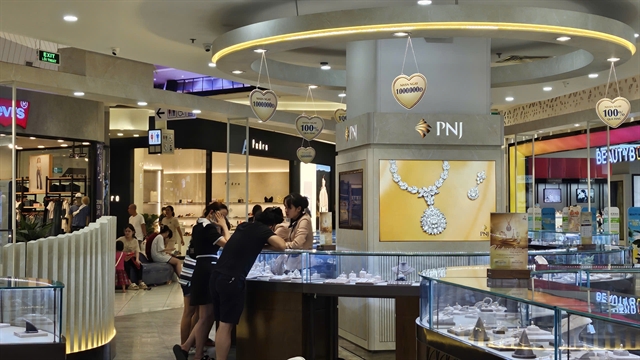
A PNJ store inside AEON Mall Hà Đông. — VNS Photo Ly Ly
Shifting consumer trends
Consumer preferences in Việt Nam are undergoing a rapid transformation.
Health and sustainability are becoming central to purchasing decisions, with increasing demand for eco-friendly and high-quality products. Shoppers are also showing greater loyalty to trusted brands, signalling a shift from price-sensitive behaviour to value-driven consumption.
Leading retail enterprises are positioning themselves to capitalise on the sector’s recovery and expansion.
Companies like FPT Retail (FRT), Mobile World Investment Corporation (MWG), Digiworld (DGW), Masan Group (MSN) and Phú Nhuận Jewelry JSC (PNJ) are leveraging their strengths to adapt to changing market conditions.
For MWG, strategic restructuring and operational efficiency have set the stage for a strong performance in 2024 and beyond.
The company’s initiatives to enhance its grocery chain, Bách Hóa Xanh, and consumer electronics brand, Erablue, are expected to yield significant results as the economy recovers and urbanisation progresses.
Similarly, Digiworld anticipates robust growth as foreign direct investment inflows bolster the economy, leading to higher consumer incomes and confidence.
Policy measures such as a 2 per cent reduction in VAT for specific goods and services are also expected to stimulate spending, further benefiting retail players.
Mordor Intelligence predicts a 12.1 per cent annual Compound Annual Growth Rate (CAGR) for Việt Nam's retail and consumer services sector from 2024 to 2029. Retail enterprises still have room for growth.
Nguyễn Việt Đức, head of Digital Business at VPBank Securities, expected that retail stocks will rebound due to escalating demand, enhanced consumer spending and the overall economic recovery momentum. — VNS
Source: VNS
Related News

CHARITY / EXHIBITION / OTHER EVENTS
INVESTMENT OPPORTUNITIES IN CA MAU PROVINCE: 96 PROJECTS AND 20 STRATEGIC PROJECTS
We are pleased to share with you information on investment projects currently seeking investors in Ca Mau Province. Should your esteemed company or association be interested, we kindly invite you to review the project information and complete the registration form via the links provided. The Ho Chi Minh City Investment and Trade Promotion Centre (ITPC) will consolidate the expressions of interest and facilitate connections with the leadership of Ca Mau Province at a meeting tentatively scheduled for 13 November 2026 in Ho Chi Minh City.

MEMBER CORNER / PROMOTIONS
BẰNG KIỀU LIVESHOW - A SYMPHONY OF LOVE UNDER THE GOLDEN GLOW
A masterclass in live music that takes the audience on a soulful journey through immortal love songs, guided by the peerless artistry and emotive storytelling of renowned singer Bằng Kiều. The highlight of the night is his seamless musical chemistry with special guest Triệu Hồng Ngọc, promising passionate and deeply resonant duets inside the magnificent Grand Ballroom.

INFRASTRUCTURE / CONSTRUCTION / LOGISTIC / PORT
ĐÀ NẴNG GREEN-LIGHTS US$105 MILLION THAI DEVELOPMENT DEAL
The central city has approved an investment proposal by Thailand’s WHA Group to develop infrastructure for the 400ha WHA Đà Nẵng Industrial Park project on two communes of Thăng Bình and Đồng Dương, with an investment of more than VNĐ2.7 trillion (US$105 million). The city said it approved WHA Industrial Development International's status as an investor in the project, which is expected to take place between 2027 and 2034.

VIETNAM ECONOMY INVESTMENT
MOBILE PHONE EXPORTS RISE 20% TO $51.8 BILLION IN FIRST NINE MONTHS
Exports of mobile phones and components rose 20 per cent year-on-year to nearly US$51.8 billion in the first nine months of 2026, with China, the US and Republic of Korea accounting for more than half of the total. Shipments to the three markets reached a combined $26.18 billion, or 50.6 per cent of total exports of the product group during the period, according to data from the Vietnam Department of Customs under the Ministry of Finance.

INFRASTRUCTURE / CONSTRUCTION / LOGISTIC / PORT
VIỆT NAM-CAMBODIA TRADE GATHERS PACE TOWARDS $20 BILLION TARGET
Trade between Việt Nam and Cambodia continues to grow, remaining a bright spot and a key pillar of bilateral cooperation as the two countries aim to raise two-way trade to US$20 billion in the coming years. After setting a record of more than $11.3 billion last year, bilateral trade reached about $8.7 billion in the first eight months of this year, up 8.3 per cent year on year.

VIETNAM ECONOMY INVESTMENT
FRUIT AND VEGETABLE EXPORTS POISED TO HIT $10 BILLION IN 2026
Fruit and vegetable exports are on track to reach nearly US$10 billion in 2026, after rising 19.9 per cent year on year to nearly US$7.4 billion in the first nine months, driven by strong seasonal demand and abundant tropical fruit supplies. The Ministry of Agriculture and Environment said the growth reflected stronger international demand for fresh produce and processed agricultural products.
Events Sponsors






















