Want to be in the loop?
subscribe to
our notification
Business News
VN STEPS UP BORDER CLEARANCE FOR AGRICULTURAL PRODUCT EXPORTS
With key agricultural products such as lychee, durian, mango, longan and dragon fruit entering the peak harvest season, Vietnamese authorities are stepping up efforts to streamline customs clearance at border gates to prevent congestion and market oversupply.
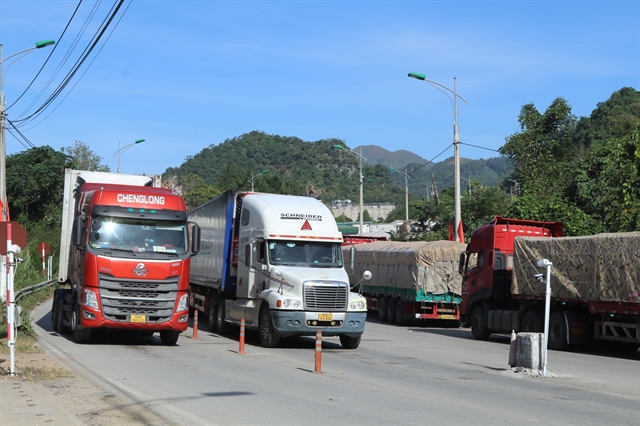
Container tructs at Tân Thanh Border Gate, Lạng Sơn Province. Vietnamese authorities are stepping up efforts to streamline customs clearance at border gates to prevent congestion and market oversupply. — VNA/VNS Photo Quang Duy
HÀ NỘI — With key agricultural products such as lychee, durian, mango, longan and dragon fruit entering the peak harvest season, Vietnamese authorities are stepping up efforts to streamline customs clearance at border gates to prevent congestion and market oversupply.
In a recent directive, Prime Minister Phạm Minh Chính urged the Ministry of Finance to instruct the customs force to prioritise the swift clearance of fresh farm produce for export.
Designating channels for agricultural products
According to Vi Công Tường, deputy head of the Customs Sub-department for Region VI (covering Lạng Sơn and Cao Bằng provinces), import-export activities at Lạng Sơn’s border gates has surged in 2025, with over 214,000 vehicles processed as of June 4, a 23 per cent increase year-on-year. Total trade value through the province has reached nearly US$33.1 billion, with agricultural goods accounting for a significant portion.
Tân Thanh border gate in Lạng Sơn, the province’s largest agricultural trade hub, is currently processing more than 500 tonnes of durian daily, along with other fruits such as jackfruit and mango, all cleared for export on the same day. To cope with rising lychee exports — currently three to five trucks per day and expected to increase — Tân Thanh has designated a dedicated lane and expanded receiving areas to handle up to 200 lychee trucks per day. Customs procedures are completed within just 10 minutes.
At Kim Thành International Border Gate No. II in Lào Cai province, authorities have also implemented special lanes and inspection points to expedite lychee exports to China.
The Ministry of Agriculture and Environment reported that Việt Nam’s 2025 lychee output is expected to reach 303,000 tonnes, up 30 per cent from 2024. While the fruit is exported to over 20 countries, China remains the dominant market, accounting for 90 per cent of total exports. Rapid, efficient customs clearance is essential to preserving product quality.
Deputy Minister of Agriculture and Environment Phùng Đức Tiến recently met with leaders of China’s General Administration of Customs, agreeing to increase inspection capacity and extend working hours at border posts to minimise delays during peak harvest periods.
For lychee exports specifically, the Ministry’s Plant Production and Protection Department has assigned staff to be on standby around the clock at border gates and testing facilities to accelerate phytosanitary procedures.
Lạng Son’s provincial leaders have reiterated their commitment to facilitating smooth customs procedures, especially for fresh fruit exports.
Meeting import market regulations and standards
Deputy Director of the Đồng Đăng – Lạng Sơn Border Gate Economic Zone Management Board Hoàng Khánh Duy noted ongoing coordination with China’s Guangxi authorities to enhance cross-border trade.
However, authorities have also advised businesses to shift towards official export channels, ensure contract-based transactions, and meet strict Chinese requirements on product quality, traceability, planting area codes, and packaging standards.
Mai Xuân Thìn, CEO of Red Dragon Co Ltd, emphasised that meeting China’s increasingly strict food safety and residue standards will boost consumer trust and strengthen Vietnamese products' position in the Chinese market. — VNS
Source: VNS
Related News

CHARITY / EXHIBITION / OTHER EVENTS
INVESTMENT OPPORTUNITIES IN CA MAU PROVINCE: 96 PROJECTS AND 20 STRATEGIC PROJECTS
We are pleased to share with you information on investment projects currently seeking investors in Ca Mau Province. Should your esteemed company or association be interested, we kindly invite you to review the project information and complete the registration form via the links provided. The Ho Chi Minh City Investment and Trade Promotion Centre (ITPC) will consolidate the expressions of interest and facilitate connections with the leadership of Ca Mau Province at a meeting tentatively scheduled for 13 November 2026 in Ho Chi Minh City.

MEMBER CORNER / PROMOTIONS
BẰNG KIỀU LIVESHOW - A SYMPHONY OF LOVE UNDER THE GOLDEN GLOW
A masterclass in live music that takes the audience on a soulful journey through immortal love songs, guided by the peerless artistry and emotive storytelling of renowned singer Bằng Kiều. The highlight of the night is his seamless musical chemistry with special guest Triệu Hồng Ngọc, promising passionate and deeply resonant duets inside the magnificent Grand Ballroom.

INFRASTRUCTURE / CONSTRUCTION / LOGISTIC / PORT
ĐÀ NẴNG GREEN-LIGHTS US$105 MILLION THAI DEVELOPMENT DEAL
The central city has approved an investment proposal by Thailand’s WHA Group to develop infrastructure for the 400ha WHA Đà Nẵng Industrial Park project on two communes of Thăng Bình and Đồng Dương, with an investment of more than VNĐ2.7 trillion (US$105 million). The city said it approved WHA Industrial Development International's status as an investor in the project, which is expected to take place between 2027 and 2034.

VIETNAM ECONOMY INVESTMENT
MOBILE PHONE EXPORTS RISE 20% TO $51.8 BILLION IN FIRST NINE MONTHS
Exports of mobile phones and components rose 20 per cent year-on-year to nearly US$51.8 billion in the first nine months of 2026, with China, the US and Republic of Korea accounting for more than half of the total. Shipments to the three markets reached a combined $26.18 billion, or 50.6 per cent of total exports of the product group during the period, according to data from the Vietnam Department of Customs under the Ministry of Finance.

INFRASTRUCTURE / CONSTRUCTION / LOGISTIC / PORT
VIỆT NAM-CAMBODIA TRADE GATHERS PACE TOWARDS $20 BILLION TARGET
Trade between Việt Nam and Cambodia continues to grow, remaining a bright spot and a key pillar of bilateral cooperation as the two countries aim to raise two-way trade to US$20 billion in the coming years. After setting a record of more than $11.3 billion last year, bilateral trade reached about $8.7 billion in the first eight months of this year, up 8.3 per cent year on year.

VIETNAM ECONOMY INVESTMENT
FRUIT AND VEGETABLE EXPORTS POISED TO HIT $10 BILLION IN 2026
Fruit and vegetable exports are on track to reach nearly US$10 billion in 2026, after rising 19.9 per cent year on year to nearly US$7.4 billion in the first nine months, driven by strong seasonal demand and abundant tropical fruit supplies. The Ministry of Agriculture and Environment said the growth reflected stronger international demand for fresh produce and processed agricultural products.
Events Sponsors






















