Want to be in the loop?
subscribe to
our notification
Business News
WOOD INDUSTRY EXPANDS MARKETS TO SUSTAIN GROWTH MOMENTUM
With an export value of nearly US$10 billion in the first seven months of this year, the sector not only ranks among the country's top five largest export industries but also leads in the agriculture–forestry–fishery group.
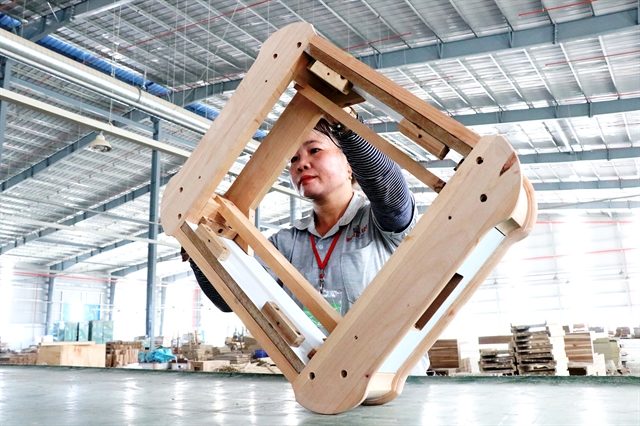
A worker checks wooden product before packaging for export in a wood processing company. — VNA/VNS Photo
HÀ NỘI — The wood and wood products industry holds a prominent position in Việt Nam’s export landscape, but to maintain and accelerate growth, the sector must swiftly expand into new markets and avoid overreliance on a few key destinations.
With an export value of nearly US$10 billion in the first seven months of this year, the sector not only ranks among the country's top five largest export industries but also leads in the agriculture–forestry–fishery group.
According to Deputy Minister of Agriculture and Environment Nguyễn Quốc Trị, the wood industry is a pillar of agricultural exports.
Its success lies not only in export figures but also in promoting the Vietnamese brand internationally.
To ensure long-term sustainability, the industry must move beyond dependence on a limited number of markets.
The US, the EU, Japan and South Korea currently account for over 80 per cent of Việt Nam’s wood exports, with the US alone making up more than 50 per cent of total export value.
This heavy dependence exposes businesses to significant risks, especially when these countries tighten trade policies or impose new technical barriers.
Both the US and EU were increasingly demanding traceability, sustainable forest certifications, and even carbon footprint calculations, noted Nguyễn Thị Thu Trang, Director of the Centre for WTO and International Trade under the Vietnam Chamber of Commerce and Industry (VCCI).
Without early preparation, wood enterprises risked losing competitiveness, even with lower prices, she said.
Many businesses are also expressing concern. The Thời báo Ngân hàng (The Banking Times) quoted Lê Minh Tấn, director of a furniture company in Bình Dương, who shared that his company primarily provided outsourcing services for American and Japanese partners.
When orders dropped, his factory was forced to operate at minimal capacity, he said.
Market diversification
Experts have suggested the wood industry must pursue two key strategies, which are market diversification and product value chains upgrading.
In addition to traditional markets, Việt Nam has strong potential in regions such as the Middle East, South Asia, South America and Eastern Europe.
These areas are undergoing rapid urbanisation with rising demand for housing and interior furnishings.
For example, Saudi Arabia and the UAE are developing massive urban projects, creating multi-billion-dollar demand for furniture annually.
Furthermore, the industry must move beyond low-cost segments or purely outsourcing. Investment should be channelled into smart furniture, custom designs and eco-friendly products, and others, according to the experts.
These high-value segments enhance order value, improve profit margins, and help build long-term brand equity.
Trần Quốc Mạnh, vice chairman of the Vietnam Handicraft Exporters Association, said that Việt Nam’s furniture industry must aim for Net Zero with eco-friendly products.
This was not only a global trend but also a strict requirement from major markets like the EU, US, Japan and the Middle East, he said.
In addition to diverse designs, most import markets now demanded green and sustainable products, he added.
These factors offered long-term competitive advantages. Wood enterprises also needed to accelerate digital transformation and restructure operations to improve competitiveness and reduce production costs, especially as order volumes and prices showed signs of decline.
Leveraging trade agreements
One major advantage for the industry is its ability to leverage next-generation FTAs such as the EVFTA, CPTPP and UKVFTA.
These agreements grant Vietnamese wood products preferential tariffs in markets like the EU, Canada, the UK, and CPTPP countries.
However, opportunities come with challenges. The EU has begun to implement the EU Deforestation Regulation (EUDR), which requires proof that wood products are not linked to deforestation.
Đỗ Xuân Lập, chairman of the Vietnam Timber and Forest Products Association (VIFORES), emphasised the importance of proactively developing legal and transparent raw material zones.
Once producers met the highest standards, wood products could confidently conquer even the most demanding markets, he said.
Many wood enterprises had already begun restructuring their operations to adapt, said Lập.
Some major companies were investing in custom designs and building domestic furniture brands alongside exports. Others were shifting to outdoor wood products and composite wood to tap into new consumption trends, he added. — VNS
Source: VNS
Related News

CHARITY / EXHIBITION / OTHER EVENTS
INVESTMENT OPPORTUNITIES IN CA MAU PROVINCE: 96 PROJECTS AND 20 STRATEGIC PROJECTS
We are pleased to share with you information on investment projects currently seeking investors in Ca Mau Province. Should your esteemed company or association be interested, we kindly invite you to review the project information and complete the registration form via the links provided. The Ho Chi Minh City Investment and Trade Promotion Centre (ITPC) will consolidate the expressions of interest and facilitate connections with the leadership of Ca Mau Province at a meeting tentatively scheduled for 13 November 2026 in Ho Chi Minh City.

MEMBER CORNER / PROMOTIONS
BẰNG KIỀU LIVESHOW - A SYMPHONY OF LOVE UNDER THE GOLDEN GLOW
A masterclass in live music that takes the audience on a soulful journey through immortal love songs, guided by the peerless artistry and emotive storytelling of renowned singer Bằng Kiều. The highlight of the night is his seamless musical chemistry with special guest Triệu Hồng Ngọc, promising passionate and deeply resonant duets inside the magnificent Grand Ballroom.

INFRASTRUCTURE / CONSTRUCTION / LOGISTIC / PORT
ĐÀ NẴNG GREEN-LIGHTS US$105 MILLION THAI DEVELOPMENT DEAL
The central city has approved an investment proposal by Thailand’s WHA Group to develop infrastructure for the 400ha WHA Đà Nẵng Industrial Park project on two communes of Thăng Bình and Đồng Dương, with an investment of more than VNĐ2.7 trillion (US$105 million). The city said it approved WHA Industrial Development International's status as an investor in the project, which is expected to take place between 2027 and 2034.

VIETNAM ECONOMY INVESTMENT
MOBILE PHONE EXPORTS RISE 20% TO $51.8 BILLION IN FIRST NINE MONTHS
Exports of mobile phones and components rose 20 per cent year-on-year to nearly US$51.8 billion in the first nine months of 2026, with China, the US and Republic of Korea accounting for more than half of the total. Shipments to the three markets reached a combined $26.18 billion, or 50.6 per cent of total exports of the product group during the period, according to data from the Vietnam Department of Customs under the Ministry of Finance.

INFRASTRUCTURE / CONSTRUCTION / LOGISTIC / PORT
VIỆT NAM-CAMBODIA TRADE GATHERS PACE TOWARDS $20 BILLION TARGET
Trade between Việt Nam and Cambodia continues to grow, remaining a bright spot and a key pillar of bilateral cooperation as the two countries aim to raise two-way trade to US$20 billion in the coming years. After setting a record of more than $11.3 billion last year, bilateral trade reached about $8.7 billion in the first eight months of this year, up 8.3 per cent year on year.
VIETNAM ECONOMY INVESTMENT
FRUIT AND VEGETABLE EXPORTS POISED TO HIT $10 BILLION IN 2026
Fruit and vegetable exports are on track to reach nearly US$10 billion in 2026, after rising 19.9 per cent year on year to nearly US$7.4 billion in the first nine months, driven by strong seasonal demand and abundant tropical fruit supplies. The Ministry of Agriculture and Environment said the growth reflected stronger international demand for fresh produce and processed agricultural products.
Events Sponsors






















