Want to be in the loop?
subscribe to
our notification
Business News
VIETNAM REMAINS TOP EU INVESTMENT DESTINATION DESPITE GLOBAL HEADWINDS
Vietnam remains the top investment destination for European businesses despite global challenges, according to European Chamber of Commerce in Vietnam's first-quarter 2026 Business Confidence Index.
The latest Business Confidence Index (BCI), released on April 15, shows a pragmatic recalibration among European investors, with confidence holding steady as companies adapt to shifting global conditions.
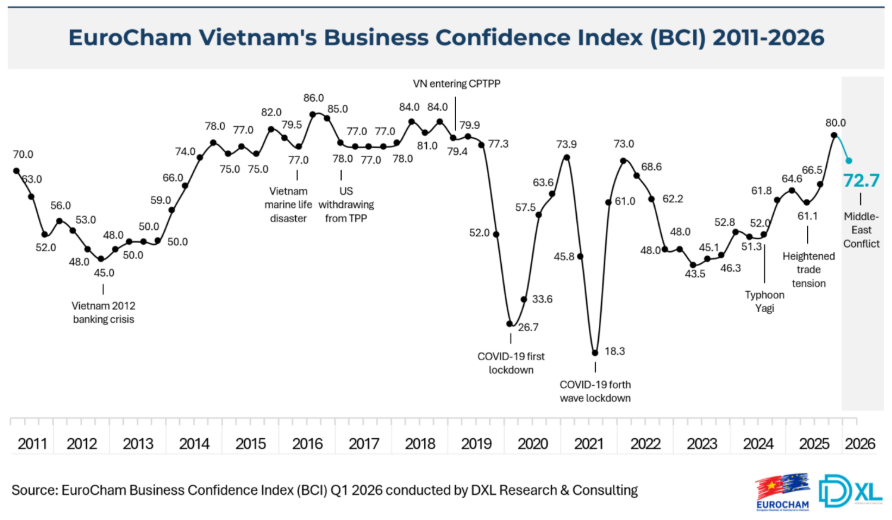
The first quarter 2026 edition of EuroCham's BCI
The index stands at 72.7, down 7.3 points from its recent peak of 80.0 in the fourth quarter of 2025, reflecting a more cautious outlook amid rising geopolitical tensions. Yet, the index remains well above levels recorded over the past four years, reinforcing a consistent message emerging from the data: while global turbulence is influencing short-term sentiment, Vietnam’s long-term appeal remains firmly intact.
A remarkable 93 per cent of European business leaders say they would recommend Vietnam as an investment destination, among the strongest endorsements in the history of the survey.
The latest BCI report delves deeper into the anatomy of investor resilience. It maps how different supply chain configurations shape risk exposure and outlines the critical regulatory reforms that investors expect from Vietnam’s newly elected government to sustain long-term momentum.
"What we are witnessing in the first quarter is not a retreat, but a necessary recalibration," commented European Chamber of Commerce in Vietnam (EuroCham) chairman Bruno Jaspaert. "The global economy today resembles a shipping route passing through rough waters, particularly tensions in the Middle East that are driving energy price volatility and supply chain adjustments. In times like these, companies look for safe harbours where they can dock with confidence. The BCI data shows that while the geopolitical weather outside may be stormy, Vietnam’s economic foundations remain resilient."
The shadow of global trade tensions looms large over the 2026 planning cycle. One year after the United States’ sweeping trade policy announcements on its so-called 'Liberation Day', businesses are still adjusting to a more fragmented and unpredictable global trading environment.
At the time, EuroCham conducted a rapid survey to capture the immediate reaction of European companies operating in Vietnam. The results indicated that more than 70 per cent of respondents expected 'High' or 'Very High' volatility, prompting many firms to revise revenue projections downward and adopt more cautious operating strategies. Most companies anticipated financial losses linked to tariffs, typically estimating a 20 per cent reduction in their bottom line.
The BCI report provides a reflection on how businesses have actually performed since then. The findings point to a far more resilient outcome than many initially feared. Despite persistent geopolitical uncertainty, 77per cent of European businesses operating in Vietnam managed to maintain or increase their revenue in 2025, with 40 per cent reporting revenue growth. While 23 per cent experienced declines, most were moderate, suggesting that global tensions have tempered expansion rather than derailing it altogether.
The data ultimately reinforces Vietnam’s role as a stabilising node within global supply chains: a market where long-term fundamentals continue to outweigh short-term geopolitical turbulence.
Today, however, the nature of risk is evolving. Businesses are no longer focused solely on trade disruptions, but increasingly on the secondary economic effects of global instability, mainly tied with the prolonged conflict in the Middle East. Energy and fuel price volatility has emerged as the most widely cited concern, affecting 75 per cent of surveyed businesses, followed by rising operating costs (61 per cent) and the risk of a slowdown in global demand (55 per cent).
Altogether, 90 per cent of respondents identify cost pressures and geopolitical conflicts as the defining risks for the year ahead. This shift highlights a broader dynamic shaping the business outlook for 2026. The challenge facing investors in Vietnam is no longer about whether opportunities exist, but rather how efficiently companies can capture them in an environment characterised by higher costs, supply chain adjustments, and greater operational complexity.
"Our members distinguish between the operational hurdles of today and the strategic dividends of tomorrow," Jaspaert said.
"When over nine out of 10 businesses continue to champion this market, it speaks volumes about Vietnam's extraordinary growth potential. The sustained GDP performance – with first-quarter 2026 expanding by 7.83 per cent, outpacing the same period last year – reinforces this confidence. The BCI numbers prove that the deeper companies anchor their operations in Vietnam, the more financially resilient they become, even when the broader global picture is fraught with risk."
Source: VIR
Related News

INFRASTRUCTURE / CONSTRUCTION / LOGISTIC / PORT
VIỆT NAM-CAMBODIA TRADE GATHERS PACE TOWARDS $20 BILLION TARGET
Trade between Việt Nam and Cambodia continues to grow, remaining a bright spot and a key pillar of bilateral cooperation as the two countries aim to raise two-way trade to US$20 billion in the coming years. After setting a record of more than $11.3 billion last year, bilateral trade reached about $8.7 billion in the first eight months of this year, up 8.3 per cent year on year.
TECHNOLOGY
AI BEGINNING TO RESHAPE RECRUITMENT CRITERIA
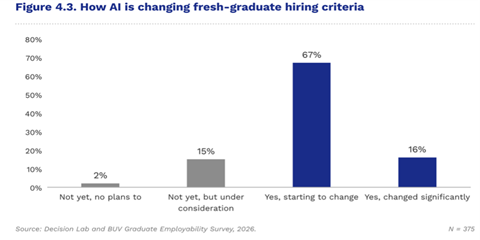
Digital literacy is the only capability area in which fresh graduates meet employers’ expectations, according to a new report. Yet, it is also the standard rising fastest, as businesses increasingly expect new hires to use AI effectively in the workplace. Some 83 per cent of employers say AI has changed, or is beginning to change, their hiring criteria, while 94 per cent report higher expectations for digital and AI capabilities than they had two to three years ago.

INFRASTRUCTURE / CONSTRUCTION / LOGISTIC / PORT
ĐÀ NẴNG GREEN-LIGHTS US$105 MILLION THAI DEVELOPMENT DEAL
The central city has approved an investment proposal by Thailand’s WHA Group to develop infrastructure for the 400ha WHA Đà Nẵng Industrial Park project on two communes of Thăng Bình and Đồng Dương, with an investment of more than VNĐ2.7 trillion (US$105 million). The city said it approved WHA Industrial Development International's status as an investor in the project, which is expected to take place between 2027 and 2034.

VIETNAM ECONOMY INVESTMENT
MOBILE PHONE EXPORTS RISE 20% TO $51.8 BILLION IN FIRST NINE MONTHS
Exports of mobile phones and components rose 20 per cent year-on-year to nearly US$51.8 billion in the first nine months of 2026, with China, the US and Republic of Korea accounting for more than half of the total. Shipments to the three markets reached a combined $26.18 billion, or 50.6 per cent of total exports of the product group during the period, according to data from the Vietnam Department of Customs under the Ministry of Finance.

VIETNAM ECONOMY INVESTMENT
FRUIT AND VEGETABLE EXPORTS POISED TO HIT $10 BILLION IN 2026
Fruit and vegetable exports are on track to reach nearly US$10 billion in 2026, after rising 19.9 per cent year on year to nearly US$7.4 billion in the first nine months, driven by strong seasonal demand and abundant tropical fruit supplies. The Ministry of Agriculture and Environment said the growth reflected stronger international demand for fresh produce and processed agricultural products.
GARMENT / TEXTILE
TEXTILE EXPORTS FACE DUAL CHALLENGES OF SUSTAINING ORDERS AND BOOSTING EFFICIENCY AMID GROWING COMPETITION
Data shows that the textile and garment sector maintained its growth momentum in the first nine months of this year. The industry's total export turnover reached an estimated US$35.721 billion in the first nine months of this year, up 3.3 per cent year-on-year. Despite posting encouraging export figures, Vietnamese textile and garment enterprises continue to navigate unpredictable market variables.
Events Sponsors






















